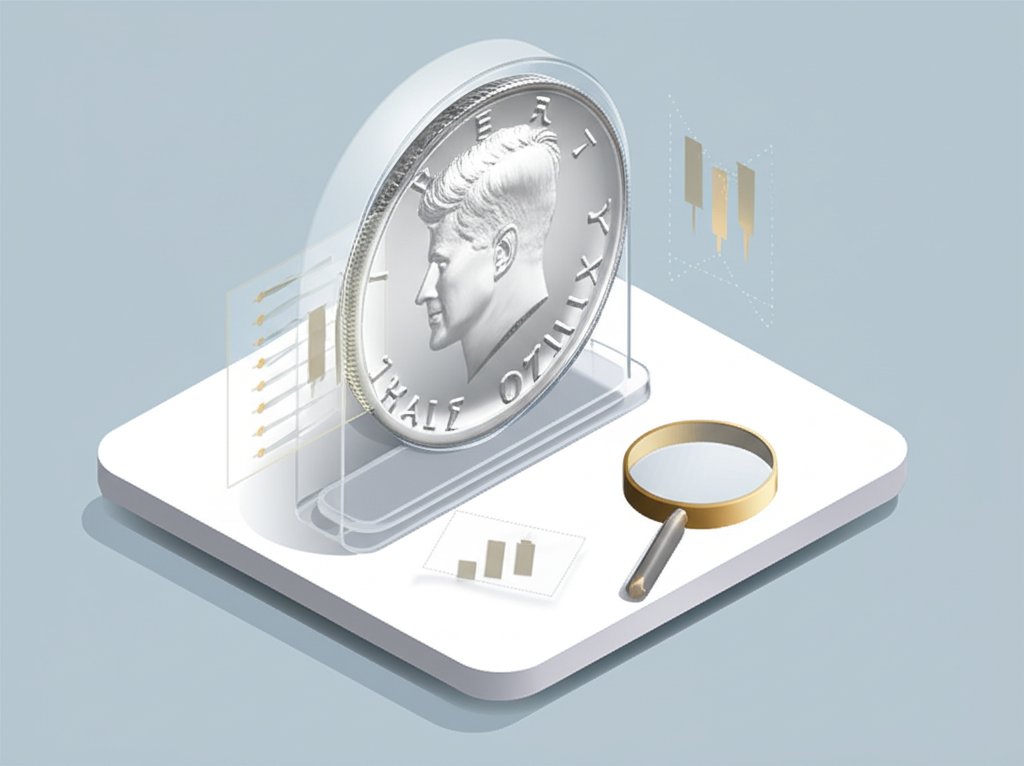
Many people ask about the "1970 silver dollar worth," often searching for a valuable coin that could be hiding in an old collection or passed-down jar. The truth, however, is that there isn't actually a circulating 1970 silver dollar coin. The specific coin sparking all this interest is usually the 1970 Kennedy Half Dollar, which holds a unique and valuable place in numismatic history as the last regular-strike U.S. coin issued for circulation that contained any silver. Understanding its story and specific characteristics is key to unlocking its true worth.
At a Glance
- No 1970 "Silver Dollar": The coin in question is the 1970 Kennedy Half Dollar, the last half dollar issued with silver for general availability (albeit limited).
- 40% Silver Content: All 1970 Kennedy Half Dollars contain 40% silver, making them intrinsically more valuable than later issues.
- 1970-D: The Key Date: The Denver-minted 1970-D Kennedy Half was only distributed in U.S. Mint Sets, never for general circulation, making it significantly scarcer.
- 1970-S: The Proof Option: San Francisco produced 1970-S proof halves exclusively for collector proof sets.
- Value Varies Wildly: Depending on condition, mint mark, and rare varieties, a 1970 Kennedy Half can be worth anywhere from its silver melt value to thousands of dollars.
- Look for Varieties: Rare "Cameo," "Deep Cameo," "Mirror Prooflike," and "Doubled Die Obverse" varieties exist, commanding significant premiums.
The "1970 Silver Dollar" Misconception and Its Real Identity
The common inquiry about a "1970 silver dollar worth" stems from a combination of factors. For decades, Americans were accustomed to circulating silver coinage. Dimes, quarters, and half dollars issued before 1965 were 90% silver, and half dollars from 1965-1969 were 40% silver. When the U.S. Mint transitioned entirely to copper-nickel clad coinage for dimes and quarters in 1965, the half dollar retained some silver content for a few more years, making the 1970 issue the very last of its kind.
This historical context leads many to assume a silver dollar must have been issued that year, especially given the impending release of the Eisenhower "Ike" dollar in 1971. But in 1970, the highest denomination circulating coin containing silver was indeed the Kennedy Half Dollar. This specific half dollar holds a unique historical and numismatic significance, making its value a frequent topic of discussion among collectors and the public alike.
The Scarcity Story of the 1970 Kennedy Half Dollar
Understanding the "1970 silver dollar worth" truly begins with dissecting the limited production and distribution of the 1970 Kennedy Half Dollar. This wasn't a coin you found easily in change, even when new.
The Denver Mint's Exclusive Release (1970-D)
In 1970, the Denver Mint (indicated by a "D" mint mark) produced 2,150,000 Kennedy Half Dollars. This might sound like a lot, but for a circulating coin, it's remarkably low. The critical detail here is that these 1970-D halves were never released for general circulation. Instead, they were exclusively distributed within official U.S. Mint Sets.
This decision by the U.S. Mint was deliberate but not widely publicized until after the ordering period for the 1970 Mint Sets had closed, preventing immediate hoarding. As a result, the 1970-D became a "key date" in the Kennedy Half Dollar series and held the distinction of being the lowest-mintage business strike half dollar until 2006. If you have a 1970-D, it means it originated from one of these collector sets, or was later separated from one.
The San Francisco Mint's Proofs (1970-S)
Alongside Denver, the San Francisco Mint (indicated by an "S" mint mark) also produced Kennedy Half Dollars in 1970. These were not intended for circulation at all; rather, 2,632,810 coins were struck as proof coins for collector proof sets. Proof coins are specially minted with polished dies and planchets, often struck multiple times, to create a sharp, mirror-like finish, designed for aesthetic appeal rather than daily use.
It's important to note that no Kennedy Half Dollars were minted in Philadelphia (which would have no mint mark) in 1970. Therefore, if you find a 1970 Kennedy Half Dollar, it will either be a 1970-D (from Denver) or a 1970-S (from San Francisco).
Diving into the 40% Silver Composition
Both the 1970-D and 1970-S Kennedy Half Dollars contain 40% silver. This isn't solid silver, but rather a clad composition where silver is present in specific layers. Each 1970 half dollar contains 0.1479 troy ounces of pure silver.
Here's how its unique metallic structure breaks down:
- Overall Weight: 11.5 grams (g)
- Diameter: 30.6 millimeters (mm)
- Thickness: 2.15 mm
- Edge: Reeded, with 150 guratan (reeds)
- Composition:
- Outer Layers: 80% silver, 20% copper
- Inner Core: 21% silver, 79% copper
This specific layering meant the coin had a lighter, more silvery appearance than its later copper-nickel counterparts, but still offered a cost-saving measure compared to 90% silver coins. The intrinsic value of this silver content forms the baseline for the coin's worth, which fluctuates with the market price of silver.
What "1970 Silver Dollar Worth" Really Means for Collectors
When people talk about the "1970 silver dollar worth," they're usually trying to gauge the monetary value of their 1970 Kennedy Half Dollar. The worth of these coins varies significantly based on their mint mark, condition, and any rare varieties they might possess.
Valuing Your 1970-D Kennedy Half
The 1970-D Kennedy Half Dollar, due to its limited distribution exclusively in mint sets, is highly sought after by collectors.
- Average Condition: A circulated 1970-D half dollar, even with some wear, typically holds a value of around $9, largely driven by its silver content and collector demand.
- Uncirculated Condition (Mint State): The real premium comes with uncirculated examples, meaning coins that show no signs of wear from handling or circulation. These can range from $29 to over $94, depending on their specific grade (e.g., MS-60, MS-65).
- High-Grade Rarities: Exceptionally high-grade uncirculated coins are truly rare and command substantial prices. A 1970-D Kennedy Half graded MS67 (Mint State 67, on a scale of 1-70) can fetch more than $7,400. This is because very few coins from that era survived in such pristine condition, especially considering they were part of handling-prone mint sets.
The Worth of 1970-S Proof Halves
The 1970-S proof Kennedy Half Dollars are generally more accessible than their D-minted counterparts, but still hold good value due to their collector-oriented production and 40% silver content.
- General Value: A typical 1970-S proof coin, in good condition, will usually be valued between $18 and $23. This is a solid increase over its intrinsic silver value.
- High-Grade Proofs: Like business strikes, the value of proof coins jumps significantly with higher grades. A 1970-S proof graded PR69 (Proof 69) might sell for around $805, reflecting its near-perfect state.
The Original Investment: 1970 Mint Sets
It’s interesting to note that the 1970 U.S. Mint Set, which included the coveted 1970-D Kennedy Half Dollar, originally retailed for just $2.50. Today, unopened 1970 Mint Sets are themselves collector’s items, and their value often exceeds the sum of the individual coins if sold separately, especially if the coins inside are well-preserved.
Beyond the Basics: Rare Varieties and Errors
For those deeply interested in the "1970 silver dollar worth," knowing about specific rare varieties and errors can turn a good find into an exceptional one. These subtle distinctions often dramatically increase a coin's value.
Seeking the "Cameo" Look (1970-S CAM/DCAM)
For 1970-S proof half dollars, collectors keenly look for "Cameo" (CAM) and "Deep Cameo" (DCAM) designations. These refer to the frosted appearance of the coin's raised design elements (like Kennedy's bust) contrasted against a highly reflective, mirror-like background.
- Cameo (CAM): Features a noticeable frost on the devices, with a reflective field.
- Deep Cameo (DCAM): Exhibits a much stronger contrast, with a heavy, distinct frost on the design and a deep, liquid-like mirror background. DCAMs are rarer and more valuable.
The ultimate prize in this category is a 1970-S Proof Deep Cameo graded PR70 – only one such coin has ever been graded perfectly, making it extraordinarily valuable.
The Elusive 1970-D Mirror Prooflike (PL)
An extremely rare variety for the 1970-D Kennedy Half Dollar is the "Mirror Prooflike" (PL). These coins, despite being business strikes, display surfaces so highly reflective that they mimic the appearance of a proof coin. This effect is usually due to dies that were over-polished, resulting in a mirror-like field. Only 6 to 10 examples of the 1970-D PL are known to exist, making them incredibly rare and highly prized by advanced collectors.
Doubled Die Obverse (DDO) Varieties (1970-S)
Errors are another fascinating aspect of coin collecting. For the 1970-S proof halves, there are known "Doubled Die Obverse" (DDO) varieties, cataloged as FS-101 and FS-102. A doubled die error occurs when a coin's design is impressed onto the die twice, with a slight misalignment, causing a visible doubling effect on certain letters, numbers, or design elements. For the 1970-S proof, these are the only significant doubled die varieties known for that year, making them important targets for error collectors.
Your Playbook: Identifying and Valuing a 1970 Kennedy Half
If you believe you have a 1970 Kennedy Half Dollar and want to determine its "1970 silver dollar worth," here's a practical guide:
Step 1: Check the Date and Mint Mark
- Date: Ensure the coin clearly reads "1970."
- Mint Mark: On the reverse (tail) side, to the left of the eagle's tail feathers, you'll find the mint mark.
- "D" means it was minted in Denver.
- "S" means it was minted in San Francisco (a proof coin).
- No mint mark means it was minted in Philadelphia, but remember, no half dollars were produced in Philadelphia in 1970. If you find a 1970 half dollar without a mint mark, it's likely a fake or a heavily worn "D" or "S" that's no longer visible, but the latter is highly improbable for a "D" since it was only found in mint sets.
Step 2: Assess Condition
The condition (grade) is paramount to value.
- Circulated: Shows signs of wear from being handled.
- Uncirculated (MS): No signs of wear, still has its original mint luster. These coins command higher prices.
- Proof (PR): Has a mirror-like field and frosted devices, indicative of special collector striking.
- Protect Your Coin: Avoid cleaning your coin, as this can severely damage its surfaces and destroy collector value. For valuable coins, consider professional grading services like PCGS or NGC.
Step 3: Spotting Varieties
After checking the mint mark and assessing general condition, carefully examine the coin for the rare varieties:
- For 1970-S Proofs: Look for the frosted design and mirror-like fields that indicate Cameo or Deep Cameo status. Use a magnifying glass to check for any doubling on the obverse (front) design elements (the DDO varieties).
- For 1970-D Business Strikes: Look for exceptionally shiny, mirror-like fields that might suggest the very rare Mirror Prooflike (PL) variety. This is extremely unlikely but worth a quick check.
Step 4: Research Current Market Values
Once you've identified your coin's specifics, consult reputable sources for current market values. Online price guides from major grading services (PCGS, NGC) or established coin dealers (e.g., Heritage Auctions archives) can provide up-to-date pricing based on recent sales. Remember, prices fluctuate with the silver market and collector demand.
Quick Answers: Decoding Your 1970 Half Dollar
Let's address some common questions about this unique coin.
Is a 1970 silver dollar real?
No, a 1970 silver dollar as a circulating coin does not exist. The U.S. Mint did not produce any dollar coins for circulation in 1970. The coin people are usually thinking of is the 1970 Kennedy Half Dollar, which contains 40% silver. For more context on why there's this confusion, check out our broader guide: Is a 1970 silver dollar real?
How can I tell if my 1970 half dollar is silver?
All 1970 Kennedy Half Dollars contain 40% silver. You don't need to perform any special tests to determine if a 1970 half dollar has silver content; if it's genuinely dated 1970, it's 40% silver. Coins from 1971 onward are copper-nickel clad and have no silver.
What's the difference between a 1970-D and a 1970-S?
The "D" mint mark indicates it was struck at the Denver Mint. These were business-strike coins, meaning they were intended for circulation but were only distributed in official U.S. Mint Sets. The "S" mint mark indicates it was struck at the San Francisco Mint. These were proof coins, specifically made for collectors with a high-quality finish and sold in proof sets.
Why are 1970-D halves so hard to find in circulation?
The 1970-D Kennedy Half Dollars were never released into general circulation. They were exclusively sold as part of the 1970 U.S. Mint Sets. This limited distribution makes them significantly scarcer than typical circulating coins, which is a major factor in their increased value.
Should I get my 1970 half dollar graded?
If you have a 1970-D Kennedy Half Dollar that appears to be in uncirculated condition, or a 1970-S proof that looks exceptionally well-preserved (especially if it has Cameo/Deep Cameo features), professional grading by a reputable service like PCGS or NGC is highly recommended. Grading authenticates the coin, assigns a precise condition, and identifies rare varieties, all of which are crucial for maximizing its potential "1970 silver dollar worth." For average circulated coins, grading costs typically outweigh the potential increase in value.
Bringing It All Together: Your Next Steps
The journey to understanding the "1970 silver dollar worth" inevitably leads to the remarkable 1970 Kennedy Half Dollar. This coin, the last of its kind to carry silver into the hands of the public (albeit through collector sets), remains a fascinating piece of American numismatic history. Whether you've stumbled upon a raw coin, inherited an old mint set, or are actively collecting, knowing the nuances of its mint marks, condition, and rare varieties is essential.
Take the time to carefully inspect any 1970 half dollar you encounter. With the right eye and a bit of research, you might find more than just its intrinsic 40% silver value; you could uncover a true numismatic treasure. Remember, the key to its worth lies not just in its silver content, but in its unique story and the scarcity of its pristine examples.