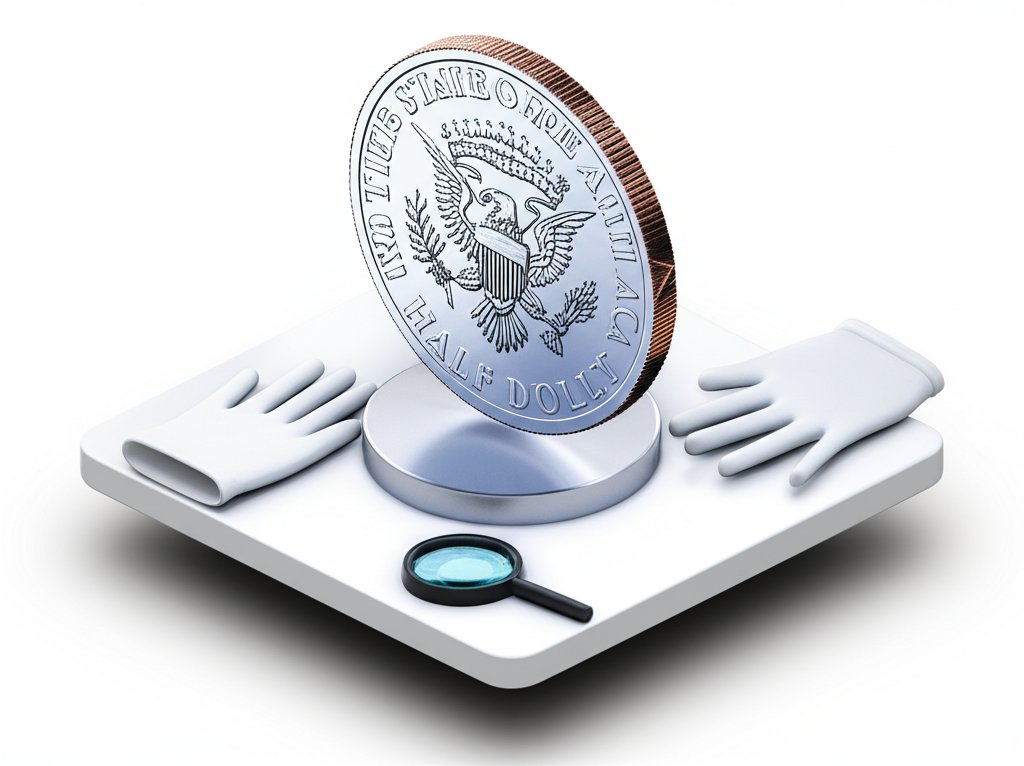
Finding a half dollar in your change can feel like a small thrill, but knowing how to truly assess its 50 cent coin value can turn that curiosity into a genuine treasure hunt. Most modern half dollars are worth exactly their face value, but some older coins, specific mintages, and, especially, those with subtle errors can command hundreds or even thousands of dollars. The secret lies in knowing what to look for beyond the obvious date.
This isn't just about collecting; it's about spotting history, understanding rarity, and potentially uncovering significant worth hidden in plain sight. We'll equip you with the expert eye to distinguish the everyday half dollar from a numismatic gem.
At a Glance: Key Takeaways for Valuing Your Half Dollar
- Silver Content is King (Initially): Dates 1964 and earlier are 90% silver; 1965-1970 are 40% silver. This is your baseline value.
- Beyond Silver, Look for Rarity: Specific dates and mint marks, particularly for Kennedy half dollars, can drive value even in clad coins.
- Errors are Goldmines: Manufacturing errors like doubled dies or incorrect planchets can skyrocket a coin's worth.
- Condition Matters Most for Premium: An uncirculated coin, especially with a high professional grade, fetches top dollar.
- Bicentennial Half Dollars Aren't Always Silver: Distinguish common clad versions from rarer 40% silver collector editions.
The Silver Standard: Your First Clue to a Valuable 50 Cent Coin
The most fundamental factor in a half dollar's worth, aside from its face value, is its silver content. Many people mistakenly think any old half dollar is silver, but the U.S. Mint changed compositions over time. Understanding these shifts is crucial for quickly identifying potential value.
Decoding the Metal: 90%, 40%, or Just Clad?
American half dollars have gone through three main metallurgical phases that dictate their basic "melt value":
- 90% Silver (1794-1964): Every U.S. half dollar minted from 1794 up to and including 1964 contains a substantial 90% silver. These coins typically weigh 12.5 grams and have a significant melt value, often well over $10 depending on current silver spot prices. This category includes popular series like Barber, Walking Liberty, Franklin, and the inaugural 1964 Kennedy half dollars.
- 40% Silver (1965-1970): In response to rising silver prices, the U.S. Mint reduced the silver content for half dollars issued between 1965 and 1970. These coins are often called "silver-clad" because they have a core of copper and nickel with outer layers of 80% silver/20% copper, resulting in an overall 40% silver composition. Weighing 11.5 grams, these pieces still carry a premium above face value, usually ranging from $3 to $8. The 1976 Bicentennial half dollars also have a 40% silver version, but only for collector sets.
- Clad (1971-Present): From 1971 onward, circulating half dollars are made from a copper-nickel clad composition. These coins contain no silver and weigh 11.34 grams. For the most part, their 50 cent coin value is exactly 50 cents, though exceptionally high-grade examples can still surprise collectors.
Quick Silver Identification Table
| Year Range | Silver Content | Weight | Melt Value (Approx. 2024, High Silver Spot) | Key Identification |
|---|---|---|---|---|
| 1794-1964 | 90% Silver | 12.5 grams | $10+ | Solid silver edge (no visible copper core), distinct "ring" when tapped. |
| 1965-1970 | 40% Silver | 11.5 grams | $3-$8 | Faint copper line on the edge, but still looks mostly silver. Still rings distinctively. |
| 1971-Present | Clad | 11.34 grams | $0.50 (Face Value) | Clear, thick copper core visible on the edge, dull "thud" when tapped. |
| Expert Tip: The quickest way to check for silver is to look at the coin's edge. A solid, uniform silver line indicates 90% silver. A faint copper stripe suggests 40% silver. A prominent reddish-brown copper stripe confirms it's a clad coin. For a deeper dive into all half dollar values, you can always Check half dollar coin value. |
Beyond Melt: Unearthing Premium Half Dollar Series and Key Dates
While silver content provides a baseline, true numismatic value often comes from a coin's rarity, historical significance, and demand among collectors. This means specific dates, mint marks, and even subtle design variations can significantly elevate a half dollar's worth.
The Classics: Barber, Walking Liberty, and Franklin Half Dollars
These older series are inherently valuable due to their 90% silver content and age. They represent distinct periods of American coinage art and history.
- Barber Half Dollars (1892-1915): These turn-of-the-century coins are generally scarce in higher grades. Any Barber half dollar is worth significantly more than its melt value if it's in good condition.
- Walking Liberty Half Dollars (1916-1947): Praised for their beautiful design, Walking Liberties are highly collectible. While all are 90% silver, certain dates and mint marks stand out. The 1921-S Walking Liberty is a prime example of a key date, with values ranging from $100 in circulated condition to over $8,000 for top-tier examples. Other notable rarities include the 1916-S, 1917-D (reverse mint mark), and 1938-D.
- Franklin Half Dollars (1948-1963): Featuring Benjamin Franklin, these coins are also 90% silver. They generally carry a premium over their melt value, especially in uncirculated condition. Values typically range from $12 to $500, with some exceptional proofs going higher. There aren't many "key dates" in the Franklin series, but high-grade examples from lower mintage years (e.g., 1948-D, 1949-S) can command higher prices.
Kennedy Half Dollars: A Deep Dive into Value
The Kennedy half dollar, first minted in 1964 as a memorial to JFK, is the most common half dollar encountered today. Its value is complex due to changing metal compositions and numerous special issues.
- 1964 Kennedy (90% Silver): This is the single circulating year with 90% silver. Expect circulated examples to be worth $12-$14, while uncirculated coins (MS-65) can fetch $20-$50. Keep an eye out for the 1964 "Accented Hair" proof variation (only found in proof sets), which features bolder hair details above Kennedy's ear. These are rarer and can be worth $50-$150.
- 1965-1970 Kennedy (40% Silver): These coins still have a premium due to their 40% silver content ($3-$8 in circulated condition). Notably, 1965-1967 coins lack a mint mark because the Mint temporarily suspended mint marks due to a coin shortage.
- The Rare 1970-D Kennedy (40% Silver): This is a standout. The 1970-D half dollar was not issued for general circulation. It was only available in U.S. Mint Sets. Consequently, finding one outside of a sealed mint set is rare, and in uncirculated condition, they can be worth $100-$300.
- 1971-Present Kennedy (Clad): Most clad Kennedy half dollars are worth face value. However, an exceptionally high-grade example can still surprise. For instance, a 1971 Kennedy half dollar graded MS-67 (Mint State-67) once sold for an astonishing $3,100! This illustrates that even common clad coins can have significant value if they are pristine and rare at the top of the grading scale.
- Special Editions:
- 1998 Matte Finish Kennedy: Only about 60,000 of these were produced for special collector sets. Their value ranges from $100-$500.
- 2014 50th Anniversary Gold Kennedy: Struck in 3/4 ounce of 24-karat gold, these commemorative coins are highly sought after, valued between $1,000-$2,000.
The Bicentennial Half Dollar (1776-1976): Not All Are Equal
Commemorating the 200th anniversary of U.S. independence, these half dollars bear a dual date (1776-1976) and a unique reverse design featuring Independence Hall. Crucially, no half dollars were dated 1975.
There are two main types:
- Circulating Clad Versions: These are very common and worth face value to about $3 in uncirculated condition.
- 40% Silver Collector Versions: These were minted for collector sets only and bear an "S" mint mark (for San Francisco). These are the valuable ones, with prices typically ranging from $6 to $50 depending on condition. To identify, look for the "S" mint mark and check the edge for the tell-tale signs of 40% silver content.
The Error Hunter's Edge: Spotting Flaws That Skyrocket 50 Cent Coin Value
While rarity and condition are major drivers, a manufacturing flaw—an "error coin"—can instantly transform a common half dollar into a highly coveted and valuable piece. These anomalies are accidental and were never meant to leave the Mint, making them particularly fascinating to collectors.
Here are some of the most notable and valuable half dollar errors:
- 1971-D on 40% Silver Planchet: This is perhaps the holy grail of Kennedy half dollar errors. It occurred when a leftover 40% silver planchet (blank coin disk) from 1970 was mistakenly fed into the presses for 1971-D clad coins. This results in a 1971-D half dollar that weighs 11.5 grams and has the edge of a 40% silver coin. These are exceedingly rare and can be worth anywhere from $6,000 to over $10,000! Check the weight and edge of any 1971-D half dollar carefully.
- 1972-D "No FG" Kennedy Half Dollar: "FG" are the initials of designer Frank Gasparro, usually found on the reverse, near the eagle's tail feathers. On this error, the initials are either very faint or completely missing. This occurred due to a grease-filled die error. Values for a 1972-D "No FG" can range from $50 to $500+, depending on the extent of the missing initials and the coin's condition.
- 1974-D Doubled Die Obverse: A doubled die occurs when the coin die itself has a duplicate image impressed during its manufacturing, resulting in a visible doubling on the coin. For the 1974-D, this doubling is most apparent on the date and some lettering on the obverse (front). These can be worth several hundred dollars.
- 1776-1976 Doubled INDEPENDENCE HALL (Bicentennial): This rare error affects the reverse of the Bicentennial half dollar, showing distinct doubling on the inscription "INDEPENDENCE HALL." This error can be worth up to $5,000 for a clear example in high grade. Look closely at the building's details and the lettering around it.
How to Spot an Error Coin:
- Use Magnification: A 5x to 10x jeweler's loupe or magnifying glass is essential for examining fine details.
- Compare: If you suspect an error, compare it side-by-side with a known good example of the same date and mint mark.
- Research: Use online resources, coin books, or reputable forums to confirm if what you've found is a known error. Not every anomaly is a valuable error; some are post-mint damage.
The Art of Assessment: Condition, Grading, and Mint Marks
Once you've identified a potentially valuable half dollar based on its silver content, date, or a possible error, the next critical step is to assess its condition. This, along with understanding mint marks, directly impacts the final 50 cent coin value.
Understanding Coin Condition and Grading
Coin condition, or "grade," is paramount. A coin's grade describes its state of preservation, ranging from heavily worn to perfectly preserved. The most widely accepted system is the Sheldon 70-point scale:
- Good (G-4): Heavily worn, major design elements are visible but faint.
- Fine (F-12): Moderate to heavy wear, some detail visible.
- Very Fine (VF-20): Moderate wear, all major details clear.
- Extremely Fine (EF-40): Light wear, sharp details.
- About Uncirculated (AU-50): Slight traces of wear on high points.
- Uncirculated (MS-60 to MS-70): No signs of wear. MS-70 is a perfect coin.
Even a slight difference in grade can mean hundreds or thousands of dollars for a rare coin. For top-tier valuable coins, professional grading services like PCGS (Professional Coin Grading Service) or NGC (Numismatic Guaranty Company) are highly recommended. They authenticate the coin and assign a precise grade, which significantly enhances its market value and buyer confidence.
Mint Marks: Decoding Where Your Coin Was Born
Mint marks are small letters on coins that indicate which U.S. Mint facility produced them. They can have a huge impact on a coin's rarity and value.
- D = Denver Mint
- S = San Francisco Mint
- P = Philadelphia Mint (Often indicated by no mint mark before 1979, then a 'P' from 1979 onwards on most denominations, though Kennedy half dollars from Philadelphia in the 1960s often had no mint mark.
- No Mint Mark: Typically means Philadelphia for many series, but as noted, 1965-1967 Kennedy half dollars from all mints lacked mint marks.
Where to Find Them: - Pre-Kennedy Half Dollars: Mint marks are usually on the reverse (back) of the coin.
- 1964 Kennedy Half Dollar: Mint mark (D or none) is on the reverse, above the eagle's left leg.
- 1968-Present Kennedy Half Dollars: Mint mark (D, S, or P) is on the obverse (front), just below Kennedy's neck.
Always check the mint mark, as some dates are significantly rarer from one mint than another. For instance, a 1970-D Kennedy half dollar is rare because it was only issued in mint sets from Denver.
Your Practical Playbook for Identifying Valuable 50 Cent Coins
Ready to start searching for your own valuable half dollars? Here’s a streamlined approach to guide your hunt:
- Sort by Date First: This is your easiest initial filter.
- 1964 and Earlier: Set these aside immediately. They are 90% silver and always worth more than face value.
- 1965-1970: Set these aside. They are 40% silver and also worth more than face value. Pay special attention to the 1970-D.
- 1971-Present: These are mostly clad, but don't discard them yet! Look for key errors and high-grade examples.
- Check the Edge for Silver Content: For your 1965-1970 pile, verify that faint silver stripe. If it's a solid silver edge (and dated 1965-1970), it's likely the very rare 1971-D on a 40% silver planchet error.
- Examine for Mint Marks and Key Dates:
- For 1964, look for the 'D' on the reverse.
- For 1965-1967, note the absence of a mint mark.
- For 1968-Present, check below Kennedy's neck for 'D', 'S', or 'P'.
- Specifically look for the 1970-D and any Bicentennial (1776-1976) with an 'S' mint mark.
- Scan for Errors and Varieties (Magnification Recommended):
- Doubled Dies: Use a loupe to check dates, lettering, and design elements for any clear doubling (e.g., 1974-D obverse, Bicentennial Independence Hall).
- "No FG": Carefully check the eagle's tail feathers on 1972-D coins.
- Other Anomalies: Keep an eye out for off-center strikes, planchet errors, or other unusual features.
- Assess Condition: For any coin you've identified as potentially valuable (beyond melt value), examine its condition. Is it circulated or uncirculated? Are the details sharp or worn down? The better the condition, the higher the value.
- Research What You Find: Once you have a potential candidate, cross-reference it with online guides, reputable coin dealer websites, or coin pricing catalogs to get an estimated 50 cent coin value.
Essential Tools: A good 5x-10x magnifying loupe and a small digital scale (accurate to 0.01 grams) are invaluable for identifying details and confirming silver content by weight.
Quick Answers: Your 50 Cent Coin Value FAQs
Are all Bicentennial half dollars valuable?
No. The vast majority of 1776-1976 Bicentennial half dollars found in circulation are clad (copper-nickel) and worth only face value. Only the versions with an "S" mint mark, minted for collector sets, contain 40% silver and carry a premium.
How do I tell if my half dollar is silver without special tools?
The easiest way is to check the date: 1964 and earlier are 90% silver. 1965-1970 are 40% silver. For these, also look at the coin's edge. A solid, uniform silver line means 90% silver. A faint, reddish copper stripe (often barely visible) means 40% silver. If there's a prominent copper stripe, it's clad.
Should I clean my old half dollar coins?
No, absolutely not. Cleaning coins, especially older or potentially valuable ones, can severely damage their surfaces and drastically reduce their numismatic value. What might look like "dirt" to you is often original toning or patina that collectors value. Leave cleaning to the experts, or better yet, leave the coin in its original state.
What's the rarest Kennedy half dollar?
While rarity can be subjective based on grade, the 1970-D Kennedy half dollar is generally considered the rarest circulating issue (though technically never released for circulation, only in mint sets), due to its limited mintage. Error coins like the 1971-D on a 40% silver planchet are exceedingly rare and among the most valuable, but they are not standard mint issues.
Your Next Step: From Pocket Change to Potential Treasure
Every half dollar you encounter holds a story, and with the knowledge you now possess, you're better equipped to read it. Whether you're sifting through old coin jars, inheriting a collection, or simply getting lucky with change, a sharp eye for dates, mint marks, and subtle errors can lead you to a surprising discovery.
Start by sorting your half dollars, then meticulously inspect the potential candidates. Don't rush the process; the most valuable errors often reveal themselves under careful scrutiny. If you suspect you have something special, seek out a local reputable coin dealer or submit the coin to a professional grading service for authentication and valuation. The thrill of the hunt is real, and your next 50-cent coin could just be worth a whole lot more.