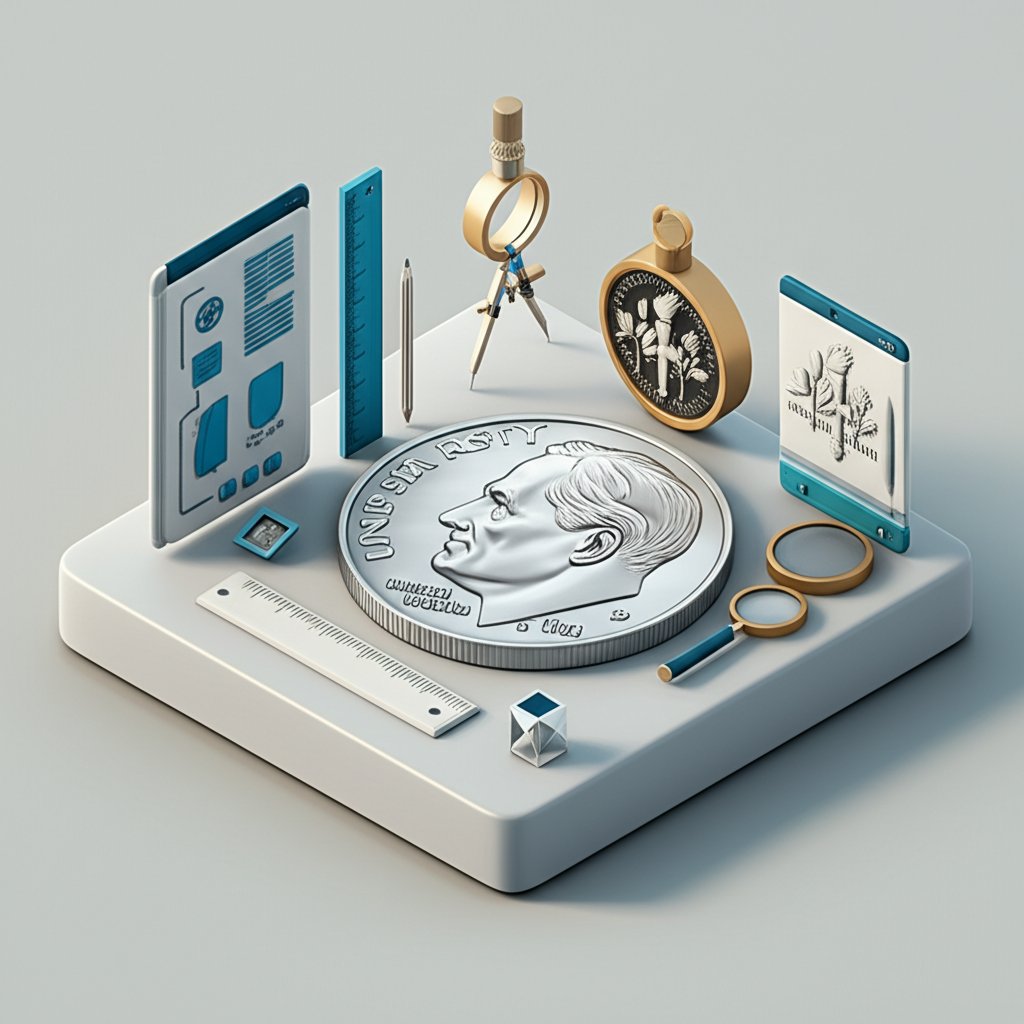
When you hold an old dime, you’re not just holding ten cents; you’re often holding a piece of history whose dime value can far exceed its face worth, sometimes dramatically. Unlocking this true value hinges significantly on understanding the specific design in your hand, a journey through America’s coinage artistry that tells tales of changing eras and evolving national identity. Each design offers distinct clues, from minting rarities to crucial aesthetic details, all influencing its collectibility and market price.
At a Glance: Deciphering Your Dime's Design Value
- Understand Historical Context: Learn the key design eras (Draped Bust, Seated Liberty, Barber, Mercury, Roosevelt) and their significance.
- Identify Key Features: Pinpoint specific design elements, mint marks, and conditional nuances that drive dime value within each series.
- Spot Valuable Variations: Discover how subtle design differences, errors, or exceptional strike quality can dramatically increase a dime's worth.
- Prioritize Condition: Recognize why a coin's state of preservation is paramount, especially for older or more common designs.
- Apply Practical Assessment: Gain actionable steps to evaluate your own dimes based on their unique design characteristics.
- Avoid Common Pitfalls: Learn to distinguish genuine rarities from common circulated pieces, focusing on what truly matters to collectors.
The Dawn of the Dime: Early Liberty Visions (1796-1837)
The story of the U.S. dime begins in 1796, authorized four years earlier by the Coinage Act of 1792. These initial issues, known as the Draped Bust dimes, are among the most sought-after by serious collectors, their dime value inherently high due to extreme rarity and historical significance. Featuring a depiction of Liberty with flowing hair and a draped bust on the obverse, the earliest versions from 1796 to 1797 displayed a small eagle on the reverse. These are exceedingly rare, often commanding five to six figures even in lower grades.
From 1800 to 1807, a slightly modified version emerged, still a Draped Bust design, but with a larger heraldic eagle on the reverse. While marginally less rare than their predecessors, these early 19th-century dimes remain very scarce and valuable. The presence of specific date variations, such as the "1804 14 Stars" variety, can further escalate their dime value, requiring meticulous examination by an expert. Even a well-worn example of a Draped Bust dime is a significant numismatic find.
Seated Liberty: A Symbol Endures (1837-1891)
The mid-19th century brought a new enduring symbol: the Seated Liberty dime, minted from 1837 to 1891. This design, showcasing Liberty seated on a rock, holding a shield and pole with a Phrygian cap, is one of the longest-running series in U.S. coinage. Its extended minting period means that while many Seated Liberty dimes are common in lower grades, certain dates and mint marks carry substantial dime value.
Initially, from 1837 to 1838, the reverse simply featured the words "ONE DIME" within a wreath. Later, starting in 1838, stars were added around the obverse rim, and a legend, "UNITED STATES OF AMERICA," was incorporated into the reverse design. In 1853, small arrows were placed beside the date to signify a weight reduction, only to be removed again in 1856. Another design change in 1860 saw the legend "UNITED STATES OF AMERICA" moved from the reverse to the obverse, and the previous reverse design became standard. Key dates in this series include the 1853 (No Arrows), 1856-S, 1871-CC, 1872-CC, and 1873-CC, with the "CC" (Carson City) mint mark often signifying significantly higher dime value due to lower mintages. Collectors also highly prize examples with strong details on Liberty's drapery and shield, as these areas were often weakly struck.
Barber's Bold Statement: The Turn of the Century Dime (1892-1916)
As the 19th century gave way to the 20th, a new design emerged from the hand of Chief Engraver Charles E. Barber. The Barber dime, minted from 1892 to 1916, features a classical rendition of Liberty wearing a cap, facing right, with "UNITED STATES OF AMERICA" encircling her. The reverse displays a wreath of corn and wheat encompassing the inscription "ONE DIME." This series represents a shift towards a more unified design aesthetic across various denominations, as Barber also designed the quarter and half-dollar of the same era.
While often overshadowed by its flashier successor, the Barber dime holds a steady and often surprising dime value, particularly for specific dates and mint marks. The 1895-O (New Orleans) and the 1901-S (San Francisco) are two of the most notable rarities in this series, fetching considerable sums even in good condition. Other strong contenders for high value include the 1894-S (though often counterfeited, so extreme caution is advised), 1896-S, 1896-O, and the 1904-S. Condition is exceptionally critical here; a well-struck Barber dime with minimal wear on Liberty's cheek, hair, and the wreath details on the reverse can be significantly more valuable than a heavily circulated example. For a comprehensive look at how all these factors contribute to the overall Understand your silver dime value, including specifics on silver content and market trends, refer to our broader guide.
Winged Liberty's Allure: The Mercury Dime (1916-1945)
The Mercury dime, officially known as the Winged Liberty Head dime, captured the public's imagination from its introduction in 1916 until 1945. Designed by Adolph A. Weinman, this iconic coin features Liberty wearing a Phrygian cap with wings, intended to symbolize freedom of thought. The resemblance to the Roman god Mercury, known for his winged helmet, led to its enduring nickname. The reverse showcases a fasces (a bundle of rods with an axe blade, symbolizing unity and strength) adorned with an olive branch, signifying peace. This design is highly revered by collectors, making it one of the most popular series to pursue.
Several factors elevate the dime value of Mercury dimes beyond their intrinsic silver content. Key dates include the 1916-D (Denver), which is arguably the most valuable, followed by the 1921 and 1921-D. Additionally, certain errors and varieties are highly sought after, such as the 1942/41 Overdate, where the previous year's "1" is visible beneath the "2." Condition is paramount for Mercury dimes, particularly the sharpness of the fasces bands on the reverse. Collectors refer to "Full Bands" (FB) or "Full Split Bands" (FSB) to denote a coin where the horizontal bands on the fasces are clearly separated and complete. A Mercury dime with Full Bands can command a significant premium, sometimes thousands of dollars more than a similar date without this distinction, even for relatively common dates like the 1945-D.
Roosevelt's Legacy: The Modern Dime (1946-Present)
Following President Franklin D. Roosevelt's death in 1945, a new dime was introduced in 1946 to honor his leadership during the Great Depression and World War II. The Roosevelt dime, designed by John R. Sinnock, features a dignified profile of FDR on the obverse. The reverse displays an olive branch (peace), a torch (liberty), and an oak branch (strength and independence), symbols that resonate with Roosevelt's legacy. This design has remained in continuous production, making it the longest-running dime series in U.S. history.
For many years, the dime value of Roosevelt dimes was largely tied to their silver content for issues struck up to 1964. All Roosevelt dimes from 1946 to 1964 are composed of 90% silver, making them intrinsically valuable even in circulated condition. From 1965 onward, dimes transitioned to a copper-nickel clad composition, rendering most modern Roosevelt dimes worth only face value. However, certain exceptions exist. The 1965 "transitional" error, where a silver planchet was mistakenly struck with 1965 dies, can be extremely valuable. Other errors, such as off-center strikes, double dies (e.g., the 1970-S, 1982 No P), or missing mint marks (like the 1982 No P), can also significantly boost a modern Roosevelt dime's value. While generally common, pristine examples of key dates or error coins are highly collectible, even for this ubiquitous design.
Practical Playbook: Unlocking Your Dime's Design Value
Understanding the nuances of each design series is critical, but applying that knowledge requires a systematic approach. Here’s a practical guide to assessing your dimes based on their iconic designs.
The Crucial Role of Condition (Grading Basics)
For every dime design, condition is king. A Draped Bust dime in "Good" condition (heavily worn but identifiable) is still a treasure, but a Seated Liberty dime in "Fine" (moderate wear) might only be worth a fraction of an "About Uncirculated" example.
- Definition: Grading assesses a coin's wear, strike quality, and surface preservation.
- Impact: A higher grade almost always means a higher dime value. For some designs, like the Mercury dime, specific high-point details (e.g., Full Bands) are critical for top grades and premiums.
- Action: Familiarize yourself with basic grading terminology (Good, Fine, VF, AU, MS). Use a magnifying glass (10x preferred) to examine design details like hair strands, facial features, and lettering for wear. Compare your coin to graded examples online or in coin guides.
Decoding Mint Marks and Key Dates
Mint marks are small letters (e.g., "D" for Denver, "S" for San Francisco, "O" for New Orleans, "CC" for Carson City, "P" for Philadelphia) that indicate where a coin was struck. Their location varies by design and era.
- Location:
- Draped Bust: No mint marks (all from Philadelphia).
- Seated Liberty: On the reverse, below the eagle or "ONE DIME."
- Barber: On the reverse, below the wreath.
- Mercury: On the reverse, below the olive branch/fasces.
- Roosevelt: On the reverse, above the torch (prior to 1968), then above the date on the obverse (from 1968, though Philadelphia used no mint mark until 1980).
- Significance: Certain mint marks in specific years represent lower mintages, making those coins considerably rarer and more valuable. For example, a 1916-D Mercury dime is vastly more valuable than a 1916-P.
- Action: Locate the mint mark on your dime. Cross-reference the date and mint mark with a reliable price guide or online database to identify potential key dates or semi-key dates that carry a premium dime value.
Spotting Design Variations and Errors
Not all valuable dimes are perfectly struck. Sometimes, deviations from the standard design or errors introduced during minting can create highly sought-after rarities.
- Design Variations (e.g., Overdates): These occur when one date is struck over another, such as the famous 1942/41 Mercury dime. These require careful examination, often with magnification, to detect the underlying numbers.
- Die Errors:
- Double Dies (DDO/DDR): When the die is struck more than once in slightly different positions, creating a doubled image on the coin. Look for doubling in the lettering, date, or design elements (e.g., 1970-S Roosevelt dime with doubled die reverse).
- Off-Center Strikes: When the planchet (blank coin disc) isn't perfectly centered in the striking chamber, resulting in a portion of the design missing and a blank curved area.
- Missing Mint Marks: The 1982 No P Roosevelt dime is a well-known example where the Philadelphia mint failed to add its "P" mint mark.
- Repunched Mint Marks (RPMs): Occur when a mint mark is punched into the die more than once in slightly different positions.
- Action: After identifying the design, date, and mint mark, research known varieties or errors for that specific issue. Use a loupe to meticulously inspect areas known for doubling or other anomalies. Don't mistake post-mint damage (scratches, dings) for genuine errors.
Authentication & Expert Advice
While you can do a lot of preliminary assessment yourself, some dimes are too valuable or complex to grade or authenticate without professional help.
- When to Seek Expertise: If you believe you have a key date, a significant error, or a coin in high-grade condition from any of the older series (Draped Bust, Seated Liberty, Barber, highly graded Mercury), professional authentication is crucial.
- Professional Services: Companies like PCGS (Professional Coin Grading Service) and NGC (Numismatic Guaranty Corporation) offer grading and encapsulation services. They verify authenticity, assign a numerical grade, and encapsulate the coin in a tamper-evident holder. This process adds credibility and protects the coin, often enhancing its dime value on the market.
- Action: For potentially valuable finds, avoid cleaning the coin (which can significantly reduce value). Instead, store it safely and consider submitting it to a reputable grading service.
Quick Answers: Your Dime Design Questions Addressed
Q: Are all old dimes valuable, especially those pre-1965?
A: Not necessarily. While all pre-1965 dimes (Draped Bust to 1964 Roosevelt) are 90% silver and thus worth more than face value for their metal content, their numismatic dime value varies wildly. Common dates in low grades might only fetch slightly above melt value, whereas key dates or high-grade examples can be worth hundreds or thousands.
Q: How do I quickly tell if my Roosevelt dime is silver?
A: Look at the date. If it's 1964 or earlier, it's 90% silver. If it's 1965 or later, it's typically clad (copper-nickel), unless it's one of the rare 1965 silver errors or a proof coin (which can also be silver from certain years, but aren't circulating currency).
Q: What does "Full Bands" mean for a Mercury dime, and why is it important for its dime value?
A: "Full Bands" (often abbreviated FB or FSB for Full Split Bands) refers to the completeness and separation of the horizontal bands on the fasces (the bundle of rods) on the reverse of the Mercury dime. A coin with sharp, distinct bands, particularly the central one, is considered to have "Full Bands." This indicates a strong strike and minimal wear, making such coins much rarer and significantly more valuable to collectors, sometimes commanding premiums of hundreds or even thousands of dollars over non-FB examples of the same date and grade.
Q: Is a Barber dime always worth more than face value?
A: Yes, absolutely. All Barber dimes (1892-1916) are 90% silver, making them worth at least their melt value. Beyond that, even common Barber dimes in very worn condition typically sell for several dollars each to collectors due to their age and historical significance. Rarer dates and higher grades can be worth hundreds or thousands.
Q: Do design errors or varieties truly increase dime value?
A: Yes, often dramatically. Genuine mint errors or significant design varieties (like double dies, overdates, or off-center strikes) are usually very scarce because they were not intended to be produced. Their rarity, coupled with collector demand for unique pieces, can elevate their dime value far beyond standard issues, sometimes into the thousands or tens of thousands of dollars. Always ensure errors are genuine mint errors and not post-mint damage.
What's Next for Your Dime Discovery?
Your journey into understanding dime value through its designs is an ongoing exploration. You now have a solid foundation to identify the key features, historical contexts, and critical details that separate a common coin from a valuable numismatic treasure. Armed with this knowledge, you can approach your own collection, or any dime you encounter, with newfound expertise.
Start by sorting your dimes by design type, then by date and mint mark. Use a magnifying glass to scrutinize the specific design elements discussed here – the Draped Bust's eagle variations, the Seated Liberty's shield details, the Barber's cap and wreath, the Mercury's fasces bands, and the Roosevelt's mint marks and potential errors. Every detail you uncover contributes to a more accurate assessment of its potential worth. Happy hunting!