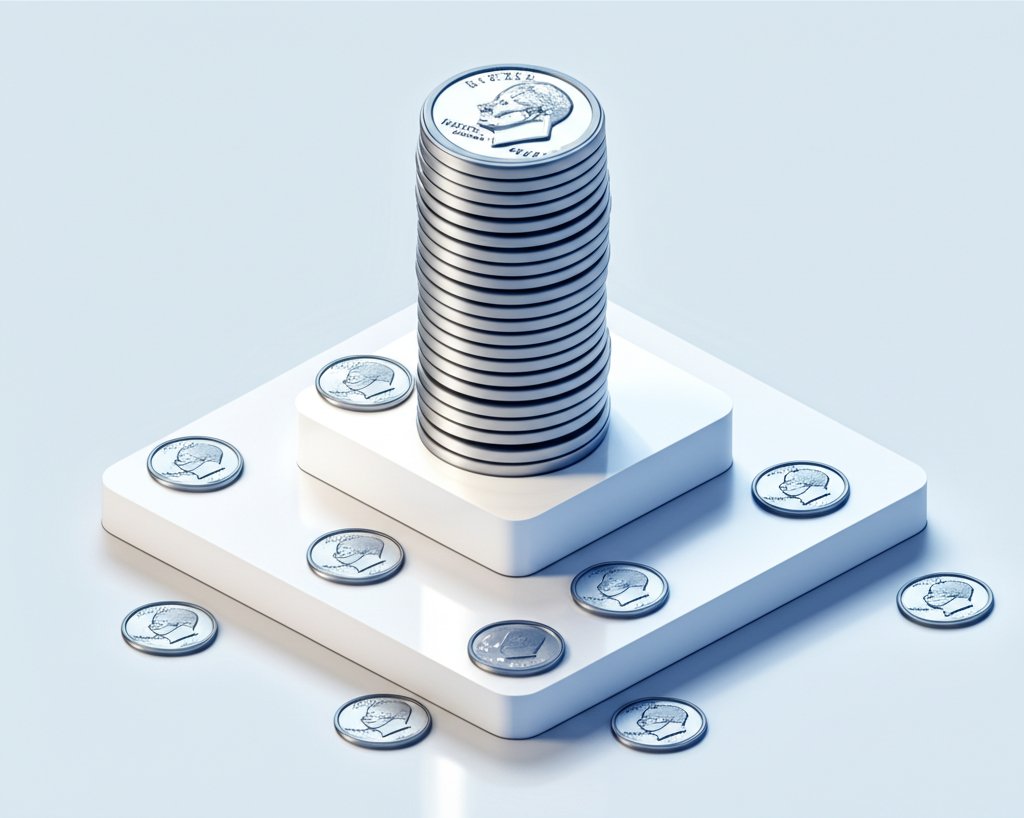
Stumbling upon an old dime, you might hold more than just ten cents in your hand. The thrill of discovering "dimes with silver" isn't just for seasoned collectors; it’s a tangible link to a bygone era when U.S. coinage contained precious metals. Before 1965, the humble dime was struck with 90% silver, a fact that can significantly elevate its worth far beyond its face value. Understanding which dimes contain silver and what factors contribute to their value is key to uncovering these metallic treasures.
At a Glance: Your Silver Dime Compass
- The Date is Decisive: Dimes minted before 1965 are the ones you're looking for, as they contain 90% silver.
- Silver Content: Each silver dime holds approximately 0.07234 troy ounces of pure silver.
- Beyond Melt Value: While silver prices dictate a baseline, rarity, condition, and mint mark can command significantly higher premiums.
- Simple Tests Work: Weight, magnetism, and visual cues are your first line of defense in identifying silver.
- Historic Designs: Barber, Mercury, and early Roosevelt dimes represent the era of silver coinage.
The Silver Shift: Why Dimes Changed and What It Means for You
The mid-1960s marked a pivotal moment in U.S. coinage. For decades, dimes, quarters, and half-dollars were composed of 90% silver and 10% copper. However, as the price of silver began to rise sharply, the intrinsic melt value of these coins started to exceed their face value. People began hoarding coins, leading to a severe shortage in circulation.
To address this crisis, the U.S. Mint transitioned from silver to a copper-nickel clad composition for dimes and quarters starting in 1965. This means any dime dated 1964 or earlier is 90% silver, while any dime dated 1965 or later is a copper-nickel alloy, with one notable exception: some 1965 dimes were accidentally struck on silver planchets, making them extremely rare and valuable errors. For our purposes, however, the hard and fast rule remains: pre-1965 for common silver content.
Spotting Silver Dimes: Your Hands-On Guide
Identifying "dimes with silver" doesn't require specialized lab equipment. A few simple, practical tests can help you distinguish silver from clad.
The Date Rule: Your First Filter
This is the easiest and most important step. Always check the date first. If a dime is dated 1964 or earlier, it's 90% silver. If it's 1965 or later, it's clad (non-silver) unless it's one of those extremely rare error coins mentioned above, which you won't encounter in everyday circulation.
The Weight Check: A Subtle Difference
Silver dimes are slightly heavier than their modern clad counterparts due to the different metal densities.
- Silver Dime (1964 and earlier): Approximately 2.5 grams
- Clad Dime (1965 and later): Approximately 2.268 grams
A digital scale, accurate to at least one decimal place, can confirm this. This difference, though small, is consistent.
The "No Stick" Test: Magnetism Reveals All
Silver is not magnetic. The copper-nickel alloy used in clad dimes, while not strongly magnetic, contains nickel, which can sometimes exhibit a very weak magnetic pull, especially in large quantities of coins. A simple magnet can help confirm the lack of magnetism in a silver dime. If it sticks, it's definitely not silver. If it doesn't stick, it could be silver, or it could be another non-magnetic metal, so combine this with other tests.
Visual Cues & Dimensions: Look Closer
- The Edge Test: Examine the coin's edge. Silver dimes have a solid silver-colored edge. Clad dimes, on the other hand, will reveal a distinct copper stripe sandwiched between two silver-colored layers (the nickel-copper alloy). This is often the quickest visual identifier after the date.
- Color and Luster: Silver dimes tend to have a different sheen than clad dimes. Silver can tone over time, developing a darker patina, while clad dimes retain a brighter, more uniform appearance.
- Dimensions: While not as critical as weight or edge color, the dimensions can also provide confirmation.
- Diameter: 17.9 mm
- Thickness: 1.35 mm
These are consistent for both silver and clad dimes, but knowing them helps ensure you're dealing with a standard dime.
Decoding Silver Dime Designs: A Quick Reference
Three primary designs represent the era of "dimes with silver" in American coinage. Knowing their appearances can add to the appreciation of your finds.
The Barber Dime (1892–1916)
Designed by Charles E. Barber, this dime features a classical head of Liberty wearing a Phrygian cap, laurel wreath, and a ribbon inscribed "LIBERTY." The reverse displays a wreath of corn and wheat enclosing the words "ONE DIME." These are among the oldest and often most worn silver dimes found, making high-condition examples quite valuable.
The Mercury Dime (1916–1945)
Officially known as the "Winged Liberty Head Dime," this iconic design by Adolph A. Weinman depicts Liberty with a winged Phrygian cap, symbolizing freedom of thought. The reverse features a fasces (a bundle of rods with an axe blade) entwined with an olive branch, symbolizing strength and peace. Mercury dimes are beloved by collectors for their striking artistry.
The Roosevelt Dime (1946–1964)
Following President Franklin D. Roosevelt's death, this design, created by John R. Sinnock, was quickly introduced. The obverse features a portrait of Roosevelt, while the reverse depicts a torch, an olive branch, and an oak branch, representing liberty, peace, and strength, respectively. The Roosevelt dime is the most common silver dime found today, especially the 1964 issues.
Beyond Melt Value: What Truly Drives a Silver Dime's Worth
While the intrinsic silver content of "dimes with silver" provides a strong baseline value, many factors can push their worth significantly higher. It’s a common misconception that all silver dimes are worth the same amount; the reality is far more nuanced.
The Metal Market: Calculating Melt Value
Every 90% silver U.S. dime contains approximately 0.07234 troy ounces of pure silver. This means you need roughly 12 silver dimes to accumulate one full troy ounce of silver.
To calculate the melt value of a single dime:
(Spot Price of Silver per Troy Ounce) x 0.07234
For instance, if the spot price of silver is $53.29 per troy ounce (as per the provided research), the melt value of a single silver dime would be:
$53.29 x 0.07234 = $3.8529
This melt value acts as a floor. No matter how common or worn, a 90% silver dime will always be worth at least its silver content.
Rarity & Mint Marks: The Scarcity Factor
Some years and specific mint marks (small letters like "D" for Denver, "S" for San Francisco, or no mark for Philadelphia) indicate lower mintage numbers, making those particular "dimes with silver" scarcer and more desirable to collectors. For example, a 1916-D Mercury Dime is famously rare and valuable due to its very low mintage.
Condition is King (or Queen): Grading and Preservation
The physical condition, or "grade," of a silver dime is a monumental factor in its collectible value. A coin's grade describes its state of preservation, from heavily worn ("Good") to perfectly preserved ("Mint State"). Key aspects include:
- Sharpness of Detail: How clear are the features (Liberty's hair, Roosevelt's ear, the fasces)?
- Wear: Are high points of the design rubbed smooth?
- Luster: Does the coin retain any of its original shine?
- Absence of Damage: Scratches, nicks, cleaning, or environmental damage significantly reduce value.
Professional coin grading services like PCGS (Professional Coin Grading Service) or NGC (Numismatic Guaranty Company) authenticate and grade coins, which can validate condition and dramatically increase market value, especially for higher grades. For a broader understanding of how these elements come together to determine a coin's overall worth, you might find it helpful to Understand your silver dime's value.
Historical Significance: Proofs and Errors
Some "dimes with silver" are valuable not just for their silver content or rarity, but for their unique place in history or an error in their production. Proof coins, for example, are special strikes made for collectors, often with a mirrored finish. Error coins, like off-center strikes or planchet errors, can also command high prices due to their uniqueness.
Real-World Riches: Notable Silver Dime Examples
To truly grasp the potential of "dimes with silver," consider these remarkable examples:
- The 1894-S Barber Dime Proof: Only 24 of these were minted, making it one of the rarest and most valuable U.S. coins. One example sold for an astonishing $2,160,000 at auction. This illustrates how extreme rarity combined with a proof strike can create legendary value.
- The 1916-D Mercury Dime: With a mintage of just 264,000 pieces, this key-date Mercury dime is highly sought after. A superb example once fetched $207,000 at auction, highlighting the power of low mintage for circulated issues.
- The 1949 Roosevelt Dime in MS68FB (Full Bands): This coin isn't rare in its general mintage, but finding one in such pristine, top-tier condition with "Full Bands" (meaning the horizontal bands on the fasces are perfectly clear and separated) is exceedingly difficult. One sold for $13,200, demonstrating that even relatively common dates can be immensely valuable in exceptional grades.
- A Common 1964 Roosevelt Dime: While not reaching the heights of the examples above, even a standard 1964 Roosevelt dime in average circulated condition holds a collectible value beyond its melt worth, often trading around $10 or more to collectors and dealers seeking bulk silver.
Your Silver Dime Playbook: How to Evaluate Your Finds
Armed with this knowledge, you can now approach your "dimes with silver" with a systematic evaluation process.
Step 1: The Date Check – Your Initial Assessment
- Action: Immediately flip the dime to its obverse (front) and locate the date.
- Decision: If it's 1964 or earlier, proceed. If 1965 or later, it's likely clad and not silver, unless it's a known error (which are exceedingly rare in circulation).
Step 2: Physical Verification – Confirming Silver Content
- Action: Conduct the edge test first. Look for a solid silver edge.
- Action: If the edge is solid, use a digital scale to confirm the weight is close to 2.5 grams.
- Action: Perform the magnetism test; the coin should not stick to a magnet.
- Tool Tip: A jeweler's loupe (10x magnification is ideal) will help with the next steps for examining details.
Step 3: Visual Inspection – Assessing Condition and Rarity Indicators
- Action: With your loupe, examine the coin for its design type (Barber, Mercury, Roosevelt).
- Action: Look for a mint mark. Its location varies by design:
- Barber Dimes: On the reverse, below the wreath.
- Mercury Dimes: On the reverse, below and to the left of the fasces.
- Roosevelt Dimes: On the reverse, above the left arch of the "ONE DIME" inscription (for earlier dates, then changed to the obverse below Roosevelt's neck in 1968).
- Action: Carefully assess the coin's condition. Are the details sharp or worn? Are there any significant scratches, dents, or signs of cleaning? A cleaned coin often has a dull, unnatural sheen, or fine hairline scratches.
- Decision Point: If the coin is in remarkably good condition, or has an unusual mint mark/date combination, its collectible value could be significantly higher than melt value.
Step 4: Research & Comparison – Estimating Value
- Action: Consult coin catalogs, online price guides (reputable numismatic sites), or coin identification apps. Search specifically for your coin's year, mint mark, and estimated condition.
- Comparison: Compare your coin to images of various grades to get a rough idea of its condition (e.g., "Good," "Very Fine," "Extremely Fine," "Uncirculated").
- Decision: This research will give you an estimated value range based on rarity and condition. Remember, online prices are often dealer asking prices, not necessarily what you'd get selling it.
When to Seek Professional Help
If you believe you have a particularly rare, high-grade, or potentially error-filled "dime with silver," it's always wise to consult with a professional coin dealer or an experienced numismatist. They can provide an accurate appraisal, help you understand its true market value, and even guide you through the process of professional grading if warranted.
Quick Answers to Common Silver Dime Questions
Are all dimes before 1965 silver?
Yes, with the caveat that 1965 dimes, while generally clad, have a tiny number of extremely rare errors struck on silver planchets. For all practical purposes, any dime dated 1964 or earlier is 90% silver.
How much silver is in a silver dime?
Each 90% silver dime contains 0.07234 troy ounces of pure silver. This means it takes approximately 12 silver dimes to equal one troy ounce of pure silver.
Can I find silver dimes in circulation today?
It's rare, but not impossible! Most have been pulled from circulation by collectors or simply worn out. Your best bets are coin roll hunting, checking old coin jars, or inheriting collections.
What's the difference between a "silver dime" and a "clad dime"?
A "silver dime" (pre-1965) is 90% silver and 10% copper. A "clad dime" (post-1964) has an outer layer of 75% copper and 25% nickel, bonded to a core of pure copper. The most obvious visual difference is the copper stripe on the edge of a clad dime.
Should I clean my silver dimes?
Absolutely not! Cleaning coins, even with seemingly gentle methods, almost always damages their surface, removes their natural patina (toning), and significantly reduces their numismatic (collectible) value. Leave them as you find them. Serious collectors prefer original, uncleaned coins.
Your Next Step to Unlocking Silver Dime Value
The world of "dimes with silver" offers a tangible connection to history and a potential financial upside. By understanding the critical date cutoff, performing simple identification tests, and appreciating the nuances of condition and rarity, you’re well-equipped to evaluate your finds. Start by checking those dates, confirming the silver, and then delve into the specifics of mint marks and condition. Your next pocket change find could be more valuable than you think.