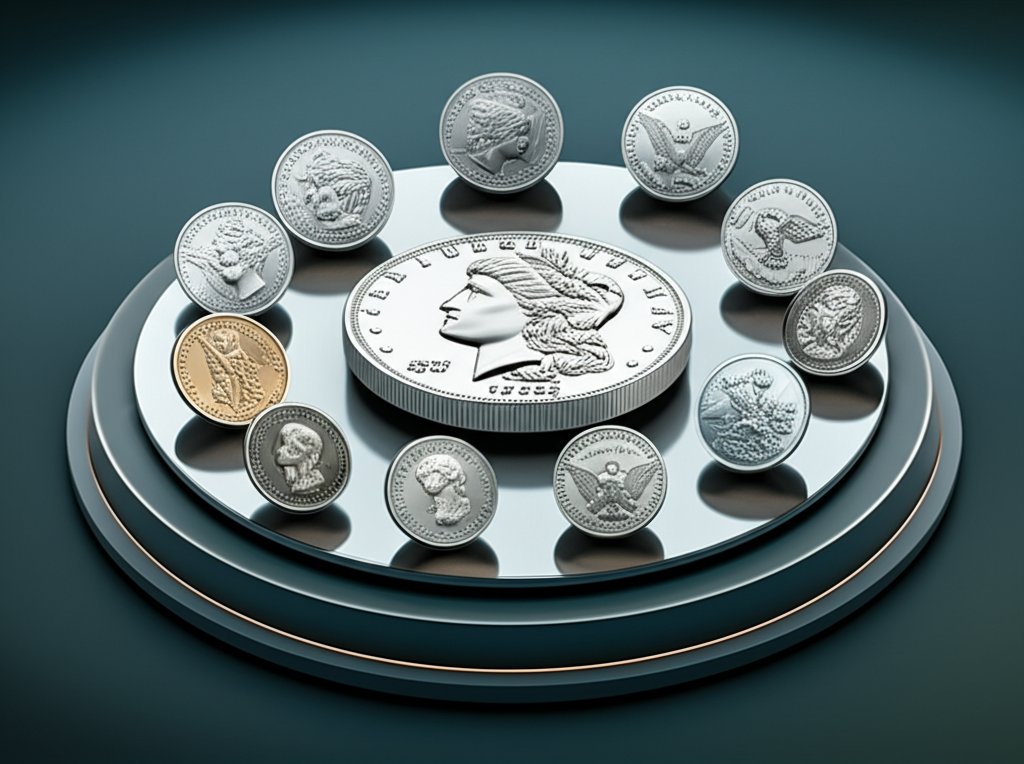
Understanding precisely how many ounces of silver a "silver dollar" contains is the first step toward appreciating its true worth. It’s a common misconception that all U.S. dollar coins bearing the word "silver" are created equal in their precious metal content. The reality is far more nuanced, with significant variations depending on the coin's type, era, and intended purpose. For collectors, investors, or simply curious individuals, knowing these specifics helps distinguish a valuable piece of bullion from a historical artifact, or even just a clad coin.
At a Glance: Decoding Silver Dollar Content
- Varies Wildly: The silver content ranges from 0.0 troy ounces in many modern circulating dollars to 5 troy ounces in specialized bullion pieces.
- Key Eras: Pre-1965 circulating dollars (like Morgan and Peace) contain 90% silver. Special collector issues like some Eisenhower dollars have 40%. Modern bullion coins like the American Silver Eagle contain 99.9% pure silver.
- Weight is Key: Physical weight, combined with the coin's date and edge, are crucial indicators of silver content.
- Not All "Dollars" are Dollars: Some large U.S. silver bullion coins, while similar in size, aren't legally denominated as dollars but have substantial silver.
- Melt vs. Numismatic Value: Silver content determines melt value. Collector appeal, rarity, and condition drive numismatic value.
The Workhorses: Morgan and Peace Dollars (90% Silver)
When most people picture a "silver dollar," they're often thinking of the iconic Morgan or Peace Dollars. These coins represent the last era of U.S. circulating currency struck with a high percentage of silver.
Both Morgan Dollars (minted 1878-1904, 1921) and Peace Dollars (minted 1921-1928, 1934-1935) share the same metallic composition and weight. They are comprised of 90% silver and 10% copper. This alloy was chosen for its durability; pure silver would be too soft for daily commerce.
Each of these magnificent coins has a total weight of 26.73 grams. Within that total, the pure silver content amounts to precisely 0.77344 troy ounces. To put that in perspective, this is approximately 24.05 grams of pure silver. While it might feel heavy, it's just shy of a full troy ounce. It's a common initial assumption that these coins contain a full ounce, but the 10% copper content means the actual silver content is slightly less.
Consider a collector who finds a roll of old silver dollars. If they're all Morgan or Peace dollars, knowing the 0.77344 troy ounces per coin allows for a quick calculation of the total silver weight, providing an immediate baseline for their intrinsic value.
The Special Case: Eisenhower Dollars (40% Silver Collector Editions)
The Eisenhower Dollar, or "Ike" dollar, minted from 1971 to 1978, often causes confusion. While the vast majority of these large coins were made of a copper-nickel clad composition for general circulation, a specific subset was minted with silver.
Only the uncirculated and proof collector versions of the Eisenhower Dollar, produced from 1971-1976, contain silver. These special issues are composed of 40% silver and 60% copper.
These 40% silver "Ike" dollars weigh 24.59 grams. Their pure silver content is notably less than their 90% silver predecessors, clocking in at 0.316 troy ounces. This is roughly 9.83 grams of pure silver.
Distinguishing these 40% silver "Ikes" from their clad counterparts is critical. The silver versions typically have a slightly different sheen and, most importantly, a solid silver-colored edge. Clad Ike dollars will reveal a distinct copper stripe along their edge, much like modern quarters or dimes. Without this visual check, you might mistake a common coin for a collector's piece with tangible silver value.
The Modern Standard: The American Silver Eagle (1 Troy Ounce)
Moving into the contemporary era, the landscape of U.S. silver "dollars" shifts dramatically from circulating currency to bullion. The most prominent example is the American Silver Eagle (ASE).
Introduced in 1986, the American Silver Eagle is not a circulating coin in the traditional sense, though it carries a legal tender face value of $1. Its primary purpose is as an investment vehicle for precious metal enthusiasts.
Each American Silver Eagle coin contains precisely one troy ounce (31.1035 grams) of .999 fine (99.9% pure) silver. This makes it the benchmark for silver bullion content among U.S. coins. Unlike older silver dollars, there's no copper alloy to account for, making its silver content straightforward and guaranteed.
Identifying an American Silver Eagle is simple: the reverse side explicitly states "1 OZ. FINE SILVER" and ".999 PURE SILVER." This clear inscription removes any doubt about its precious metal composition. These coins are valued almost entirely on their silver melt value, which fluctuates daily with the spot price of silver. For those interested in the broader factors that influence a silver dollar's overall market price—beyond just its intrinsic metal value—understanding factors like rarity, condition, and historical significance is crucial. You can delve deeper into these broader considerations by reviewing the Key silver dollar value factors.
The Giants: America the Beautiful Silver Bullion Coins (5 Troy Ounces)
While not "dollars" in denomination, it’s worth mentioning another significant U.S. Mint silver bullion series due to their substantial silver content and large size, often discussed in the same breath as other U.S. silver coins. The America the Beautiful (ATB) series silver bullion coins (2010-2021) are the largest silver coins ever issued by the U.S. Mint.
Each coin in this series, despite having a face value of a quarter dollar (25¢), contains an impressive five troy ounces (155.517 grams) of .999 fine silver. These are massive coins, visually distinct from any standard circulating currency. Their size and weight immediately signal their bullion nature. Like the American Silver Eagle, their value is almost entirely tied to the prevailing spot price of silver.
Historical Precursors: Early U.S. Silver Dollars
Before the Morgan and Peace Dollars, U.S. silver dollars had various compositions, marking different eras of coinage. These coins are now primarily collected for their numismatic value rather than their silver content, but understanding their metal composition is still foundational.
- Flowing Hair (1794-1795) and Draped Bust (1795-1804) Dollars: These early coins contained 89.24% silver. Their total weight was 26.96 grams, translating to approximately 0.776 troy ounces of pure silver. These are extremely rare and highly prized historical artifacts.
- Seated Liberty (1840-1873) and Trade Dollars (1873-1885): These issues moved to the 90% silver standard, similar to the later Morgan and Peace dollars. Seated Liberty dollars had the same 26.73 gram total weight, yielding 0.77344 troy ounces of pure silver. Trade Dollars, however, were an exception; designed for commerce in Asia, they were heavier at 27.22 grams and contained 0.7874 troy ounces of pure silver, meant to compete with Mexican silver eight-reales coins.
For these very old and rare coins, the slight variations in silver content are minor considerations compared to their historical significance, condition, and scarcity. Their market value often vastly exceeds their melt value.
Practical Playbook: How to Identify the Silver Content in Your Dollar
Knowing the theoretical silver content is one thing; identifying it in a coin you hold is another. Here’s a practical guide:
1. Date Check: The First and Fastest Filter
- 1964 or Earlier (Circulating Dollars): If your dollar coin is dated 1964 or earlier (e.g., Morgan, Peace, Seated Liberty), it's highly likely to be 90% silver, containing approximately 0.77344 troy ounces of pure silver. The exception would be extremely rare counterfeits.
- 1971-1976 (Eisenhower Dollars): For these dates, look closely. If it's a collector's proof or uncirculated strike, it might be 40% silver (0.316 troy ounces). If it was intended for general circulation, it's typically clad (no silver).
- 1986 to Present (American Silver Eagle): These are always 1 troy ounce of .999 fine silver.
- 2010-2021 (America the Beautiful Quarters): These are always 5 troy ounces of .999 fine silver.
- Post-1964 Circulating Dollars (e.g., later Eisenhower, Susan B. Anthony, Sacagawea, Presidential): These are not made of silver. The Coinage Act of 1965 largely removed silver from circulating U.S. coinage.
2. Edge Check: The Visual Tell
- Solid Silver-Colored Edge (No Copper Stripe): This is a strong indicator of 90% silver coins (Morgan, Peace, Seated Liberty) and some 40% silver Eisenhower dollars. The silver alloy runs all the way through.
- Distinct Copper Stripe: If you see a clear red/orange copper layer between two silver-colored layers on the coin's edge, it's a clad coin and contains no silver (e.g., most circulating Eisenhower dollars, modern quarters, dimes).
3. Weight Check: The Scientific Confirmation
For precise verification, especially for coins like the Eisenhower dollar where visual checks can be ambiguous, a digital scale accurate to 0.01 grams is invaluable.
- Morgan/Peace Dollar: Should weigh approximately 26.73 grams.
- 40% Silver Eisenhower Dollar: Should weigh approximately 24.59 grams.
- American Silver Eagle: Should weigh precisely 31.1035 grams (one troy ounce).
If a coin's weight is significantly off, it could indicate wear, damage, or even a counterfeit.
4. Inscription Check (Modern Bullion):
- American Silver Eagle: Look for "1 OZ. FINE SILVER" and ".999 PURE SILVER" on the reverse.
- America the Beautiful: Look for "5 OZ. .999 FINE SILVER" and "QUARTER DOLLAR" (despite its weight) on the edge or reverse.
Pitfalls to Avoid:
- Confusing Clad with Silver "Ikes": The Eisenhower Dollar is the biggest trap. Always check the edge for the copper stripe.
- Wear and Tear: Heavily circulated older coins will weigh slightly less than their original mint weight due to metal loss. Account for this in your estimation, but significant discrepancies are red flags.
- Counterfeits: Unfortunately, counterfeiting exists. If a deal seems too good to be true, or if multiple checks don't align, proceed with caution and consult an expert.
Quick Answers: Your Silver Dollar FAQs
Are all U.S. dollar coins made of silver?
No, absolutely not. The vast majority of dollar coins minted after 1964 (such as the circulating Eisenhower, Susan B. Anthony, Sacagawea, and Presidential dollars) contain no silver. Only specific historical issues and modern bullion coins hold significant silver content.
How do I calculate the melt value of a silver dollar?
Once you know the pure silver content in troy ounces (e.g., 0.77344 for a Morgan dollar, 1.00 for an American Silver Eagle), multiply that by the current spot price of silver per troy ounce. For example, if silver is $25/ounce, a Morgan dollar's melt value is 0.77344 * $25 = $19.34.
Is a silver dollar's value just its silver content?
For modern bullion coins like the American Silver Eagle, yes, its value is almost entirely based on its silver content. However, for older circulating silver dollars (Morgan, Peace, historical issues), their numismatic value (collector value based on rarity, condition, and historical significance) can often far exceed their melt value. Always consider both.
What does "fine silver" or ".999 pure" mean?
"Fine silver" or ".999 pure" indicates that the metal is 99.9% pure silver, with only 0.1% or less of other trace elements. This is the standard for investment-grade silver bullion. Older circulating coins were typically 90% pure silver, meaning 90% silver and 10% copper.
Why do some silver dollars contain copper?
Copper was added to silver dollars in the past to increase their hardness and durability. Pure silver is a relatively soft metal, making it prone to wear and damage in daily circulation. The copper alloy made the coins more robust for everyday use.
Concrete Takeaways for Your Silver Dollars
The journey of understanding your silver dollar's value begins with its silver content. Don't assume all "silver dollars" are equal; take a moment to identify its type and era.
- Date First: A date of 1964 or earlier is a strong initial sign of 90% silver. Post-1986 means bullion.
- Edge Second: Check for that telltale copper stripe on the edge; its absence means potential silver.
- Weigh if Unsure: For specific models like the Eisenhower dollar, or if you suspect heavy wear or counterfeiting, weighing the coin against its known specifications provides crucial confirmation.
- Modern Bullion is Simple: The American Silver Eagle explicitly states its 1 troy ounce of .999 fine silver.
With these methods, you can confidently assess the intrinsic value of the silver in your dollar coins, making informed decisions whether you're collecting, investing, or simply satisfying your curiosity.