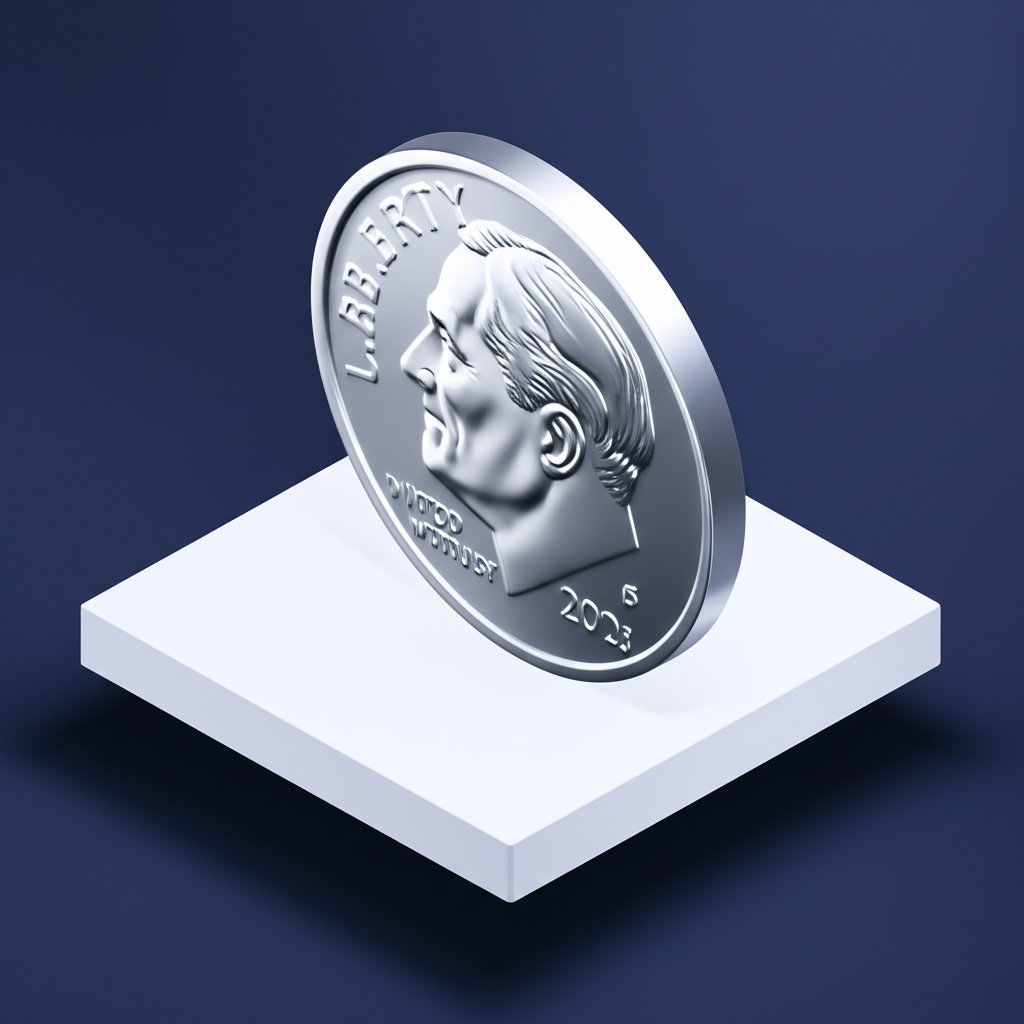
A dime, in its simplest form, is ten cents. You hand one over, and you get change for a dollar or cover a portion of your coffee. But if you’re asking "how much does a dime cost" in a deeper sense, you’re likely peering into the world of numismatics, where some dimes are worth far more than their face value. We’re talking about a small, silver coin that could hide a surprising intrinsic value or a significant collector’s premium.
Consider the pre-1965 silver dime, a piece of American history with a precious metal core. These aren't just 10 cents; they're tiny silver ingots masquerading as pocket change. Understanding their true worth requires looking past the number "10" stamped on them and diving into factors like metal content, rarity, and condition.
At a Glance: Unlocking Your Dime's Potential Value
- Not All Dimes Are Equal: Only dimes minted in 1964 or earlier contain actual silver. Modern dimes are copper-nickel clad.
- Two Main Value Paths: A silver dime's worth comes from either its silver melt value (based on current silver prices) or its numismatic collector value (based on rarity, condition, and demand).
- Identify First: Always check the date and the coin's edge to confirm it's silver before assessing its worth.
- Condition Matters Immensely: Even a common silver dime can be worth hundreds or thousands if it's in pristine, uncirculated condition with full details.
- Key Dates & Errors Are Goldmines: Certain years, mint marks, or striking errors can push a dime's value into the thousands or even millions.
- Tools for the Trade: A magnifier, digital scale, and good coin reference are essential for accurate identification and evaluation.
The 10-Cent Illusion: Why Some Dimes Defy Face Value
For most people, a dime is just a dime. It's that small, ridged coin that seems to disappear from your pocket faster than any other. But savvy collectors and precious metal enthusiasts know better. The question, "how much does a dime cost?" isn't a simple mathematical equation for every dime you encounter. It’s a prompt to differentiate between two very distinct types of dimes: those with only face value, and those with hidden silver or collector value.
The crucial dividing line is the year 1964. Any dime dated 1964 or earlier was struck from a composition of 90% silver and 10% copper. These are the "silver dimes" we're talking about. Dimes minted from 1965 onward, however, are made from a copper-nickel clad composition. They contain no silver whatsoever and are only worth their face value of ten cents, regardless of how old they get, barring extremely rare minting errors. This makes the date the absolute first thing to check.
Unpacking the Silver Dime: Composition, Weight, and Design
To truly grasp "how much does a dime cost," you need to understand the physical characteristics of its silver predecessors.
The Silver Recipe: 90% Pure
Every U.S. silver dime produced before 1965 contains 90% pure silver and 10% copper. This specific alloy was chosen for its durability and resistance to wear, yet still delivering a high precious metal content. Each silver dime weighs approximately 2.5 grams and contains about 0.0723 troy ounces of pure silver. That's not a huge amount individually, but it adds up quickly in bulk.
A Trio of Timeless Designs
Over the years, three main designs graced the silver dime, each with its own historical significance and aesthetic appeal:
- Barber Dime (1892–1916): Designed by Charles E. Barber, this dime features a classical depiction of Liberty wearing a cap, facing right, on the obverse (front). The reverse (back) shows a wreath around the denomination. These are the oldest and often the most challenging to find in good condition.
- Mercury Dime (1916–1945): Officially known as the "Winged Liberty Head" dime, this iconic design by Adolph A. Weinman shows Liberty wearing a winged cap, often mistaken for the Roman god Mercury. The reverse features a fasces (a bundle of rods with an axe blade) symbolizing strength and unity. Its elegant design makes it a favorite among collectors.
- Roosevelt Dime (1946–1964): Designed by John R. Sinnock, this dime commemorates President Franklin D. Roosevelt. The obverse features Roosevelt's profile, while the reverse shows a torch, olive branch, and oak branch, symbolizing liberty, peace, and strength, respectively. The silver versions of Roosevelt dimes are the most common you'll find due to their more recent mintage.
Recognizing these designs can help you appreciate the history you hold, but remember, the date is the primary indicator of silver content.
Calculating the Melt Value: The Foundation of Silver Worth
For most common silver dimes, their intrinsic value is tied directly to the current market price of silver. This is known as the silver melt value. It’s the baseline answer to "how much does a dime cost" when you're dealing with easily available, circulated examples.
Here’s how to calculate it:
- Find the Spot Price of Silver: This is the current market price for one troy ounce of pure silver. You can find this on financial news sites, metal dealer websites, or apps. Let’s assume, for example, the spot price is $30 per troy ounce.
- Know the Silver Content: Each 90% silver dime contains approximately 0.0723 troy ounces of pure silver. This is a constant.
- Multiply: Multiply the silver content by the current spot price.
- Example: 0.0723 troy oz/dime * $30/troy oz = $2.169 per dime.
So, in this scenario, a silver dime is worth roughly $2.17 due to its metal content alone, significantly more than its 10-cent face value. This melt value can fluctuate daily with the silver market. For a deeper dive into all aspects of your dime's potential worth, including more on melt value vs. collector premiums, you might want to Understand your dime's worth.
Beyond Melt: When a Dime Costs More Than Just Silver
While melt value provides a floor, many silver dimes command prices far above their metal content. This is where the world of numismatics comes in, turning a simple coin into a collectible treasure. The answer to "how much does a dime cost" can jump dramatically based on these factors:
1. Rarity and Scarcity: The Core of Collectible Value
Certain silver dimes were minted in much smaller quantities than others, making them rarer and thus more valuable. These are often called "key dates" or "semi-key dates."
- Mint Mark: Look for tiny letters (S for San Francisco, D for Denver, O for New Orleans, CC for Carson City) near the date or on the reverse. The absence of a mint mark usually indicates Philadelphia. Certain mint marks for specific years can denote scarcity.
- Low Mintage Numbers: Some years or mint mark combinations had very low production runs. For example, the 1916-D Mercury Dime had a mintage of only 264,000, making it highly sought after.
- Case Snippet: An 1894-S Barber Dime, with a minuscule mintage of only 24 pieces, is one of the most famous and valuable U.S. coins, having sold for over $2 million at auction. While extremely unlikely to find, it illustrates the extreme impact of scarcity.
2. Condition (Grade): The Visual Assessment
The physical condition of a coin is paramount. A coin's "grade" describes its state of preservation, from heavily worn to perfectly preserved. Professional grading services like PCGS (Professional Coin Grading Service) or NGC (Numismatic Guaranty Corporation) assign a numerical grade (on a scale of 1 to 70) and verify authenticity.
- Circulated Grades (G-4 to AU-58): These coins show varying degrees of wear from being in circulation. Details are worn down, but the date and mint mark are typically legible.
- Uncirculated Grades (MS-60 to MS-70): These coins show no signs of wear and retain their original mint luster. Higher grades like MS-65 (Mint State 65) or MS-68 with "Full Bands" (FB) on Mercury dimes or "Full Torch" (FT) on Roosevelt dimes (indicating crisp, complete details) can drastically increase value.
- Case Snippet: A common 1943 Mercury Dime might be worth its melt value ($2.17 at $30 silver) in G-4 condition. However, a 1943 Mercury Dime in MS-67 FB condition could be worth several hundred dollars, purely due to its exceptional preservation.
3. Errors and Varieties: Unique Flaws
Mistakes made during the minting process can create rare and highly collectible coins known as error coins or varieties.
- Doubled Die: Where the coin's design appears doubled in some areas due to an error in the die.
- Off-Center Strikes: When the coin blank isn't perfectly aligned, resulting in a portion of the design being missing and an un-struck blank area.
- Mint Mark Errors: Such as the 1945-S Micro-S Mercury Dime, where the "S" mint mark is unusually small.
- Case Snippet: While a regular 1949 Roosevelt Dime might fetch modest premiums above melt, a 1949 Roosevelt Dime in MS-68FB (Full Bands) condition has sold for $13,200, highlighting how both condition and subtle variabilities contribute to "how much does a dime cost" in the collector market.
4. Historical Significance: Telling a Story
Sometimes, a coin's story or its connection to a significant event can add to its allure, though this often overlaps with rarity and condition. For instance, the Mercury dime's design itself evokes the early 20th century and World War I era.
Spotting a Gem: Key Dates and Significant Rarities
Knowing which dimes are particularly sought after can significantly inform your answer to "how much does a dime cost." Here are some notable examples:
- Barber Dimes (1892-1916):
- 1894-S: The undisputed king, with only 24 minted.
- 1895-O (New Orleans): Low mintage, challenging to find.
- 1901-S (San Francisco): Another rare mint mark.
- 1905-O, 1905-S, 1909-D, 1913-S: Good examples of scarcer dates/mints.
- Mercury Dimes (1916-1945):
- 1916-D (Denver): The most famous Mercury dime key date due to its low mintage (264,000).
- 1921 & 1921-D: Scarce dates.
- 1942/1 Overdate & 1942/1-D Overdate: Distinctive minting errors where a "1" is visible under the "2" in the date.
- 1945-S Micro-S: A significant variety where the "S" mint mark is noticeably smaller than usual.
- Roosevelt Dimes (1946-1964):
- While most silver Roosevelt dimes derive their value primarily from silver melt, certain conditions or varieties can add premium. The 1949 (Philadelphia) Roosevelt dime in high grades (MS-67 or higher with Full Bands) can command hundreds to thousands of dollars.
- 1950-D (Denver) and 1955 (Philadelphia) in high grades also show some collector premium.
It's crucial to remember that a coin's condition dramatically impacts its value. A common date in superb condition can easily outprice a rare date in poor condition.
Your Silver Dime Playbook: Identification, Care, and Next Steps
Once you've encountered a dime that might be silver, what's your next move? This practical guide will walk you through the steps to confirm its identity and assess its potential worth.
Step-by-Step Identification: Is It Really Silver?
- Check the Date: This is the quickest way. If it's 1965 or later, it's not silver (unless it's a rare error, which is highly improbable for casual finds). If it's 1964 or earlier, proceed to the next steps.
- Examine the Edge: This is the most reliable visual test.
- Silver Dime (pre-1965): Will have a solid, consistent silver-grey color all the way around the edge.
- Clad Dime (1965+): Will show a distinct copper stripe in the middle of the edge, sandwiched between the outer nickel layers.
- Weigh It: A digital scale is helpful.
- Silver Dime (90%): Weighs approximately 2.5 grams.
- Clad Dime (copper-nickel): Weighs approximately 2.27 grams. This difference, while small, is consistent.
- Magnet Test (Less Reliable, but a Good Check): Silver is non-magnetic. Hold a strong magnet close to the coin. If it sticks, it's not silver. If it doesn't stick, it could be silver, but it could also be other non-magnetic metals. Use this as a confirming test, not a primary one.
Your Essential Silver Dime Toolkit
- 10x Magnifying Loupe: To examine dates, mint marks, and details for wear and errors.
- Digital Scale (accurate to 0.01g): For precise weight verification.
- Coin Reference Guide or App: (e.g., A Guide Book of United States Coins – the "Red Book") to look up mintages, key dates, and estimated values.
- Non-abrasive Gloves (optional but recommended): To handle coins without transferring oils from your skin, which can cause damage.
Where to Find Silver Dimes
- Coin Roll Hunting (CRH): A popular method. Obtain boxes of dime rolls from your local bank. A box of dimes ($250 value) often yields at least one silver dime, though results vary widely. It's a treasure hunt!
- Estate Sales and Garage Sales: People often sell inherited collections or loose coins without knowing their true value.
- Flea Markets and Antique Shops: Some vendors might have silver dimes mixed in with other items.
- Online Marketplaces: While you’ll often pay market value, sites like eBay or specialized coin dealer websites are excellent for finding specific dates or types.
What to Do After You Find One: Preservation and Storage
Congratulations, you've found a silver dime! Now what?
- DO NOT Clean Your Coins: Cleaning, polishing, or scrubbing a coin, even if it looks dirty, will almost always reduce its numismatic value. You can damage the surface, remove natural toning, and leave hairline scratches visible under magnification. Leave cleaning to the professionals, or better yet, don't clean it at all.
- Store Properly: Place your silver dimes in inert, archival-safe holders.
- Mylar 2x2 Holders: Cardboard flips with a Mylar window are affordable for individual coins.
- Archival Coin Tubes: Good for storing multiple common silver dimes.
- Slabs (for graded coins): Professional grading services return coins encapsulated in protective, tamper-evident plastic holders.
- Inventory: Keep a record of your finds: date, mint mark, condition notes, and where you found them. This helps track your collection's value.
Selling Your Silver Dimes: Getting the Best Price
The best way to sell depends on your goal (quick cash vs. maximum return) and the coin's value.
- Local Coin Shops (LCS):
- Pros: Quick cash, expert appraisal, face-to-face transaction.
- Cons: You’ll likely receive less than full market value, as they need to make a profit. Best for common silver dimes.
- Online Marketplaces (eBay, specialized forums):
- Pros: Access to a wider audience, potentially higher prices for rare or graded coins.
- Cons: Fees (listing, final value), shipping costs, risk of fraud, more effort (taking photos, writing descriptions, shipping).
- Coin Shows:
- Pros: Opportunity to get multiple offers from different dealers, good for higher-value coins.
- Cons: Requires travel, can be intimidating for beginners.
- Precious Metal Dealers: Best for selling common silver dimes in bulk, purely for their melt value. They'll typically pay a percentage of the current spot price.
A Note on Melting: Is It Legal?
Yes, it is legal to melt U.S. silver dimes (pre-1965) for their silver content. The prohibition on melting U.S. coinage only applies to current circulating currency (post-1964 clad coins) to prevent the destruction of legal tender. Silver dimes are considered collectible items and precious metal commodities.
Quick Answers: Common Questions About Dime Value
Q: Are all dimes worth only 10 cents?
A: No. While modern dimes (1965 and newer) are generally only worth 10 cents, dimes minted in 1964 and earlier contain 90% silver and have a value significantly higher than 10 cents, based on their silver content and potential collector value.
Q: How can I quickly tell if a dime is silver?
A: The fastest way is to check the date (1964 or earlier). Then, look at the coin's edge. A silver dime will have a solid silver-gray edge, while a non-silver (clad) dime will show a visible copper stripe in the middle.
Q: What's the difference between "melt value" and "collector value"?
A: Melt value is the intrinsic worth of a silver dime based solely on the current market price of the silver it contains. Collector value (or numismatic value) is the premium above melt value that a coin commands due to its rarity, condition, historical significance, and demand among collectors. Rare dates or high-grade coins have a higher collector value.
Q: Should I clean my old dimes?
A: Absolutely not. Cleaning old coins, especially silver ones, almost always decreases their numismatic value. It can remove natural toning, cause microscopic scratches, and damage the original surface. Professional collectors prefer coins in their original, uncleaned state.
Q: What is a "key date" dime?
A: A "key date" dime is a specific year and mint mark combination that is highly sought after by collectors due to its low mintage or scarcity. Examples include the 1916-D Mercury dime or the 1894-S Barber dime. These often command significant premiums.
Q: Is it worth looking through my spare change for silver dimes?
A: While unlikely to find them in modern circulation, some people still enjoy "coin roll hunting" (getting rolls of dimes from banks) specifically to search for pre-1965 silver dimes. It can be a fun and occasionally rewarding hobby.
Your Path Forward: Deciding on Your Dime's Future
Understanding "how much does a dime cost" transforms from a simple question into an exciting investigation. You've learned to differentiate between a common dime and a valuable silver one, how to calculate its basic melt value, and the advanced factors that can send its price soaring.
Your next steps depend on what you've found:
- For common silver dimes (1964 Roosevelt, well-circulated): These primarily hold melt value. Decide if you want to hold onto them for their silver content, sell them to a precious metal dealer for quick cash, or use them as a starting point for a silver stack.
- For potentially rare or high-grade silver dimes (older designs, key dates, pristine condition): These warrant a closer look. Use your magnifier, check against reference guides, and consider seeking an appraisal from a reputable coin dealer or submitting them for professional grading if you suspect significant value.
Remember, every silver dime holds a piece of history and a tangible store of value. Approaching it with knowledge and care will ensure you unlock its true potential.