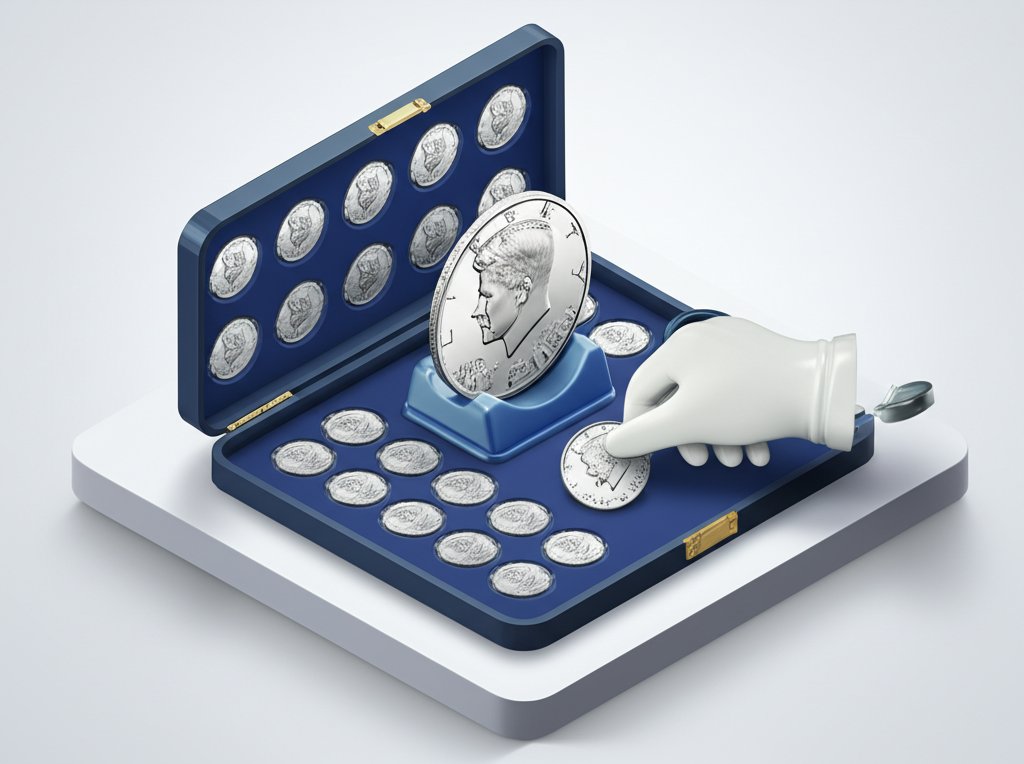
You might be surprised how much is a half dollar you've tucked away in a drawer or inherited. While many half dollars still trade at face value, others hide significant worth, sometimes reaching into the thousands, even hundreds of thousands of dollars. Unearthing these treasures requires a keen eye and a bit of specialized knowledge, turning a simple coin into a fascinating historical artifact and a potential windfall.
At a Glance: Spotting a Valuable Half Dollar
- Silver Content is Key: Most pre-1971 half dollars contain silver (90% for pre-1965, 40% for 1965-1970).
- Rarity Reigns: Low mintage numbers, production errors, and exceptional condition drive value.
- Specific Dates & Varieties: Certain years or unique minting quirks can drastically increase a coin's worth.
- Never Clean: Cleaning a coin, no matter how dirty, will almost certainly destroy its numismatic value.
- Professional Grading: For potentially valuable coins, a third-party grading service can authenticate and enhance value.
The Foundation of Value: Silver Content & Numismatic Rarity
Before diving into specific coins, it's crucial to understand the pillars of half dollar value. Beyond face value, a half dollar's worth typically stems from its precious metal content or its numismatic (collector) appeal.
Decoding Silver Content
The quickest way to gauge initial value for many older half dollars is by their silver content:
- Pre-1965 Half Dollars (Kennedy, Franklin, Walking Liberty): These are composed of 90% silver. Each contains approximately 0.3617 troy ounces of pure silver. Their value is directly tied to the fluctuating spot price of silver, making them worth considerably more than 50 cents, even in circulated condition.
- 1965-1970 Half Dollars (Kennedy): A significant shift happened here. These coins contain 40% silver (often called "junk silver"). They hold roughly 0.1479 troy ounces of silver. While still more valuable than face value, their intrinsic worth is less than their 90% counterparts.
- Post-1970 Half Dollars: With very few exceptions (like specific collector's proofs), half dollars minted after 1970 are made of copper-nickel clad. These typically hold only face value, unless they possess rare numismatic qualities like errors or an exceptional grade.
The Trinity of Rarity: What Collectors Seek
Once you've moved beyond intrinsic silver value, numismatic rarity takes over. Three factors predominantly determine how much is a half dollar worth to a collector:
- Low Mintage (Scarcity): Simply put, fewer coins minted means fewer available for collectors. This drives up demand and price. A coin with a mintage of a few hundred thousand will almost always be more valuable than one with hundreds of millions. Examples include the 1970-D Kennedy half dollar, which saw a very low mintage of 2.1 million and was only released in mint sets, never for general circulation.
- Errors and Varieties (Uniqueness): These are accidental quirks that occurred during the minting process, making a coin unique. Common errors include:
- Doubled Dies: Where the design elements appear doubled. A notable example is the 1964 Kennedy half dollar with doubling on "IN GOD WE TRUST."
- Off-Center Strikes: When the coin blank isn't perfectly centered during striking.
- Clipped Planchets: When a piece of the blank coin material is missing.
- Overdates: A date struck over a previous one, like the 1817/4 Capped Bust.
- No Mint Mark: Occasionally, a mint mark (like 'P' for Philadelphia, 'D' for Denver, 'S' for San Francisco) might be missing due to an error, making the coin distinctive.
- Condition (Preservation): This is paramount. A coin's grade, which assesses its wear and preservation, can dramatically impact its value. A coin graded MS-65 (Mint State, meaning uncirculated with minor imperfections) can be worth 10 to 100 times more than the same coin in "Good" or "Fine" condition. Specific condition indicators, such as "Full Bell Lines" on Franklin halves, where the horizontal lines on the Liberty Bell are fully visible and unbroken, can multiply a coin's value. This is where attention to detail really pays off.
For a broader understanding of half dollar values across all types and how to identify valuable ones, you might find our main guide helpful: Half dollar coin values.
Unlocking Historical Riches: Early American Half Dollars
Some of the most valuable half dollars predate the well-known Franklin and Kennedy series. These often represent significant historical artifacts, and their values reflect both age and extreme rarity, especially in higher grades.
Capped Bust Half Dollars (1807–1839)
These early half dollars are a numismatic playground due to their manual production methods, leading to numerous die varieties and overdates. Discovering one of these with a clear "overdate" (like an 1817/4, where a '7' was struck over a '4') can be a six-figure event. For instance, an 1817/4 Capped Bust in VF-35 condition sold for $329,000. These coins, even in lower grades, can easily fetch hundreds to thousands of dollars, making them significant finds.
Barber Half Dollars (1892–1915)
Designed by Charles Barber, these feature Lady Liberty on the obverse and an eagle on the reverse. While many circulated heavily, specific low-mintage dates and mint marks (like 1897-O or 1913-S) command high prices in good condition. An average Barber half dollar might start at $20-$100, but an uncirculated example of a rare date can easily cross into the thousands.
The Earliest Giants: Draped Bust and Flowing Hair
To illustrate the pinnacle of half dollar value, consider these historical titans:
- 1797 Draped Bust Half Dollar: A PCGS MS-66 specimen with a "Small Eagle" reverse fetched an astonishing $1,527,500 in 2015. This is the highest known grade and represents extreme rarity from the early U.S. Mint.
- 1796 Draped Bust 15 Stars Half Dollar: As one of the very first half dollars produced by the U.S. Mint, with a minuscule mintage of only 3,918 coins, a PCGS MS-63 sold for $1,292,500 in 2008. These are truly once-in-a-lifetime finds.
- 1794 Flowing Hair Half Dollar: From the first year of issue, an AU-55 example realized $705,000 in 2023. This demonstrates the immense value placed on coins from the dawn of U.S. coinage.
These top-tier examples underscore that pristine condition combined with extreme scarcity from the earliest days of the U.S. Mint creates unparalleled value.
Mid-Century Gems: Walking Liberty & Franklin Half Dollars (1916-1963)
These series are often the sweet spot for collectors and treasure hunters. They are old enough to have significant numismatic value, especially in specific dates and conditions, and many still contain high silver content.
Walking Liberty Half Dollars (1916–1947)
Considered one of the most beautiful U.S. coin designs, the "Walker" series has several key dates:
- 1921-D Walking Liberty: This is a major rarity due to an extremely low mintage of just 208,000 coins. Even in well-worn condition, a 1921-D can be worth $1,000 or more. In high grades, values soar into the tens of thousands; a PCGS MS-66 sold for $188,000 in 2022.
- 1938-D Doubled Die Obverse: This rare variety shows distinct doubling on the date and lettering, a prized error that significantly boosts value.
Generally, Walking Liberty halves from the 1910s and 1920s (especially with 'D' or 'S' mint marks) tend to be scarcer and more valuable than those from the 1930s and 1940s. All Walking Liberties contain 90% silver, providing a strong baseline value.
Franklin Half Dollars (1948–1963)
Featuring Benjamin Franklin on the obverse and the Liberty Bell on the reverse, these 90% silver coins have their own sought-after varieties:
- 1955 "Bugs Bunny" Franklin: This whimsical error is a result of a die clash, making Franklin appear to have buck teeth due to a faint imprint of the eagle's wings from the reverse. A clear "Bugs Bunny" can fetch $500+ in MS-65 condition.
- "Full Bell Lines" (FBL): This is a critical condition indicator for Franklin halves. On the reverse, the Liberty Bell has horizontal lines. If these lines are clearly defined and unbroken from rim to rim, the coin qualifies as "Full Bell Lines" (often denoted as FBL by grading services). This level of detail signifies a superior strike and preservation, often doubling or even tripling a coin's value compared to one of the same grade without FBL.
All Franklin halves, regardless of specific variety, are 90% silver, giving them strong intrinsic value.
Kennedy Half Dollars: More Than Just Face Value (1964–Present)
The Kennedy half dollar series, starting in 1964, holds a special place, marking the last widespread use of silver in circulating U.S. coinage. While common, several specific dates and varieties are highly valuable.
The Early Silver Years (1964-1970)
- 1964 (90% Silver): This is the only year Kennedy halves were minted in 90% silver for general circulation. They are always worth more than face value due to their silver content.
- 1964 "Accented Hair" Proof: A rare and early proof variety of the 1964 Kennedy half dollar, identifiable by bolder, more distinct hair strands above JFK's ear and a missing serif on the "I" in LIBERTY. These are highly coveted and can command values well over $1,000, with a PCGS PR-68DCAM example selling for $10,575 in 2019.
- 1970-D (40% Silver): This is a key date with the lowest mintage of any Kennedy half dollar (2.1 million). Crucially, these coins were never released for circulation and were only available in U.S. Mint Proof Sets or Mint Sets. If you find a 1970-D Kennedy half dollar outside of its original mint packaging, it's a significant discovery. Values for a high-grade example (e.g., MS-67) can exceed $12,000.
Modern Errors & Collector's Specials
Even clad Kennedy half dollars can be valuable if they have specific errors or were part of special collector issues.
- 1982 "No P" Kennedy Half Dollar: Coins minted in Philadelphia typically carry a "P" mint mark. Some 1982 Kennedy halves are missing this mint mark, a recognized error that can significantly increase their value, ranging from $300 to $3,000+ depending on condition.
- 1974-D Doubled Die Obverse: Look for clear doubling on the lettering, particularly "IN GOD WE TRUST" and "LIBERTY." In higher uncirculated grades (MS-64+), these can be worth $400-$800 or more.
- 1992-S Silver Proof Kennedy Half Dollar: Starting in 1992, the U.S. Mint resumed issuing special collector proof sets that included 90% silver Kennedy half dollars. While not intended for circulation, if found, these are considerably more valuable than their clad counterparts, often selling for $10-$20.
Bicentennial Half Dollars: Identifying the Special Ones
The 1776-1976 Bicentennial half dollar is one of the most common half dollars you'll encounter. Most are made of copper-nickel clad and are only worth 50 cents. However, special collector versions exist:
- 40% Silver Bicentennial Half Dollars: These were struck for collectors and sold in proof and mint sets. They contain 40% silver, similar to 1965-1970 Kennedy halves. You can identify them by their uniform silver-colored edge; clad coins will show a distinct copper stripe between the nickel layers. These typically sell for $10-$15. If found in their original mint packaging, they might fetch slightly more.
Your Toolkit for Discovery: Practical Inspection & Care
Finding a valuable half dollar isn't just about luck; it's about knowing what to look for and how to handle your potential finds.
Essential Tools for Every Collector
- 10x Magnifying Glass (Jeweler's Loupe): Absolutely crucial. This allows you to scrutinize details like mint marks, doubling, subtle errors, and the critical "Full Bell Lines" on Franklin halves.
- Soft Cotton Gloves: Handling coins with bare hands leaves oils and fingerprints that can damage the surface over time, especially on uncirculated coins.
- Good Lighting: Natural daylight or a high-quality LED lamp helps reveal details clearly.
The Inspection Protocol: What to Examine
When you come across a half dollar, follow these steps:
- Check the Date: This is your first filter. Dates pre-1971 are immediately interesting for their silver content.
- Locate the Mint Mark: Typically on the reverse (Walking Liberty, Franklin) or obverse (Kennedy). 'D' for Denver, 'S' for San Francisco, 'P' for Philadelphia (or no mark, which historically meant Philadelphia). Look for any missing mint marks for dates where one should be present (e.g., 1982 Kennedy).
- Inspect for Errors and Varieties:
- Doubling: Use your magnifier to look for blurred or split letters and numbers, especially on dates, legends ("LIBERTY," "IN GOD WE TRUST"), and design elements.
- Die Clashes/Breaks: Look for faint outlines of design elements appearing in unintended places (like the "Bugs Bunny" Franklin).
- Off-Center Strikes/Clipped Planchets: Visually obvious anomalies where the design is incomplete or skewed.
- Assess Condition: This is subjective but critical.
- For silver coins: Is there significant wear? Are the high points of the design (e.g., Liberty's head, Franklin's cheek) worn flat, or are details still visible?
- For Franklin halves: Are the "Full Bell Lines" on the Liberty Bell (reverse) clearly defined and unbroken?
- For Kennedy "Accented Hair": Are the hair strands above JFK's ear distinct? Is the serif missing on the "I" in LIBERTY?
The Cardinal Rule: Never Clean Your Coins!
This cannot be stressed enough. Cleaning a coin, even gently, will remove the original patina, scratch the surface, and immediately diminish its numismatic value. What might look like dirt to you is often part of the coin's history and character to a collector. Leave cleaning to professionals, and frankly, most valuable coins are best left untouched.
When to Consider Professional Grading
If you believe you have a genuinely valuable half dollar (especially one that's a key date, a rare error, or in exceptionally good condition), professional grading by a reputable third-party service like PCGS (Professional Coin Grading Service) or NGC (Numismatic Guaranty Corporation) is highly recommended.
- Why Grade? A professional grade provides an impartial, universally recognized assessment of your coin's condition and authenticity. This gives buyers confidence and typically results in a higher sale price.
- Cost vs. Value: Grading isn't free, but for a coin potentially worth hundreds or thousands, the cost is a worthwhile investment. Do your research on estimated value before submitting to ensure it's economically sensible.
Common Questions About Half Dollar Value
Are all old half dollars valuable?
No. Many older half dollars from the mid-20th century, particularly later dates in the Franklin and Walking Liberty series, circulated widely and are only worth their intrinsic silver value (for pre-1971 issues) or face value (for clad coins) if they are in common, worn condition. Value primarily comes from scarcity, errors, or exceptional preservation.
How do I know if my Bicentennial half dollar is silver?
Check the edge. If it has a uniform silver-colored edge without a visible copper stripe in the middle, it is a 40% silver collector's edition. If you see a copper stripe, it's a common clad coin worth face value.
Can I find valuable half dollars in circulation today?
It's highly unlikely, but not impossible. Most valuable silver coins were pulled from circulation decades ago. However, occasionally a 1970-D Kennedy half dollar (from a mint set) or a rare error coin could theoretically slip through. Your best bets are coin rolls, inherited collections, or estate sales.
Is cleaning my half dollar a good idea?
Absolutely not. Cleaning a coin, no matter how carefully, will almost always reduce its value significantly by damaging its surface and patina. Resist the urge.
What should I do if I think I have a valuable half dollar?
First, use a 10x magnifier to compare your coin's details with known varieties and error descriptions. Do not clean it. Handle it by the edges. If you suspect significant value, consult a reputable coin dealer or consider professional grading.
Charting Your Course: What to Do Next
Unearthing a valuable half dollar is an exciting prospect, but it requires patience and a systematic approach. Instead of guessing, follow these practical steps:
- Categorize Your Coins:
- Pre-1965 (90% Silver): These are always worth more than face value. Put them aside.
- 1965-1970 (40% Silver): Also worth more than face value. Separate these.
- Post-1970 Clad: Unless you suspect an error, these are generally face value.
- Bicentennial (1976): Check the edge for silver content.
- Focus on the "Big Three" Rarity Factors: For any coin, especially those not immediately identifiable as high-silver content:
- Dates & Mint Marks: Are there any low-mintage dates for that specific series (e.g., 1921-D Walking Liberty, 1970-D Kennedy)?
- Errors & Varieties: Closely inspect for doubling, missing elements, or other oddities. Use your magnifier.
- Condition: How well-preserved is it? Does it show full details, or is it heavily worn? Look for specific condition markers like "Full Bell Lines."
- Cross-Reference Your Finds: Use online resources, coin price guides, or even reputable coin dealer websites to compare your coin's date, mint mark, and condition with known valuable issues. Pay attention to auction results for similar coins.
- Seek Expert Opinion (When Warranted): If your research suggests you have a potentially valuable coin (especially one worth hundreds or thousands), it's time for an expert. A local coin dealer can offer an initial assessment. For high-value items, professional grading by PCGS or NGC is the gold standard for authentication and maximizing value.
By understanding the key indicators of silver content, rarity, and condition, you're well-equipped to evaluate your collection and potentially discover how much is a half dollar hiding extraordinary value. Happy hunting!