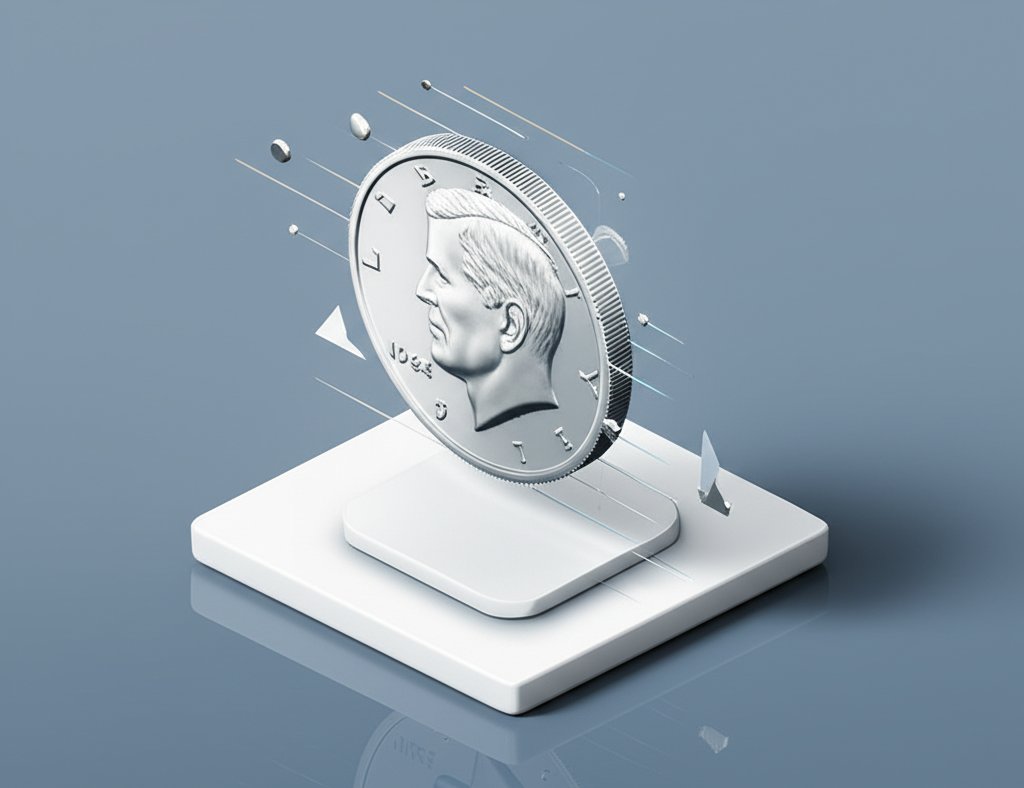
When you ask "how much silver is there in a 1964 silver dollar," you're touching on a common point of confusion among collectors and casual coin holders alike. Here’s the immediate clarification: there were no circulating silver dollars minted by the U.S. Mint in 1964. The last widely circulated silver dollar was the Peace Dollar, which ended in 1935. However, 1964 is an incredibly significant year for silver coinage, specifically for the 1964 Kennedy Half Dollar. This coin is indeed 90% silver, making it a valuable piece of American history and a tangible asset.
This article dives deep into understanding the silver content of these iconic 1964 half dollars, how to calculate their melt value, and why they hold a special place in your collection.
At a Glance: What You'll Learn About 1964 Silver Coins
- Clarifying the Myth: No circulating U.S. silver dollars were minted in 1964. The focus is on the 1964 Kennedy Half Dollar.
- Silver Purity: The 1964 Kennedy Half Dollar is 90% pure silver.
- Exact Silver Weight: Each 1964 half dollar contains 0.362 troy ounces (or 11.4 grams) of pure silver.
- Calculating Melt Value: Learn a simple formula to determine your coin's intrinsic silver worth based on current market prices.
- Why 1964 is Special: It marks the last year any U.S. circulating coin was struck with 90% silver.
- Identifying Your Coin: Tips to quickly verify if your half dollar is truly a 1964 silver issue.
The "1964 Silver Dollar" Conundrum: Setting the Record Straight
Let's address the elephant in the room: if you’re searching for the silver content of a "1964 silver dollar," you're likely thinking of the immensely popular 1964 Kennedy Half Dollar. It’s a common misconception, and for good reason—1964 was a watershed year for U.S. coinage, particularly for its silver content.
While no silver dollars (like Morgan or Peace Dollars) were produced for general circulation in 1964, the Kennedy Half Dollar, first minted that year to honor the recently assassinated President John F. Kennedy, was indeed struck in 90% silver. This coin, along with dimes and quarters from 1964 and earlier, represents the end of an era when U.S. circulating coinage contained significant precious metal.
It's crucial to make this distinction because a "1964 silver dollar" doesn't exist as a common circulating coin. If you encountered a coin labeled as such, it would either be a rare pattern coin, a privately minted novelty, or simply misidentified. For all practical purposes when discussing silver content and value from 1964, we're talking about the half dollar.
Unpacking the Silver in a 1964 Kennedy Half Dollar
So, how much silver is in a 1964 Kennedy Half Dollar? The answer is substantial, especially compared to coins minted just a year later.
Every 1964 Kennedy Half Dollar was minted with a composition of 90% silver and 10% copper. This means that out of its total weight, a significant portion is pure silver. Specifically, each 1964 silver half dollar contains 0.362 troy ounces (which equates to approximately 11.4 grams) of actual silver weight (ASW).
To put that into perspective, nearly two-fifths of an ounce of pure silver is packed into each of these coins. This makes them highly desirable for both their historical significance and their intrinsic metal value.
Calculating Your 1964 Half Dollar's Melt Value
The melt value is the intrinsic worth of the silver contained within the coin, based on the current market price of silver. This is often the floor value for a 1964 silver half dollar, as numismatic (collector) value can add a premium above and beyond the melt value, depending on its condition, rarity, and specific mint mark.
Here’s how to calculate the melt value of your 1964 silver half dollar:
- Identify the Actual Silver Weight (ASW): For a 1964 Kennedy Half Dollar, this is consistently 0.362 troy ounces.
- Find the Current Silver Spot Price: The "spot price" is the real-time market price for one troy ounce of pure silver. You can find this on financial news websites, precious metal dealer sites, or specialized coin melt value calculators. This price fluctuates daily, sometimes hourly.
- Perform the Calculation:
Multiply the ASW by the current silver spot price.
Melt Value = 0.362 troy ounces × Current Silver Spot Price
Example Scenario:
Let's say the current silver spot price is $25.00 per troy ounce.
- Melt Value = 0.362 oz × $25.00/oz
- Melt Value = $9.05
In this example, your 1964 Kennedy Half Dollar would have a melt value of $9.05. This calculation provides a solid baseline for understanding its worth.
Why 1964 is a Pivotal Year for U.S. Coinage
The year 1964 isn't just arbitrary; it marks a significant turning point in American monetary history. It was the last year that the U.S. Mint produced circulating dimes, quarters, and half dollars with a 90% silver composition.
The Coinage Act of 1792 originally defined the U.S. dollar, and its fractional parts like the half dollar, based on specific weights and purities of silver. A dollar was a defined weight of silver, a half dollar was exactly half that weight, and so on. This system of intrinsic metallic value underpinned the U.S. currency for over 170 years.
However, rising silver prices and increasing demand in the mid-1960s made it uneconomical to continue using such high silver content in circulating coinage. People began hoarding silver coins, leading to shortages in circulation.
- Post-1964 Shift:
- 1965-1970 Half Dollars: The composition changed to a "silver clad" design, containing only 40% silver (with a copper core). These are still valuable for their silver content, but significantly less than their 1964 predecessors.
- 1971-Present Half Dollars: The silver content was eliminated entirely, replaced by a copper-nickel clad composition (like modern quarters and dimes). These coins have virtually no intrinsic metal value beyond their face value.
This dramatic shift is why the 1964 Kennedy Half Dollar stands out. It's the final testament to an era when the coins in your pocket truly held precious metal value. For a broader perspective on identifying valuable half dollars across different years and compositions, you might find our main guide helpful: What's Your Half Dollar Worth?.
Verifying Your 1964 Silver Half Dollar: Practical Tips
It’s easy to confuse a silver 1964 half dollar with later clad versions that look similar. Here’s how to quickly determine if your coin is the valuable 90% silver variety:
- Check the Date: This is the absolute first step. It must be 1964. Any date 1965 or later will have reduced or no silver content.
- Examine the Edge: This is the most reliable visual test. Gently tilt the coin and look at its side (the reeded edge).
- 90% Silver (1964): The edge will appear uniformly silver. There will be no visible copper stripe or core.
- 40% Silver Clad (1965-1970): You will see a faint but distinct copper stripe running through the middle of the edge.
- Copper-Nickel Clad (1971-Present): The copper stripe will be much more pronounced and obvious.
- Weight (Less Practical for Home): A 1964 silver half dollar weighs 12.5 grams. Modern copper-nickel clad halves weigh 11.34 grams. While this is a definitive test, it requires an accurate scale and isn't usually the first method collectors use.
- Sound Test (Informal): A pure silver coin, when gently dropped onto a hard, non-marring surface (like a wooden table or another coin), will produce a distinctive, higher-pitched "ping" sound compared to the duller "thud" of a clad coin. This is an informal test and not foolproof, but experienced collectors can often tell the difference.
Why Silver Content Matters Beyond Melt Value
While the melt value provides a baseline, the enduring presence of silver in coins like the 1964 half dollar speaks to a fundamental principle of economics: intrinsic value.
Historically, the value of money was tied to the precious metal it contained. This made currency trustworthy and resistant to arbitrary devaluation. When governments decouple currency from precious metals, its value becomes more dependent on faith in the issuing authority and less on tangible assets. This is why many people view silver and gold coins as a hedge against inflation or economic uncertainty. Their value doesn't disappear; it simply fluctuates with the market price of the underlying metal.
The 1964 Kennedy Half Dollar embodies this principle. Regardless of its face value of 50 cents, its real-world worth is significantly higher due to its substantial silver content.
Common Questions & Misconceptions
Let's clear up some frequently asked questions and common misunderstandings surrounding the 1964 silver half dollar:
Q: Is a 1964 silver dollar rare?
A: As established, there isn't a circulating 1964 silver dollar. If you mean the 1964 Kennedy Half Dollar, it's not particularly "rare" in terms of mintage numbers – millions were produced. However, finding one in excellent condition, or one that has been saved from circulation, is less common. Its value primarily comes from its silver content, not extreme rarity.
Q: How can I tell if my 1964 half dollar is real silver?
A: The most definitive home test is to examine the coin's edge. A genuine 1964 silver half dollar will show a uniform silver color all the way through, with no visible copper stripe. If you see a distinct copper line on the edge, it's either a 40% silver (1965-1970) or a copper-nickel clad (1971-present) coin.
Q: What's the difference in value between a 90% silver half dollar and a 40% silver half dollar?
A: The difference is substantial. A 90% silver 1964 half dollar contains 0.362 troy ounces of silver. A 40% silver half dollar (1965-1970) contains 0.1479 troy ounces of silver. This means the 1964 coin has more than twice the silver content, and thus more than twice the melt value, assuming the same silver spot price.
Q: Should I sell my 1964 half dollar for its melt value or try to get more?
A: For most circulated 1964 Kennedy Half Dollars, the melt value will be the primary driver of its worth. If the coin is in exceptional, uncirculated condition, or if it's a rare variety (like a proof coin with specific characteristics), it might command a premium above melt value from a collector. However, unless you're a seasoned numismatist, selling for melt value to a reputable dealer or as part of a silver lot is often the easiest and most practical approach. Always check a price guide for truly high-grade examples.
Q: Do mint marks affect the silver content of a 1964 half dollar?
A: No, mint marks (like "D" for Denver, or no mark for Philadelphia) do not affect the silver content. All 1964 Kennedy Half Dollars, regardless of their mint, contain 90% silver and 0.362 troy ounces of ASW. Mint marks can, however, sometimes influence the numismatic (collector) value of certain years or conditions.
Your Action Plan: Unlocking the Value of Your 1964 Half Dollar
Now that you understand the details, here’s a quick guide to assess your 1964 Kennedy Half Dollar:
- Confirm the Year and Type: Ensure your coin is explicitly dated "1964" and is a Kennedy Half Dollar.
- Perform the "Edge Test": Examine the coin's side. If it's uniformly silver with no copper stripe, you have a 90% silver coin.
- Find the Current Silver Spot Price: Use a reliable online source to get the real-time price per troy ounce of silver.
- Calculate Melt Value: Multiply 0.362 by the current silver spot price. This is your baseline value.
- Consider Numismatic Value:
- Is it in pristine, uncirculated condition? Look for sharp details, original luster, and no scratches or wear.
- Are there any known errors or varieties? (This is advanced and usually requires expert identification).
If your coin is exceptionally well-preserved, its collector value might exceed its melt value. Otherwise, the melt value is typically what you can expect.
- Decide Your Next Steps: You can hold onto it as a silver investment, sell it to a precious metal dealer for its melt value, or offer it to coin collectors if its condition warrants a premium.
Understanding that the "1964 silver dollar" you might be searching for is actually the 1964 Kennedy Half Dollar is the first, most crucial step. These coins are tangible pieces of history, carrying a significant amount of silver that continues to make them valuable today. Handle them with care, confirm their authenticity, and you'll be well on your way to appreciating their true worth.