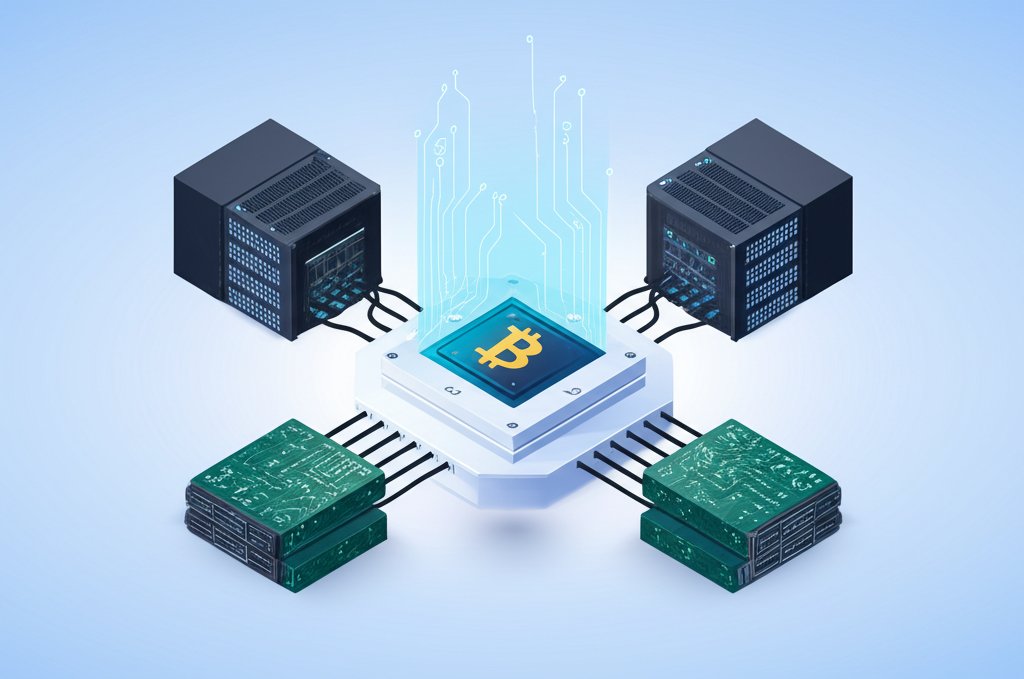
Crypto mining is a high-stakes game where every watt and every hash counts. At its core, maximizing daily profit hinges on selecting and operating the right miner ASIC. These specialized devices are the workhorses of the blockchain, but their performance and profitability aren't set in stone; they're dynamic variables you can influence with smart choices and careful management.
At a Glance: Optimizing Your Miner ASIC Profit
- Understand ASIC Fundamentals: Grasp how these specialized devices work and their inherent advantages and disadvantages in the mining ecosystem.
- Master Key Performance Metrics: Focus on hashrate (TH/s), power efficiency (J/TH), and total power consumption (W) to evaluate potential profitability.
- Match Miner to Scale: Choose an ASIC appropriate for your operational size, from quiet home setups to large-scale industrial farms, considering noise and cooling needs.
- Optimize Operating Environment: Implement robust cooling, stable power, and appropriate ventilation to maintain peak performance and extend hardware lifespan.
- Leverage Profitability Calculators: Accurately project earnings and payback periods by factoring in all variables, especially local electricity costs.
- Stay Ahead of Market Trends: Understand the competitive landscape of manufacturers and the rapid evolution of ASIC technology.
The Heart of Crypto Mining: What Makes a Miner ASIC Tick?
A miner ASIC (Application-Specific Integrated Circuit) is not just another computer chip; it's a finely tuned machine built for a singular purpose: solving the complex cryptographic puzzles that secure a blockchain. Imagine a super-specialized calculator that can only do one type of sum, but it does that sum billions of times per second. This specialization allows ASICs to achieve significantly higher performance and superior energy efficiency compared to general-purpose hardware like GPUs or CPUs for mining.
For example, a Bitcoin ASIC is designed solely to execute the SHA-256 algorithm. While incredibly powerful for its designated task, this specialization means it can't mine cryptocurrencies that use different algorithms, such as Scrypt (Litecoin) or Ethash (Ethereum Classic). This commitment to a single algorithm, combined with a high initial cost and a rapid obsolescence cycle as new models emerge, presents the core challenge for profitability. You're investing in a powerful but niche tool that needs to earn its keep quickly.
Decoding ASIC Performance: Hashrate, Efficiency, and Power
When you're evaluating a miner ASIC, three numbers reign supreme: hashrate, power consumption, and energy efficiency. Understanding how these interrelate is the bedrock of profitable mining.
- Hashrate (e.g., TH/s, GH/s, MH/s): This is the raw processing power of your ASIC, measured in hashes (calculations) per second. A higher hashrate means more attempts to solve a block, increasing your chances of earning rewards. For Bitcoin, hashrate is often in Terahashes per second (TH/s). The Bitmain Antminer S21 XP, for instance, boasts 270 TH/s—a colossal number designed for industrial scale. In contrast, an older model like the DragonMint T1 offers 16 TH/s, highlighting the exponential increase in hashing power over time.
- Power Consumption (W): This tells you how much electricity the ASIC draws, measured in watts (W). This is your primary operating cost. An Antminer S21 XP pulls 3645W, while a WhatsMiner M30S++ consumes 3,472W. The difference in these numbers, when multiplied by your electricity cost, can significantly impact your daily profit.
- Energy Efficiency (J/TH or W/TH): This critical metric measures how much energy is consumed per unit of hashrate. It's often expressed as Joules per Terahash (J/TH) or Watts per Terahash (W/TH). Lower numbers are better. The Antminer S19 Pro, with its 29.5 J/TH, set a high standard for its time, meaning it produces a lot of hashing power for relatively little energy. The AvalonMiner 1246, at 38 J/TH, is less efficient by comparison. This metric directly translates to how many coins you mine per dollar of electricity spent.
Practical Application: Consider two hypothetical ASICs. Miner A has 100 TH/s at 3000W. Miner B has 80 TH/s at 2000W. At first glance, Miner A is more powerful. However, Miner A's efficiency is 30 J/TH, while Miner B's is 25 J/TH. If electricity costs are high, Miner B, despite lower raw hashrate, might be more profitable due to its superior efficiency. This nuanced comparison is crucial, especially in an increasingly competitive environment where every fraction of a J/TH matters. For a broader overview of how various models stack up, you might find value in our comprehensive guide on Maximize Bitcoin Miner Profit.
Matching Your Miner ASIC to Your Ambition: Home Setup vs. Industrial Farm
Your choice of miner ASIC should align perfectly with your operational scale and available infrastructure. What works for a professional mining farm won't necessarily be suitable for a quiet corner in a home office.
For the Home Miner or Enthusiast: Prioritizing Quiet and Simplicity
If you're looking to dip your toes into mining or run a small operation without disturbing your neighbors (or yourself), focus on ASICs with lower noise levels and manageable power requirements.
- Noise Level: Anything above 60 dB can be intrusive. Models like the IceRiver AE1 Lite (Aleo, 300 MH/s, 500W, 45 dB) or the iPollo V1 Mini (Ethash, 330 MH/s, 240W, 35 dB) are designed with home environments in mind, offering significantly quieter operation. Even the Fluminer L1 (Scrypt, 5.6 GH/s, 1300W, 45 dB) is a decent option for beginners.
- Power Consumption: Keep it below 1,500W to avoid extensive electrical upgrades. Standard household circuits typically handle 15-20 amps, which limits total wattage.
- Hashrate: For beginners, models in the 6-30 TH/s range are a practical starting point, balancing performance with infrastructure demands.
For Mid-size to Professional Operations: Balancing Power and Efficiency
As you scale up, the focus shifts entirely to maximizing hashrate and efficiency, with environmental controls becoming a non-negotiable part of the setup.
- Hashrate: Professionals target 30–115+ TH/s for Bitcoin (SHA-256) or even higher for specialized algorithms. Models like the Antminer S19 Pro (110 TH/s) or WhatsMiner M30S++ (112 TH/s) are industry standards for good reason—they deliver substantial hashing power. The new generation, like the Antminer S21 Pro at 234 TH/s, pushes this even further.
- Power Consumption: Prepare for 3,000–8,000W per unit. This necessitates dedicated electrical circuits, industrial-grade power distribution units (PDUs), and often three-phase power.
- Cooling Infrastructure: High-power ASICs generate immense heat. Air-cooled units (Antminer S21 Pro, 76 dB) require significant ventilation, while hydro-cooled units like the Antminer S19 XP Hydro (255 TH/s, 5304W, 50 dB) demand advanced plumbing and cooling systems, but offer quieter operation and potentially higher stability.
- Algorithm Specialization: Don't forget that different ASICs mine different coins. The Antminer L9, for example, is specifically for Scrypt coins like Litecoin and Dogecoin, offering 17 GH/s. Your choice must align with the cryptocurrency you intend to mine.
Beyond the Specs: Creating the Optimal Mining Environment
Even the most powerful miner ASIC will underperform if its operating environment isn't meticulously managed. Heat, dust, and unstable power are the silent killers of mining profitability.
Temperature and Humidity Control: Your ASIC's Lifeline
ASICs generate a tremendous amount of heat. Operating them within their optimal temperature range (typically 0°C to 40°C, though closer to 20-25°C is ideal for longevity) is paramount. Exceeding these limits can lead to:
- Thermal Throttling: The ASIC automatically reduces its performance (hashrate) to prevent damage, directly cutting into your profits.
- Reduced Lifespan: Constant high temperatures degrade components faster, leading to premature failure and costly replacements.
- Instability: Overheated ASICs can crash or produce invalid shares, wasting energy and time.
Solutions: - Ventilation: For air-cooled units, powerful exhaust fans, intake fans, and proper ducting are essential to move hot air away and draw in cooler air.
- Airflow: Arrange ASICs to allow for maximum airflow through their heatsinks. Don't stack them too closely.
- Air Conditioning: In hotter climates, dedicated AC units or evaporative coolers might be necessary for larger setups.
- Hydro Cooling: For industrial scales, systems like the Antminer S19 XP Hydro use water blocks to directly cool chips, offering superior heat dissipation and often enabling higher clock speeds and quieter operation. This requires specialized infrastructure but can be highly efficient.
- Humidity: Keep relative humidity between 0% and 95%. Too high risks condensation and corrosion; too low can increase static electricity.
Stable Power and Noise Mitigation: Essential Operational Hygiene
- Power Stability: ASICs are sensitive to power fluctuations. Invest in high-quality Power Supply Units (PSUs) and ensure your electrical infrastructure can handle the sustained load without voltage drops or surges. A dedicated electrical circuit for each miner or small cluster is ideal.
- Noise Control: Many high-performance ASICs, like the Antminer S21 series, operate at 76 dB—equivalent to a loud vacuum cleaner. For residential or office settings, this is unsustainable.
- Soundproofing: Constructing insulated enclosures or dedicated mining containers can significantly reduce noise.
- Remote Location: Placing miners in a garage, basement, or a purpose-built outbuilding can mitigate noise impact.
- Hydro-cooling: As seen with the S19 XP Hydro, water cooling can drastically reduce fan noise, making these units more palatable for certain environments.
The Profit Equation: Mastering ASIC Mining Calculators
Choosing an excellent miner ASIC is only half the battle; knowing if it will be profitable is the other. This is where a robust mining profitability calculator becomes your best friend. These tools transform complex variables into actionable financial projections.
Here are the key inputs you'll typically feed into a calculator and why each matters:
- Miner Hashrate: Your ASIC's raw processing power (e.g., 270 TH/s for an S21 XP).
- Cryptocurrency Price: The current market value of the coin you're mining (e.g., Bitcoin price in USD). Fluctuations here are your biggest external risk.
- Network Difficulty: This metric reflects the overall competition on the blockchain. As more miners join, difficulty increases, meaning it takes more hashing power to find a block. It dynamically adjusts to keep block times consistent.
- Block Reward: The amount of cryptocurrency awarded for successfully mining a block (e.g., 6.25 BTC for Bitcoin, plus transaction fees).
- Mining Pool Fees: If you mine with a pool (which most do), they take a percentage (typically 1-3%) of your earnings for their services.
- Device Power Consumption (W): The total wattage your ASIC draws (e.g., 3645W for an S21 XP).
- Electricity Cost ($/kWh): Your local electricity rate. This is arguably the most critical variable. A high-efficiency ASIC in a location with $0.03/kWh can be immensely profitable, while the same ASIC at $0.20/kWh might be a money pit.
- Hardware Initial Cost: The upfront price you pay for the ASIC. This is crucial for calculating your Return on Investment (ROI) and payback period.
Scenario Snippet:
Let's say you're considering the Bitmain Antminer S21 Pro (234 TH/s, 3510W).
- Current Bitcoin Price: $65,000
- Network Difficulty: (A high, fluctuating number)
- Electricity Cost: $0.05/kWh
- Pool Fees: 2%
- Initial Cost: $5,000
A calculator would estimate your daily gross revenue, subtract your daily electricity cost ($0.05/kWh * 3.510 kW * 24 hours = $4.21/day), then account for pool fees. This gives you your net daily profit. Dividing the initial cost by the net daily profit will give you an estimated payback period. Small changes in electricity cost or Bitcoin price can dramatically alter these outcomes. Always run calculations with worst-case, best-case, and realistic scenarios.
Navigating the ASIC Manufacturer Landscape
The miner ASIC market is dominated by a few key players, each with their own strengths and focus. Understanding this landscape can help inform your purchasing decisions.
- Bitmain: The undisputed industry leader, known for its iconic Antminer series (S21, S19, L9, etc.). Bitmain often sets the benchmark for performance and efficiency, consistently releasing cutting-edge hardware. Their product lines cater to various algorithms (SHA-256, Scrypt) and scales, from industrial-grade hydro-cooled units to powerful air-cooled machines.
- MicroBT: A strong competitor to Bitmain, MicroBT produces the popular Whatsminer series (e.g., M30S++). They are renowned for powerful and often very efficient miners, establishing a loyal user base for their reliability and competitive pricing.
- Canaan Creative: Manufactures the AvalonMiner series (e.g., 1246). Canaan is recognized for its focus on stability, robust design, and a generally good price-to-performance ratio, making them a solid choice for medium to large farms prioritizing longevity.
- Innosilicon: Known for producing high-performance miners for a variety of algorithms beyond just Bitcoin, including Ethash and others, catering to miners looking for specialized solutions.
When choosing a manufacturer, consider not just the raw specs but also factors like warranty, customer support, and the availability of spare parts.
Practical Playbook: A Step-by-Step Approach to ASIC Profitability
Ready to optimize your miner ASIC setup? Follow these steps for a focused approach:
- Define Your Scale and Budget:
- Home/Small Scale: Prioritize low noise (<50 dB), moderate power (<1500W), and a manageable initial investment.
- Professional/Industrial Scale: Focus on highest hashrate and efficiency, accepting higher noise/power demands for advanced cooling.
- Research Target Cryptocurrencies:
- Identify coins that align with your risk tolerance and have a stable mining ecosystem.
- Confirm the hashing algorithm (e.g., SHA-256 for Bitcoin, Scrypt for Litecoin).
- Select the Right ASIC Model:
- Based on your chosen algorithm and scale, narrow down potential ASICs using hashrate, efficiency (J/TH), and power consumption.
- Example for Bitcoin Professionals: Compare Antminer S21 Pro (234 TH/s, 3510W) vs. WhatsMiner M30S++ (112 TH/s, 3472W). The S21 Pro offers significantly more hashrate for a similar power draw, indicating better efficiency and potentially higher profitability despite a higher initial cost.
- Calculate Profitability Religiously:
- Use multiple online calculators.
- Input your exact electricity cost ($/kWh).
- Run scenarios with varying cryptocurrency prices and network difficulty projections.
- Factor in pool fees and your initial hardware cost for ROI.
- Plan Your Environment:
- Electrical: Ensure dedicated circuits and robust wiring for high-power ASICs. Consult an electrician if needed.
- Cooling: Design a ventilation system (fans, ducts) or a hydro-cooling loop that can maintain temperatures below 40°C.
- Noise: Implement soundproofing or strategically locate your miners away from living spaces.
- Security: Protect your investment from theft and environmental hazards (fire, water).
- Source Your Hardware:
- Buy directly from reputable manufacturers (Bitmain, MicroBT, Canaan) or authorized distributors to avoid scams and ensure warranty coverage.
- Beware of secondary markets without proper verification.
- Set Up and Monitor:
- Follow manufacturer instructions for setup.
- Join a reliable mining pool.
- Continuously monitor hashrate, temperature, and power consumption. Use monitoring software provided by the manufacturer or third parties.
- Regularly clean dust from fans and heatsinks.
Quick Answers: Common ASIC Mining Questions
Q: Are older miner ASIC models ever profitable?
A: Yes, absolutely, but it heavily depends on your electricity cost. An older, less efficient ASIC (like an Antminer S9) can still generate profit if your electricity cost is extremely low (e.g., below $0.03-$0.05/kWh). However, in most residential scenarios with higher electricity rates, their operating cost will quickly outweigh their revenue. Always use a profitability calculator to verify.
Q: How often should I upgrade my miner ASIC?
A: There's no fixed schedule. The optimal time to upgrade is when the profitability of your current ASIC significantly diminishes due to rising network difficulty or when a new generation of ASICs offers a dramatic leap in efficiency, making your current hardware comparatively expensive to run. Track your ROI and payback period. If a new model promises a much faster payback, it might be time.
Q: What's the biggest mistake new ASIC miners make?
A: By far, the biggest mistake is underestimating or miscalculating electricity costs. Many aspiring miners focus solely on hashrate and initial cost, forgetting that electricity is a continuous operational expense that can quickly turn a profitable venture into a losing one. Always verify your actual $/kWh rate, including any hidden fees or peak hour charges.
Q: Can I mine different cryptocurrencies with the same miner ASIC?
A: Generally, no. ASICs are designed for one specific cryptographic algorithm. A Bitcoin ASIC (SHA-256) cannot mine Litecoin (Scrypt), and a Litecoin ASIC cannot mine Aleo (zkSNARK). If you want to mine different coins, you'll need different ASICs specialized for each algorithm.
Charting Your Path to ASIC Mining Success
Optimizing your miner ASIC performance and profitability isn't about guesswork; it's about making informed decisions at every stage. From carefully selecting the hardware that matches your goals and infrastructure, to meticulously managing its operating environment, and rigorously calculating your potential earnings, each step contributes to your bottom line. The world of crypto mining is dynamic, with new hardware emerging and network conditions constantly shifting. By staying educated, adaptable, and focused on efficiency, you can position yourself for maximum daily profit in this exciting frontier.