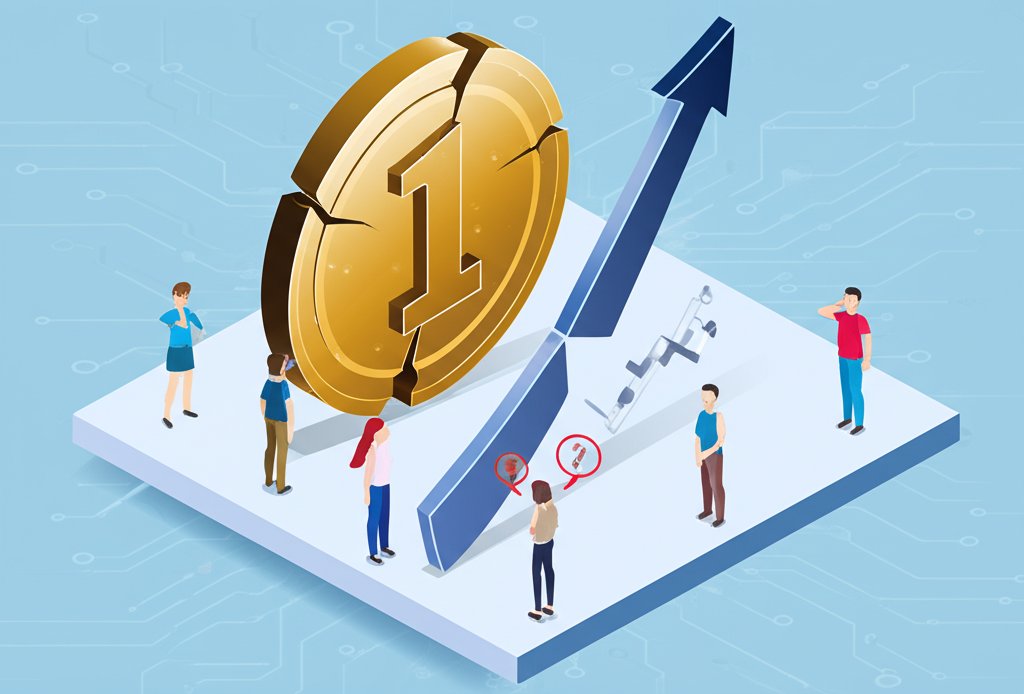
The digital asset space often throws up confusing signals, and few names carry as much historical baggage as "OneCoin." So, when we see reports of a "slight gain" in the onecoin price, it immediately raises a flurry of questions and, more importantly, a thick veil of market skepticism. This isn't just about price movements; it's about navigating a name deeply scarred by controversy, forcing a critical look at what these numbers truly represent.
At a Glance: Deconstructing the OneCoin Price Gain
- Understanding "OneCoin (ONE)": Distinguish between the notorious historical scam and any current token sharing the name.
- The Illusion of a "Gain": A 4.18% increase on minimal volume ($0.02) and tiny market cap ($3.47K) signifies almost no real market activity or value.
- Liquidity as a Warning Sign: Very low liquidity ($6.05K) makes any significant transaction difficult and highly volatile.
- The Weight of History: Why the name "OneCoin" alone should trigger extreme caution and skepticism from any informed investor.
- Due Diligence is Paramount: How to critically evaluate projects, especially those with red flags, before considering any form of engagement.
The Ghost in the Machine: Why "OneCoin" Rings Alarm Bells
For many in the crypto community, the name "OneCoin" is synonymous with one of the most infamous Ponzi schemes in recent history. Led by Ruja Ignatova, the "Cryptoqueen," the original OneCoin project, which peaked around 2014-2016, defrauded investors out of billions of dollars globally. Crucially, it never had a functioning blockchain, a fundamental component of any legitimate cryptocurrency. It was a purely centralized ledger, entirely controlled by its creators, used to simulate value and entice new investors.
This historical context is vital because any modern token bearing the name "OneCoin (ONE)" automatically inherits this legacy of suspicion. The market doesn't forget, and regulatory bodies certainly don't. When we observe a reported live price of $0.0₅34964 for a token named "OneCoin (ONE)", coupled with a market capitalization of $3.47K, it's not merely a low valuation; it's a stark warning. The initial reaction isn't excitement over a gain, but rather a deep dive into the underlying legitimacy and purpose of such an asset.
Deconstructing the "Slight Gain": More Smoke Than Fire
The data states a 4.18% increase in the onecoin price over 24 hours. On the surface, any gain might seem positive. However, context is everything in financial markets. This "gain" comes attached to a 24-hour trading volume of only $0.02. To put this into perspective, two cents' worth of transactions can easily manipulate the price of an asset with such negligible activity. It's akin to a single pebble causing a ripple in a nearly stagnant pond; it looks like movement, but it hardly indicates a robust, healthy ecosystem.
Genuine price increases are typically driven by significant trading volume, reflecting broad market interest, demand, and liquidity. When the trading volume is essentially zero, a percentage increase becomes statistically meaningless. It doesn't signal investor confidence, fundamental growth, or even widespread awareness. Instead, it suggests an asset that is either completely inactive, artificially propped up, or simply listed on an obscure platform with virtually no real-world trading taking place. This makes any reported price surge, no matter how percentage-wise large, fundamentally suspect.
The Pitfalls of Low Liquidity: A Trader's Nightmare
Beyond the paltry trading volume, the reported liquidity for "OneCoin (ONE)" stands at $6.05K. Liquidity refers to how easily an asset can be converted into cash without affecting its price. In a healthy market, high liquidity ensures that you can buy or sell substantial amounts of an asset quickly and at a predictable price. Low liquidity, on the other hand, is a serious red flag.
Imagine trying to sell even $100 worth of a token with only $6.05K in total liquidity across all available exchanges. Your sell order alone could dramatically crash the price, making it impossible to exit your position without significant losses. Conversely, a small buy order could send the price soaring, creating an artificial pump. This environment is ripe for manipulation, where a few individuals can control the market dynamics, leaving unsuspecting participants vulnerable. For any digital asset, especially one with a contentious past like "OneCoin," extremely low liquidity points towards an asset that is effectively untradeable for all practical purposes, posing immense risks for anyone considering investment.
"Decentralized Digital Currency" Claims: A Critical Examination
The ground truth mentions "OneCoin is a decentralized digital currency that leverages blockchain technology for secure transactions." This statement directly clashes with the history of the original OneCoin scam, which famously lacked a real, verifiable blockchain. For any token claiming to be "OneCoin" and decentralized, a rigorous audit of its underlying technology is not just recommended, but absolutely essential.
Legitimate decentralized digital currencies operate on open-source blockchains where every transaction is transparent and verifiable by anyone. The code is public, and the network is secured by a distributed consensus mechanism, not by a central entity. If a project makes these claims but cannot provide clear, publicly auditable evidence of its blockchain, its consensus mechanism, and its genuinely decentralized nature, it should be approached with extreme skepticism. The very foundation of trust in cryptocurrency rests on this technological transparency and decentralization. Without it, any asset, regardless of its reported price, is merely an unchecked claim.
The Harmony (ONE) Distinction: Avoiding Confusion
It's important to clarify a common source of confusion: there is a legitimate cryptocurrency project called Harmony, which uses the ticker symbol ONE. Harmony (ONE) is a blockchain platform designed for fast, secure, and scalable decentralized applications (DApps), known for its sharding technology and Effective Proof-of-Stake (EPoS) consensus. Its token, ONE, is used for transaction fees, staking, and governance within its vibrant ecosystem.
The onecoin price data we're analyzing ($0.0₅34964 price, $3.47K market cap, $0.02 volume) does not pertain to Harmony (ONE). Harmony (ONE) is a well-established project with a significantly higher market capitalization and trading volume, available on numerous major exchanges. The "OneCoin (ONE)" we're discussing here, with its negligible market activity, appears to be a separate, highly obscure, and potentially problematic entity. Always verify the specific project and its ticker symbol, along with its legitimate market data, to avoid confusing it with established, legitimate platforms like Harmony. For a broader understanding of how legitimate cryptocurrencies can see significant price movements and market activity, you might want to Learn about One Coin's surge in a healthy market context, which stands in stark contrast to the scenario we're analyzing here.
Navigating Purchase and Storage Claims for Obscure Tokens
The information suggests that "to buy and store ONE, you can purchase it on crypto exchanges or via peer-to-peer markets, and then store it in a crypto wallet (hot wallet or cold wallet)." While this is standard advice for legitimate cryptocurrencies, applying it to a token like the "OneCoin (ONE)" described here requires extreme caution.
Crypto Exchanges: Which exchanges? The ground truth explicitly states, "ONE saat ini tidak tersedia di OKX." This is a significant indicator. If an asset isn't listed on reputable, high-volume exchanges, it's often a sign of either lacking legitimacy, failing to meet listing standards, or targeting niche, unregulated platforms. Trading on obscure exchanges carries inherent risks, including lack of security, poor liquidity, and potential for scams.
Peer-to-Peer (P2P) Markets: P2P trading for such a low-volume, high-risk asset is an even greater gamble. P2P platforms often lack the escrow services or regulatory oversight of centralized exchanges, making fraud a significant concern. You're dealing directly with individuals, and verifying the authenticity of the token or the trustworthiness of the seller becomes your sole responsibility.
Crypto Wallets: Storing any token in a hot or cold wallet is standard practice. However, the key question isn't how to store it, but why you would want to store an asset with no verifiable utility, virtually no market, and a highly suspicious background. The very act of acquiring and holding such a token introduces unnecessary risk.
Practical Playbook: A Skeptic's Guide to "OneCoin Price" and Similar Assets
Given the multitude of red flags associated with any project named "OneCoin" exhibiting minimal market activity, here's a practical framework for approaching such assets:
- Verify the Blockchain:
- Action: Demand evidence of a public, auditable blockchain. Can you find a block explorer? Are transactions verifiable? Is the code open-source on platforms like GitHub?
- Pitfall: Claims of a "private blockchain" or a "blockchain in development" are immediate red flags for a token claiming to be decentralized.
- Example: A legitimate project will link directly to its block explorer (e.g., Etherscan for Ethereum tokens) and its code repository. If "OneCoin (ONE)" cannot, walk away.
- Assess Market Activity vs. Claims:
- Action: Compare reported price gains with actual trading volume and liquidity. Real growth is backed by substantial, sustained trading.
- Pitfall: Don't be swayed by large percentage gains if the underlying volume is negligible. It's often an illusion.
- Example: A 4.18% gain on $0.02 volume tells you nothing about genuine demand; it merely tells you that two cents' worth of activity occurred. A real asset might show a 1% gain on millions in volume.
- Scrutinize Exchange Listings:
- Action: Check which exchanges list the token. Are they reputable and regulated? Does the project meet their listing requirements?
- Pitfall: Avoid obscure, unregulated exchanges or P2P markets for assets with high-risk profiles.
- Example: The explicit mention of "not available on OKX" for "OneCoin (ONE)" is a major warning. Top exchanges have stringent due diligence processes to protect their users.
- Research the Team and Project Vision:
- Action: Identify the core team members, their backgrounds, and their transparency. Understand the project's whitepaper, its use case, and its long-term viability.
- Pitfall: Anonymous teams, vague whitepapers, or promises of unrealistic returns are hallmarks of scams.
- Example: The original OneCoin lacked a verifiable team and a clear, implementable vision beyond recruitment. Any new "OneCoin" must counter this historical narrative with overwhelming transparency.
- Understand Regulatory Stance:
- Action: Be aware of how regulatory bodies worldwide view the project or similar names. The history of OneCoin guarantees regulatory scrutiny for anything associated with it.
- Pitfall: Ignoring regulatory warnings can lead to significant financial and legal repercussions.
- Question the Narrative:
- Action: If a project relies heavily on recruitment, multi-level marketing (MLM) structures, or guaranteed returns, question its legitimacy.
- Pitfall: The promise of easy money is the most common lure in fraudulent schemes.
Quick Answers: Addressing Common Misconceptions
Q: Is the current "OneCoin (ONE)" with a live price the same as the infamous OneCoin scam?
A: It's highly unlikely to be the exact same operational scam, as regulatory actions largely shut down the original. However, any project emerging with the "OneCoin" name, especially with negligible market activity and unclear legitimacy, is either an attempt to capitalize on the notorious name, a very obscure unrelated token, or a deliberate effort to mislead. The name itself should trigger extreme caution.
Q: Can I safely invest in "OneCoin (ONE)" given its reported slight price gain?
A: Absolutely not, based on the provided data. A "slight gain" on a $0.02 trading volume and a $3.47K market capitalization is statistically irrelevant and highly indicative of an illiquid, risky, and potentially manipulative asset. Safe investing requires significant liquidity, transparent technology, and a clear, legitimate use case, none of which appear evident here.
Q: What does a $0.02 trading volume really mean for an asset?
A: It means there is virtually no market for the asset. A 24-hour volume of two cents implies that either no one is buying or selling, or that any minimal activity is enough to create a percentage price change. It's a clear sign of an asset that is effectively dead or non-existent in terms of real-world trading.
Q: Why isn't "OneCoin (ONE)" available on major exchanges like OKX?
A: Major exchanges like OKX have rigorous listing criteria, including requirements for liquidity, legitimate technology, active development, a clear use case, and compliance with regulatory standards. An asset with negligible volume, minimal liquidity, and a name linked to a major scam would almost certainly not meet these criteria. Its absence from reputable platforms is a significant red flag.
The True Cost of Skepticism: Your Financial Security
The reported onecoin price seeing a "slight gain" is not a signal to act, but rather a flashing red light demanding intense scrutiny. In the volatile world of digital assets, names carry weight, and history offers crucial lessons. The original OneCoin saga reminds us that the promise of decentralization and secure transactions means nothing without a verifiable blockchain and genuine market participation.
Any investment decision in a token bearing such a name, especially one with practically non-existent market activity, is an extremely high-risk gamble. Your primary focus should always be on preserving capital and making informed choices based on fundamental analysis, not superficial percentage gains. Always prioritize verifiable technology, transparent teams, robust liquidity, and a clear, legitimate use case. When in doubt, extreme skepticism is your best defense against potential financial pitfalls.