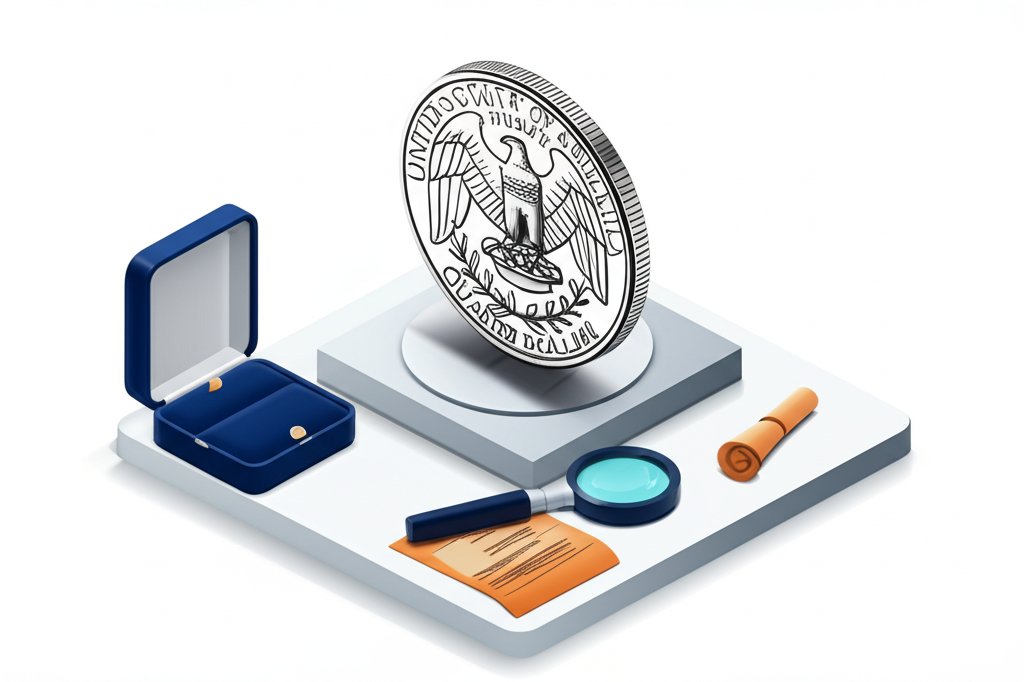
Holding an old quarter, you might wonder if its true quarter dollar coin value extends beyond mere pocket change. It's a common, thrilling thought for anyone who stumbles upon a pre-1965 coin or a shinier, modern silver proof. The reality is, many of these coins hold significantly more value than their face denomination, thanks to their precious metal content and sometimes, their history.
This guide delves deep into what makes a silver quarter valuable, how to identify it, and the precise factors that determine its worth, helping you understand if your find is a silver stacker's delight or a numismatist's treasure.
At a Glance: Unlocking Your Quarter's True Value
- Identify Silver: Look for a date of 1964 or earlier, or a solid silver rim.
- Melt Value Baseline: Understand the minimum worth based on silver content (0.1808 troy ounces).
- Numismatic Premiums: Learn how condition, rarity, and type drastically increase value.
- Key Dates: Pinpoint specific years and mintmarks that fetch hundreds or thousands.
- Modern Proofs: Recognize that post-1992 silver proofs have a different value dynamic.
- Actionable Steps: Get clear guidance on valuation and what to do next.
Distinguishing Your Silver Quarter: The First Crucial Step
Before you can determine your quarter dollar coin value, you need to confirm it's actually silver. This isn't just about age; it’s about composition. All U.S. quarters minted for circulation in 1964 and earlier contain 90% silver and 10% copper. Quarters from 1965 onward are "clad," meaning they're composed of layers of copper and nickel, with no silver for circulation issues.
How to Spot a Silver Quarter:
- Check the Date: This is the quickest and most reliable method. If the date is 1964 or earlier, it's silver. No exceptions for circulating issues.
- Examine the Rim: A silver quarter will have a solid, uniform silver color around its edge. Clad quarters, conversely, reveal a distinct copper stripe between two nickel layers when viewed from the side.
- The "Ring" Test: Though less precise, silver quarters often produce a higher-pitched, more sustained "ring" when gently dropped on a hard surface compared to the duller "clunk" of clad coins.
- Weight and Feel: Silver quarters feel slightly heavier (6.25 grams) and have a distinct, brighter luster compared to the 5.67-gram clad coins. This tactile difference becomes more apparent once you've handled a few of each.
If your quarter dates to 1965 or later and isn't a special modern proof issue (more on those later), its value is almost certainly just 25 cents.
The Dual Path to Value: Melt vs. Numismatic
Every silver quarter has two potential layers of value: its melt value and its numismatic (or collector) value. Understanding both is essential for a true assessment of its quarter dollar coin value.
- Melt Value (Intrinsic Worth): This is the baseline. It's the value of the silver contained within the coin, determined by the current spot price of silver on the commodities market. Regardless of condition, every 90% silver quarter holds this minimum worth.
- Numismatic Value (Collector Premium): This is where things get exciting. It's any value above the melt value, driven by factors like the coin's scarcity, condition, historical significance, and collector demand. A rare, high-grade silver quarter can be worth hundreds or even thousands of dollars beyond its silver content.
Most circulating silver quarters from 1932-1964 (Washington quarters) trade primarily on their melt value, especially in lower grades. However, even among these, certain dates and mintmarks can carry significant premiums.
Calculating Your Silver Quarter's Melt Value
Determining the melt value of your silver quarter is straightforward once you have the necessary information. Each U.S. 90% silver quarter contains approximately 0.1808 troy ounces of pure silver.
Here's the simple calculation:0.1808 troy ounces × Current Spot Price of Silver per Troy Ounce = Melt Value
Let's use a quick example:
Imagine the spot price of silver is $25.00 per troy ounce.0.1808 × $25.00 = $4.52
In this scenario, any 90% silver quarter you possess is immediately worth at least $4.52, which is significantly more than its 25-cent face value. This intrinsic value acts as a floor, ensuring these coins are always a valuable commodity. For a more comprehensive overview of how this value is calculated and general market insights, refer to our detailed <a href="../how-much-is-a-silver-quarter-worth/">Guide to Silver Quarter Value</a>.
Unlocking Numismatic Premiums: What Collectors Crave
While melt value offers a solid floor, the true potential of your quarter dollar coin value often lies in its numismatic appeal. This is where a coin transcends its metal content and becomes a piece of history, art, and rarity.
Several factors dictate a coin's numismatic premium:
- Condition (Grade): This is paramount. A coin's grade describes its state of preservation, from "Poor" (barely recognizable) to "Mint State 70" (perfect, uncirculated). Even slight differences in wear can mean hundreds or thousands of dollars.
- Example: A common 1943 Washington quarter might be worth $4.50 in "Good" condition (AG-3) for its silver. The exact same coin in "Mint State 65" (MS-65) could command $50-$100 or more because of its pristine condition and original luster.
- Rarity: How many were minted? How many survive today? Low mintage figures or high attrition rates (coins lost or melted) directly correlate with rarity and, thus, value. "Key dates" and "semi-key dates" refer to coins with exceptionally low mintages.
- Coin Type/Series: Older, shorter-lived, and historically significant series generally command higher premiums due to their scarcity and design appeal.
- Case Snippet: A Seated Liberty quarter from the mid-19th century, even in a lower circulated grade, will almost always be worth more than a common Washington quarter in similar condition simply because of its age and the difficulty in finding them.
- Mintmark: This small letter (e.g., "D" for Denver, "S" for San Francisco, "O" for New Orleans) indicates where the coin was struck. Sometimes, a specific mintmark for a given year can signify a much lower mintage than coins from other mints, making it a key date.
- Varieties and Errors: Sometimes, during the minting process, anomalies occur. These can range from subtle die cracks to dramatic double strikes or overdates. Genuine errors and rare varieties are highly sought after by specialists.
- Example: The famous 1918/7-S Standing Liberty quarter, an overdate variety where a "7" is visible beneath the "8," is a significant rarity, potentially worth thousands even in circulated condition.
Spotlight on High-Value Silver Quarters: Series & Key Dates
While every 90% silver quarter holds intrinsic value, certain series and specific dates stand out for their exceptional numismatic premiums. Knowing these can help you quickly identify potential treasures.
Early Quarters (1796-1891): The Rarest of the Rare
These are the foundational pieces of American coinage, incredibly scarce and highly valuable in almost any condition.
- Draped Bust Quarters (1796-1807): The very first quarter dollar, the 1796, is a monumental rarity. Any coin from this era is a significant find.
- Capped Bust Quarters (1815-1838): These coins, particularly the earlier "Large Size" varieties, are very desirable.
- Seated Liberty Quarters (1838-1891): While some dates are more common, many (especially from Carson City "CC" and San Francisco "S" mints) are key dates. Look for pre-1853 coins (heavier weight) and post-1853 with arrows at the date (lighter weight, to combat hoarding).
Barber Quarters (1892-1916): A Classic Design with Notable Scarcities
Designed by Charles E. Barber, these quarters present a distinct challenge for collectors due to many low mintage issues.
- Key Dates:
- 1896-S: Low mintage from San Francisco.
- 1901-S: Perhaps the most famous Barber quarter rarity, with an extremely low mintage of just 72,664 coins. Even in heavily worn condition, this coin can be worth thousands.
- 1913-S: Another low-mintage San Francisco issue.
- General Tip: Any Barber quarter in higher circulated grades (Fine to Extremely Fine) or uncirculated condition will be worth a substantial premium over melt.
Standing Liberty Quarters (1916-1930): Artistry and Infamous Rarities
Celebrated for its striking design, this series has some of the hobby's most sought-after rarities.
- Key Dates/Varieties:
- 1916: The first year of issue, with a very low mintage, making it highly valuable.
- 1918/7-S Overdate: As mentioned earlier, this error is a significant collector's item.
- 1921: A very low mintage year.
- 1927-S: Another key date due to low mintage.
- Identifying Type 1 vs. Type 2: The 1916 and early 1917 coins are "Type 1" (bare breast). Later 1917 and subsequent years are "Type 2" (chain mail covering breast). Type 1s are generally more valuable.
- Date Visibility: The date on Standing Liberty quarters often wore off quickly due to its placement. A coin with a fully visible, strong date can command a premium, even if it's not a key date.
Washington Quarters (1932-1964): The Most Common, Yet Still Offering Gems
Most 90% silver Washington quarters are common, but there are two critical exceptions.
- Key Dates:
- 1932-D (Denver Mint): Low mintage (436,800).
- 1932-S (San Francisco Mint): Also low mintage (408,000).
- These two dates, especially in higher grades, are significant premiums.
- Condition: While common dates trade near melt value in circulated grades, uncirculated (MS-60 and above) Washington quarters from any year command a premium, particularly those with strong luster and minimal marks.
Modern Silver Proof Quarters: A Different Breed
Since 1992, the U.S. Mint has produced special silver proof quarters specifically for collectors. These are not intended for circulation and are easily identifiable by their mirror-like fields and frosted, detailed devices. They are typically sold in annual proof sets.
- Composition: Modern silver proofs are generally 90% silver until 2018, when the U.S. Mint began striking them in 99.9% fine silver.
- Value Drivers: Their value is a blend of their intrinsic silver content and their collector demand, which is influenced by their specific mintage within the proof set, popularity of the design (e.g., State Quarters, America the Beautiful series), and whether they are still sealed in their original government packaging.
- Not Circulation Finds: You won't find these in your change. If you have one, it's likely from a collection or was purchased directly from the Mint or a dealer.
Beyond the Basics: Grading and Market Savvy
Once you've identified a potentially valuable silver quarter, understanding its grade and the current market are your next steps to accurately assessing its quarter dollar coin value.
- Understand Grading: While professional grading by services like PCGS or NGC is essential for high-value coins, familiarize yourself with basic grading terminology (Good, Fine, VF, AU, MS). This helps you compare your coin to sales records.
- Consult Price Guides: Reputable sources like the "Red Book" (A Guide Book of United States Coins) or online databases (PCGS Price Guide, NGC Price Guide) provide estimated values based on grade for various dates and mintmarks. Remember, these are guides, not guarantees.
- Track Silver Spot Price: Regularly check the current spot price of silver. This directly impacts the melt value and influences the overall market sentiment for silver coins.
- Consider Professional Opinion: For any coin you suspect is genuinely rare or high-grade, a professional appraisal from a reputable coin dealer or submission to a third-party grading service is a wise investment. They can verify authenticity, assign an accurate grade, and provide a market-backed valuation.
Your Practical Playbook for Silver Quarter Valuation
Ready to assess your finds? Here's a quick-start guide:
- Sort by Date: Separate all quarters 1964 and earlier. Put any 1965+ quarters aside unless you know them to be modern silver proofs.
- Identify Key Dates:
- Washington (1932-1964): Look specifically for 1932-D and 1932-S.
- Standing Liberty (1916-1930): Check for 1916, 1921, 1927-S, and especially the 1918/7-S. Any Type 1 (bare breast) is also notable.
- Barber (1892-1916): Key dates include 1896-S, 1901-S, 1913-S.
- Early (pre-1892): Almost all of these are valuable; research each date.
- Assess Condition (Roughly):
- Is the date clearly visible?
- Are major design elements (e.g., Washington's hair, Liberty's face) distinct or very worn?
- Is there any original mint luster?
- Are there significant scratches or damage?
- Compare to Resources: Use online price guides (PCGS/NGC are excellent free resources) or a physical "Red Book" to cross-reference your identified key dates and approximate grades.
- Calculate Melt Value: For common 1932-1964 Washington quarters that aren't key dates and are in circulated condition, their value will mostly be their melt value. Use the formula:
0.1808 × current silver spot price. - Seek Expert Eyes for Premiums: If you have an older, key date, or seemingly high-grade silver quarter, consider taking it to a reputable local coin dealer for an in-person assessment.
Quick Answers: Common Silver Quarter Questions
Q: Are all quarters from 1964 and earlier valuable?
A: Yes, all U.S. circulating quarters dated 1964 and earlier are 90% silver and are always worth more than their 25-cent face value due to their silver content. However, their value beyond melt depends heavily on rarity and condition.
Q: How do I tell a silver quarter apart from a regular clad quarter without checking the date?
A: The most reliable method besides the date is the rim. A silver quarter will have a uniform silver-colored edge, while a clad quarter will show a distinct copper stripe in the middle of its edge.
Q: Can I find silver quarters in my change today?
A: It's extremely rare, but not impossible. Occasionally, an older silver quarter might accidentally slip back into circulation, but it's like finding a needle in a haystack. Most silver quarters have been identified and removed from circulation by collectors or dealers.
Q: What about modern proof quarters? Are they worth much?
A: Modern silver proof quarters (post-1992) are produced for collectors and contain 90% or 99.9% silver. Their value is based on their silver content and collector demand. They are worth more than face value, but typically less than older, rare circulated silver quarters.
Q: Should I clean my silver quarter to increase its value?
A: Absolutely not. Cleaning a coin, even gently, will almost always damage its surface and significantly decrease its numismatic value. Collectors prefer coins with their original patina, even if dirty. Leave cleaning to the experts, or better yet, don't clean it at all.
Taking the Next Step with Your Silver Quarters
Determining your quarter dollar coin value is a journey that blends a bit of history, a dash of metal market knowledge, and an eye for detail. You now have the tools to identify silver quarters, understand the two core components of their worth, and spot the rare gems that command significant premiums.
Whether you've uncovered a stash of common Washington quarters whose value lies primarily in their silver content, or a genuine numismatic rarity like a 1901-S Barber quarter, remember that informed decisions lead to the best outcomes. Take your time, research your finds, and if in doubt, always consult a trusted expert to ensure you fully realize the true potential of your silver quarter's value.