You’re sifting through old boxes, perhaps a forgotten jar of coins, and there it is: a dollar coin. Most people think of these as little more than a buck, but what if that humble disc of metal holds a secret worth thousands, even millions? This isn't just a fantasy; truly rare dollar coins exist, waiting for a sharp eye to uncover them. Understanding what separates a common piece from a genuine numismatic treasure is the first step toward finding significant value in your collection.
At a Glance: Spotting Rare Dollar Coins
- Beyond Face Value: Learn which historical and modern dollar coins command premium prices.
- The Rarity Factors: Understand how mintage, errors, mint marks, and condition determine worth.
- Legendary Gems: Discover the iconic classic dollar coins that fetch millions.
- Modern Surprises: Identify valuable error and high-grade Presidential Dollars.
- Your Action Plan: Get practical steps for inspecting, researching, and potentially valuing your finds.
Beyond Face Value: What Makes a Dollar Coin Truly Rare?
The term "rare" in coin collecting isn't just about age; it's a complex interplay of several crucial factors. Think of it less as a simple timeline and more as a series of circumstances that converge to create scarcity and demand. The older a coin, the more opportunity it has had to be lost, damaged, or melted down, which naturally contributes to rarity. However, a brand-new coin with a specific, well-documented minting error can easily eclipse the value of a centuries-old, common piece.
One of the most significant factors is mintage quantity – how many coins of a particular type were originally produced. A coin minted in the tens of thousands is inherently rarer than one minted in the hundreds of millions. When you combine low mintage with a specific mint location (indicated by mint marks like 'CC' for Carson City or 'S' for San Francisco), the scarcity intensifies. Furthermore, the historical significance of a coin can elevate its status, such as being the very first of its kind or tied to a pivotal moment. The presence of errors – accidental deviations during the manufacturing process – also creates unique, highly sought-after rarities. Finally, and perhaps most critically, the overall condition of a coin plays an enormous role. Even a rare coin will fetch a fraction of its potential value if it's heavily worn or damaged, whereas a pristine, "uncirculated" example can command staggering sums.
The Legends: Classic Rare Dollar Coins to Know
While most dollar coins you encounter today are modern circulating issues, the lineage of U.S. dollar coinage stretches back to the late 18th century, producing some of the world's most valuable numismatic treasures. These are the coins that define "rare dollar coins" for collectors.
Flowing Hair Dollar: America's First Rarity
Imagine holding the very first dollar coin ever issued by the U.S. government. That's the Flowing Hair Dollar, minted only in 1794 and 1795. Its design, featuring a bust of Liberty with long, flowing hair, is iconic and directly links to the dawn of American coinage. Given its age and status as the inaugural dollar, finding one in any condition is a monumental discovery. A prime example from 1794 famously sold for an astounding $12,000,000, with another fetching $6,600,000, illustrating their immense historical and monetary value.
The Elusive 1804 Dollar: King of American Coins
Often dubbed "The King of American Coins," the 1804 Dollar is a true enigma and one of the world's rarest coins. Interestingly, these coins weren't actually minted in 1804 for circulation. The few known examples were originally struck in 1834 as diplomatic gifts for foreign heads of state. Their mysterious origin and extreme scarcity have cemented their legendary status. Record sales underscore their unparalleled desirability, with one specimen realizing $7,680,000 and another achieving $3,877,500. This coin embodies the pinnacle of rarity and historical intrigue in numismatics.
Trade Dollars: East Meets West Rarity
Minted from 1873 to 1885, the U.S. Trade Dollar was explicitly designed for commerce in Asia, particularly China, to compete with other nations' silver trade coinage. These coins often bear unique "chopmarks" – small oriental characters stamped by Chinese merchants to verify the coin's silver content and authenticity. While most Trade Dollars are valuable due to their silver content and historical role, certain dates and mint marks are exceedingly rare. The 1885 Trade Dollar stands out, especially proof versions; one sold for an incredible $3,960,000, and an 1885 proof example reached $2,100,000. These demonstrate how a coin's intended purpose and subsequent journey can create unique collector interest.
Morgan Silver Dollars: A Melted Treasure
The Morgan Silver Dollar, produced from 1878 to 1904 and again in 1921, is one of the most beloved American coins. These large, hefty silver dollars are cherished for their classic design and historical significance as symbols of the American West. However, their story is also one of deliberate scarcity: over 270 million Morgan Dollars were melted down under the Pittman Act of 1918 to support the war effort. This massive melting program drastically reduced the availability of many dates and mint marks, particularly those with already low mintages. Key dates like the 1893-S (San Francisco mint) are exceptionally rare; one sold for $2,086,875. The 1889-CC (Carson City mint) is another highly sought-after example, with one fetching $881,250, showcasing the premium placed on low-mintage Carson City issues.
Seated Liberty Dollars: Pre-Civil War Gems
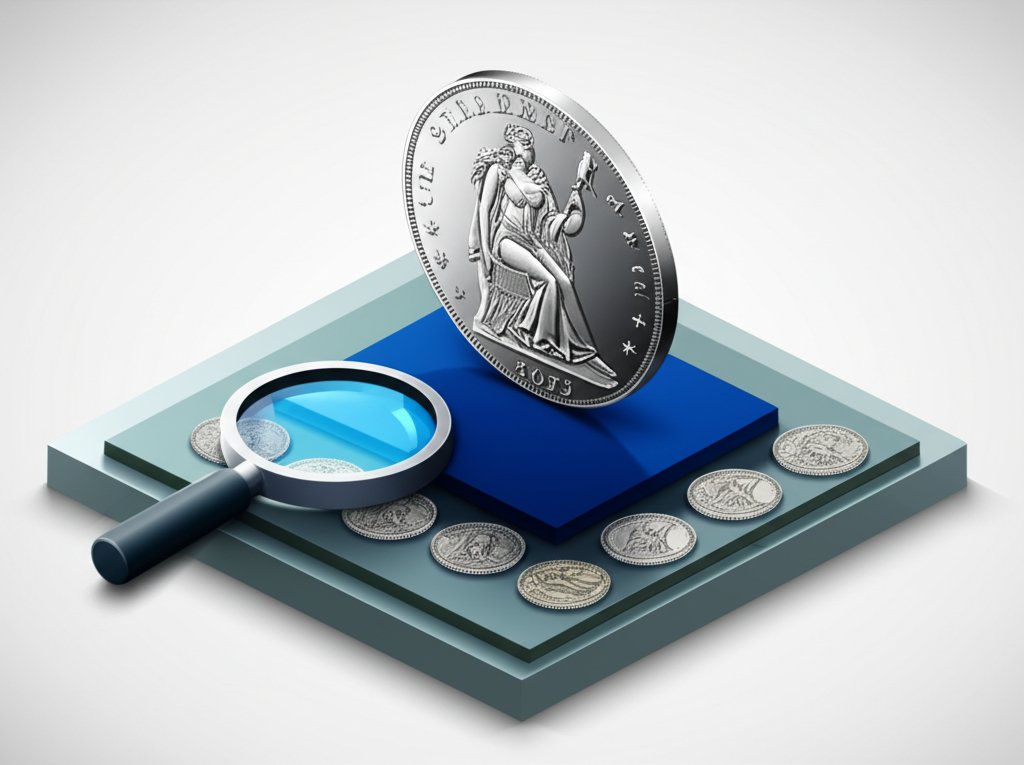
The Seated Liberty Dollar, minted from 1840 to 1873, represents an important era in American coinage, bridging the pre-Civil War period and the nation's expansion. These coins are notoriously difficult to find in uncirculated condition, making high-grade examples especially coveted. The design features Liberty seated on a rock, holding a shield and pole. Certain mint marks and varieties stand out for their extreme rarity. A 1870-S (San Francisco) specimen, for instance, sold for a remarkable $1,092,500. Another incredibly rare variety, the 1866 "No Motto" Seated Liberty Dollar, lacking the "In God We Trust" motto, achieved $1,050,000.
While these classic examples are often out of reach for casual collectors, understanding their characteristics offers a blueprint for how rarity is defined across all dollar coins. For a comprehensive overview of how to evaluate dollar coins across different series, including more accessible types, refer to our main guide on Spotting Dollar Coins Worth Money.
Modern Surprises: Rare Presidential Dollars
For many, the idea of a "rare dollar coin" conjures images of ancient artifacts. However, even relatively modern series like the Presidential Dollars (issued from 2007 to 2016) can harbor significant value, particularly when they feature unusual minting errors or possess exceptionally high grades. Most Presidential Dollars are indeed worth only face value, but specific anomalies have surprised the numismatic world.
Minting Error Marvels
Minting errors occur when something goes wrong during the coin production process, resulting in a coin that deviates from its intended design. These imperfections, far from making a coin worthless, can transform it into a unique and highly prized collectible.
Consider these astonishing examples from the Presidential Dollar series:
- Wrong Planchet Strikes: A 2008-P James Monroe dollar was mistakenly struck on a dime planchet, resulting in a significantly smaller and lighter coin. This dramatic error, graded PCGS MS65, sold for a stunning $20,400. It's an immediate giveaway when a dollar coin is clearly not dollar-sized.
- Feeder Finger Strikes & Missing Elements: Another remarkable error involved a 2008-S Martin Van Buren dollar. It suffered a feeder finger strike error, weighing only 2.8 grams, and crucially, was missing its edge lettering entirely. This NGC PR65 example commanded $5,980. The combination of multiple distinct errors amplifies its rarity.
- Wrong Metal & Double Strikes: The 2007 John Adams dollar holds a couple of notable error records. One was mistakenly struck on a 9-gram aluminum planchet, resulting in an unusually light coin; it sold for $3,335 (PCGS MS64). Another 2007-P John Adams dollar was double-struck on an aluminum feeder finger fragment, showcasing a dramatic misprint that fetched $2,300 (PCGS MS64).
These examples highlight that significant errors – such as strikes on incorrect planchets, missing crucial design elements, or multiple striking anomalies – are what truly elevate a modern dollar coin's value far beyond its face value.
Beyond Errors: Condition and Designations
While errors are often the headline-grabbers for modern rare dollar coins, exceptional condition and special designations can also create considerable value, particularly for astute collectors.
- First Day of Issue & Special Labels: Collectors often seek out coins released on the very first day of issue, especially when certified with a "First Day of Issue" label by grading services like PCGS or NGC. A 2007-D Thomas Jefferson dollar with such a designation, graded PCGS MS65, sold for $5,000. These labels signify a coin's early provenance and often imply meticulous handling from the moment of release.
- Original Sealed Mint Bags: Bulk lots of uncirculated coins still in their original sealed U.S. Mint bags can also be highly desirable. A lot of 2,000 Woodrow Wilson dollars from 2013, remaining untouched in their factory-sealed bags, sold for $4,350. This premium reflects their perfectly preserved, uncirculated state, which collectors value for potential future grading.
- Reverse Proofs & High Grades: Limited mintage special editions, such as reverse proofs, also command high prices. A 2015-P Harry S. Truman reverse proof coin, from a limited set of only 17,000, achieved $3,601 in a perfect PCGS PR70 grade. A PR70 (Proof 70) grade signifies a flawless coin with no visible imperfections, even under magnification.
- Top-Tier Uncirculated Coins: Even regular circulation strike Presidential Dollars can become highly valuable if they achieve the absolute top grades, like MS70 (Mint State 70), indicating a perfect, uncirculated coin. Examples include a 2016-P Ronald Reagan dollar with a signature label that fetched $2,228 (PCGS MS70), a 2014-D Herbert Hoover dollar that sold for $2,200 (PCGS MS68), and a 2015-D Dwight D. Eisenhower dollar, unique at its PCGS MS68 grade, which commanded $2,000. These examples demonstrate that even without errors, perfect preservation of a relatively common coin can still create a significant premium for the dedicated collector.
Your Action Plan: Unlocking Value in Your Collection
So, you have some dollar coins. How do you go from simply owning them to potentially identifying a rare treasure? It’s a methodical process that combines careful inspection with targeted research.
Step 1: The Initial Scan — Identifying Potential Rarities
Before diving deep, perform a quick but thorough visual check on any dollar coin you encounter.
- Dates: Note the year of issue. Older coins (pre-1935) are inherently more likely to be valuable, but don't dismiss modern ones.
- Mint Marks: Look for small letters below the president's bust or near the date. Common mint marks include 'P' (Philadelphia), 'D' (Denver), and 'S' (San Francisco). The absence of a mint mark typically means it was minted in Philadelphia (until 1979 for dollars). Rarer marks like 'CC' (Carson City), 'O' (New Orleans), 'C' (Charlotte), 'D' (Dahlonega, pre-1906 gold coins only, but a general reminder to check D mints), and 'W' (West Point) are extremely significant. For Presidential Dollars, mint marks are on the edge.
- Obvious Errors: Look for anything that seems "off." Is the coin the wrong size or weight for a dollar? Does it have unusual markings, missing elements (like edge lettering on Presidential Dollars), or dramatically off-center strikes? Are there visible cracks or gashes in the metal that aren't just damage? These are immediate red flags for potential errors.
- Condition: How worn is the coin? Does it still have its original luster? Are the fine details of the design sharp and clear, or are they rubbed smooth? While not every coin needs to be flawless, better condition almost always means higher value.
Step 2: Researching Key Dates and Varieties
Once you have a potential candidate, it's time to dig deeper. This step is critical because rarity often comes down to very specific combinations of date, mint mark, and known varieties.
- Low Mintage Figures: For older series like Morgan Dollars or Seated Liberty Dollars, research which dates and mint marks had the lowest production numbers. Online price guides and coin collecting resources are invaluable here. For example, knowing that an 1893-S Morgan Dollar had an extremely low mintage immediately flags it as a significant rarity.
- Known Error Types: For newer series like Presidential Dollars, focus your research on known, documented errors. A coin struck on a dime planchet is a specific, well-known type of error, as are missing edge lettering or double strikes. Don't assume every anomaly is an error; some might be post-mint damage.
- Distinguishing Chopmarks: For Trade Dollars, learn to recognize authentic merchant chopmarks (often small, stylized Chinese characters) versus modern damage. Legitimate chopmarks can add historical intrigue and value to these specific coins.
Step 3: Condition is King
Even with a rare date or error, a coin's condition is paramount. It determines the ultimate value more than almost any other factor.
- Uncirculated Matters: Coins that have never been used in commerce ("uncirculated" or "mint state") are exponentially more valuable than those that have seen heavy circulation. They retain their original luster and all design details.
- Handling Tips: If you believe you have a valuable coin, handle it only by its edges. Oils from your skin can permanently damage the surface, reducing its grade and value. Store it in a non-PVC, archival-safe holder.
- Cleaning is Taboo: Never, under any circumstances, attempt to clean a coin. Cleaning almost invariably damages the surface, even if it looks "better" to the untrained eye, and can drastically reduce its numismatic value. Leave any restoration to professionals, if it's even advisable.
Step 4: Professional Appraisal and Grading
For any dollar coin you suspect is truly rare and valuable, professional authentication and grading are indispensable.
- Why Grade? A professional grade from a reputable service like the Professional Coin Grading Service (PCGS) or the Numismatic Guaranty Company (NGC) provides an objective, universally recognized assessment of your coin's condition. This grade directly impacts its market value and provides confidence to potential buyers.
- When to Grade? If online research suggests your coin could be worth hundreds or thousands of dollars, the cost of grading (which can range from $30 to $100+ depending on value and turnaround time) is a worthwhile investment. For coins clearly worth only face value, grading isn't necessary.
- What They Do: These services authenticate the coin, assign a numerical grade (from 1 to 70), and encapsulate it in a sealed, tamper-evident holder. This process is the gold standard for buying and selling rare coins.
Quick Answers to Common Questions
Q: Are all old dollar coins valuable?
A: No, not all old dollar coins are valuable. While age can contribute to rarity, factors like mintage quantity, specific mint marks, the presence of errors, and especially the coin's condition are far more critical. Many common date silver dollars, for example, are only worth their melt value if heavily circulated.
Q: How do I tell if my dollar coin has a mint error?
A: Look for clear deviations from the standard design. This could include coins struck on the wrong planchet (e.g., a dollar coin that's dime-sized and weighs less), missing design elements (like edge lettering on Presidential Dollars), double strikes, off-center strikes, or dramatic die cracks. Researching known errors for specific coin series can help you identify legitimate anomalies.
Q: Should I clean my dollar coin?
A: Absolutely not. Never clean a dollar coin, especially if you suspect it might be rare or valuable. Cleaning, even with gentle methods, almost always damages the coin's surface, removes its original patina, and can significantly decrease its numismatic value. It's best to leave the coin in its original state.
Q: What's the best way to store rare dollar coins?
A: For valuable or potentially valuable dollar coins, store them in inert, archival-safe holders. This means non-PVC flips or slabs from professional grading services like PCGS or NGC. Keep them in a cool, dry place away from direct sunlight or extreme temperature fluctuations to prevent environmental damage.
Ready to Hunt for Rare Dollar Coins?
The journey of spotting rare dollar coins in your collection is a fascinating blend of historical exploration and detective work. From the legendary Flowing Hair Dollars to the modern, error-laden Presidential Dollars, value can reside in the most unexpected places. Your success hinges on meticulous observation, informed research, and a healthy dose of patience.
Start by carefully examining any dollar coin that crosses your path, noting its date, mint mark, and overall condition. Keep an eye out for anything unusual – an unexpected weight, missing details, or an odd strike could be the tell-tale sign of a hidden treasure. With diligent effort and the right approach to identification and professional assessment, you might just uncover a piece of history that’s worth far more than its face value. Happy hunting!