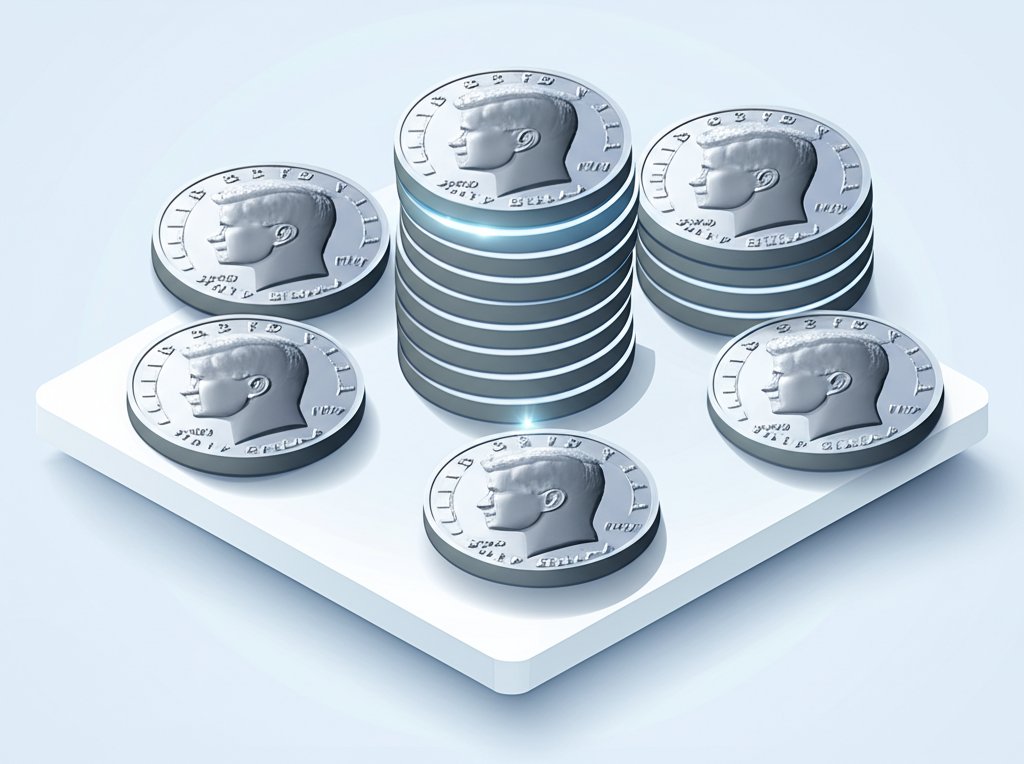
Finding a silver 50 cent piece lurking in an old jar, a forgotten collection, or even a lucky change roll can feel like discovering hidden treasure. While most half dollars circulating today are worth only their face value, specific dates and types of silver 50 cent pieces hold significant appeal—and value—for collectors and precious metal enthusiasts alike. Understanding what you have is the first step to unlocking its potential worth.
At a Glance: Key Takeaways for Your Silver Half Dollars
- Date is King: Half dollars dated 1970 or earlier are made of silver.
- Two Silver Purity Levels: 90% silver (1964 and earlier) and 40% silver (1965-1970).
- Beyond Silver: Some "key dates" are rare and valuable regardless of silver content alone.
- Condition Matters Most: The coin's grade is the biggest factor in its final numismatic (collector) value.
- Seek Expert Opinion: For truly valuable pieces, a professional appraisal offers accurate grading and valuation.
The Defining Factor: Silver Content by Date
The easiest and most reliable way to determine if your 50-cent piece has intrinsic value beyond its face worth is to check its date. This simple act immediately tells you if the coin contains silver and, if so, how much.
The Golden Era: 90% Silver Half Dollars (1964 and Earlier)
Any half dollar minted in 1964 or before is guaranteed to be 90% silver. These coins were a staple of American commerce before the Coinage Act of 1965 removed silver from most circulating coinage. This category includes two iconic designs:
- Walking Liberty Half Dollars (1916-1947): Featuring Lady Liberty striding towards the sunrise.
- Franklin Half Dollars (1948-1963): Depicting Benjamin Franklin on the obverse.
- 1964 Kennedy Half Dollars: The inaugural year for the Kennedy half dollar, this single year saw the coin minted in 90% silver before the content was reduced.
These pieces are always worth significantly more than 50 cents, primarily driven by the fluctuating price of silver. Even in circulated condition, their melt value often makes them desirable.
The Transitional Period: 40% Silver Half Dollars (1965-1970)
Following the Coinage Act of 1965, the U.S. Mint began producing Kennedy half dollars with a reduced silver content of 40%. These coins are recognizable by their dates, ranging from 1965 to 1970.
While not as heavily silver-laden as their pre-1965 counterparts, these 40% silver half dollars are still worth more than face value. They represent a unique chapter in U.S. coinage history and remain highly collectible for their silver content. They are often referred to as "silver-clad" because the outer layers contain silver, bonded to a copper core.
Modern Half Dollars: Copper-Nickel (1971 to Today)
With very few exceptions (primarily special proof sets not intended for circulation), half dollars minted after 1970 are composed of copper and nickel. These coins, including most Kennedy half dollars from 1971 onwards, do not contain silver and are typically worth only their 50-cent face value.
Rule of Thumb: If your half dollar is dated 1970 or earlier, you have found a coin worth more than 50 cents. It's a quick and simple identifier that saves you time and sets you on the right path.
Unearthing Rarity: Beyond the Melt Value
While silver content provides a baseline value for many silver 50 cent pieces, certain half dollars transcend their intrinsic metal worth due to their rarity, historical significance, or specific mintage characteristics. These are the "key dates" and varieties that collectors actively seek out, often paying premiums well above the current silver spot price.
Walking Liberty Half Dollars (1916-1947): A Collector's Hunt
The Walking Liberty series is celebrated for its artistic design and also for its numerous challenging dates and mint marks. Early issues, especially those with low mintages or from specific mints, command significant value.
- 1916-S: A low mintage coin from the San Francisco Mint, highly prized in any condition.
- 1921 & 1921-D: Both the Philadelphia and Denver Mint issues from 1921 are scarce, representing a major hurdle for collectors aiming to complete the series.
- Other Scarce Dates: Keep an eye out for other lower mintage dates like 1917-D (obverse), 1917-S (obverse), 1919-D, 1919-S, 1938-D.
Even common date Walking Liberties are valued for their 90% silver content, but these key dates can be worth hundreds, even thousands, in higher grades.
Franklin Half Dollars (1948-1963): Subtle Nuances
Franklin half dollars are generally valued for their 90% silver. However, a few dates and varieties stand out for collectors:
- 1949-S: A relatively lower mintage for the series, making it more desirable.
- 1955 (Bugs Bunny Variety): Not a true key date by mintage alone, but a popular error. This refers to a die clash that makes Franklin's teeth appear like Bugs Bunny's. While not extremely rare, it's a recognized and collected variety.
- Full Bell Lines (FBL) designation: For any Franklin half dollar, collectors also look for coins where the small horizontal lines on the Liberty Bell (on the reverse) are fully struck and visible. Coins with "Full Bell Lines" often fetch a premium.
Kennedy Half Dollars (1964-Today): The Modern Hunt
While most modern Kennedy half dollars are not silver, the early issues and specific varieties hold collector interest:
- 1964 (90% Silver): As mentioned, this is the only year Kennedy half dollars were struck in 90% silver. Every 1964 half dollar is a valuable silver 50 cent piece.
- 1970-D (40% Silver): This is arguably the most important key date for the Kennedy series. The 1970-D half dollar was only issued in mint sets and was never released into general circulation. This scarcity makes it highly valuable, especially in uncirculated condition. Finding one outside of its original mint packaging is a rare treat.
- Special Proof Sets (e.g., 1976-S Silver Bicentennial): Some later Kennedy half dollars (especially Bicentennial issues from 1976) were minted in 40% silver for special collector proof sets. These will usually have an "S" mint mark and are identifiable by their brighter finish, often still in original government packaging. These are not typically found in circulation.
The Supreme Factor: Coin Condition (Grade)
Once you've identified a silver 50 cent piece, and perhaps even a key date, the single biggest determinant of its final value is its condition, or "grade." A common-date silver half dollar might be worth $10 for its melt value, but the very same coin in perfect, uncirculated condition could easily be worth hundreds of dollars to a collector. The difference in value between two coins just one grade apart can be astonishing.
Coin grading is a precise art, requiring years of experience to master. It involves scrutinizing every aspect of a coin: its strike, luster, surface preservation, and the presence (or absence) of marks, scratches, and wear.
- Circulated vs. Uncirculated: Coins that have been used in commerce ("circulated") will show signs of wear, dullness, and scratches. "Uncirculated" coins, also known as "Mint State" (MS), show no signs of wear and retain their original mint luster.
- Subtleties of Wear: Even within circulated grades, slight differences in wear on high points can mean significant value differences. For example, a "Very Fine" (VF) coin will be worth much less than an "Extremely Fine" (EF or XF) coin.
- Luster: Original mint luster, the cartwheel effect seen on untouched coins, is highly prized and significantly impacts value.
- Eye Appeal: Beyond the technical grade, a coin's overall "eye appeal" also plays a role. A well-struck coin with minimal distracting marks will always be more desirable.
It's nearly impossible for an untrained eye to accurately grade a coin to professional standards. This is why, for any potentially valuable silver 50 cent piece, a professional appraisal is an invaluable step. They can precisely assess the grade, which directly translates into an accurate market value. For a broader understanding of how condition impacts value across different denominations, you might find it helpful to explore more about How much are your half dollars worth? in general.
Pitfalls and Smart Moves in Valuing Silver Half Dollars
Navigating the world of coin valuation can be tricky. Here’s how to avoid common mistakes and make smart decisions when assessing your silver 50 cent pieces.
Common Pitfalls to Avoid
- Overestimating Condition: Most people tend to overestimate the grade of their coins. What looks "good" to an amateur eye might be considered "very fine" or even "fine" by a professional grader due to subtle signs of wear or damage.
- Cleaning Coins: Never, ever clean a silver coin. Cleaning, even with seemingly gentle methods, removes the coin's original patina and luster, which are crucial for collector value. A cleaned coin, regardless of its rarity, is considered damaged and will almost always be worth significantly less than an uncleaned counterpart. Leave any dirt or grime as is.
- Relying Solely on Online Calculators (for numismatic value): While online silver melt value calculators are great for determining the intrinsic metal worth, they cannot account for numismatic value. A rare date in high grade could be worth many multiples of its melt value, and a calculator won't tell you that.
- Misidentifying Errors: Genuine mint errors are rare and valuable. However, many common anomalies are mistaken for errors (e.g., post-mint damage, die chips that aren't significant). Always verify any perceived error with an expert.
Smart Moves for Accurate Valuation
- Separate by Date and Type: Start by sorting your half dollars. Group all 90% silver (pre-1965) together, then 40% silver (1965-1970). Keep any key dates or potential varieties separate.
- Protect Your Coins: Once identified, handle silver half dollars by their edges to avoid transferring oils from your skin, which can damage the coin surface over time. Store them in non-PVC flips or slabs to prevent environmental damage.
- Consult a Reputable Price Guide: Once you have a general idea of your coin's type and condition, consult current coin price guides (e.g., the Red Book) for ballpark values. Remember these are guides and actual market value can vary.
- Professional Appraisal for High-Value Coins: For any silver 50 cent piece you believe could be particularly valuable due to rarity, error, or exceptionally high grade, seeking a professional appraisal from a qualified numismatist is crucial. They can accurately grade the coin and provide a precise market valuation. This small investment can prevent you from unknowingly selling a treasure for too little.
- Understand the Market: Silver prices fluctuate daily, directly impacting the melt value of your coins. Numismatic values are influenced by collector demand, rarity, and overall market trends.
Your Practical Playbook: What to Do When You Find a Silver Half Dollar
So, you've found a silver 50 cent piece. Here's a step-by-step guide to assessing its worth:
- Check the Date Immediately:
- 1964 or earlier? It's 90% silver. Set aside.
- 1965-1970? It's 40% silver. Set aside.
- 1971 or later? Unless it's a known special proof issue (like a Bicentennial "S" mint mark proof), it's likely copper-nickel and worth face value.
- Identify the Coin Type:
- Walking Liberty (1916-1947): Note the date and mint mark (often on the reverse, below the eagle). Look for 1916-S, 1921, 1921-D, etc.
- Franklin (1948-1963): Note the date and mint mark (above the bell on the reverse). Look for 1949-S or a "Bugs Bunny" variety.
- Kennedy (1964-1970): Note the date and mint mark (above the date on the obverse). The 1964 is 90% silver, while 1965-1970 are 40% silver. The 1970-D is a key date.
- Assess Condition (Roughly):
- Is it heavily worn, or can you see most of the details?
- Does it have its original shine (luster), or is it dull?
- Are there any deep scratches, dents, or signs of cleaning?
- Self-assessment is for initial sorting only; do not attempt professional grading yourself.
- Estimate Silver Value:
- Use an online silver melt value calculator. Input the current spot price of silver and specify whether your coin is 90% or 40% silver. This provides a baseline value.
- Consider Numismatic Value:
- If you have a key date (e.g., 1916-S Walking Liberty, 1970-D Kennedy) or a coin in exceptionally good condition, its collector value will likely exceed its silver melt value. This is where research in a reputable price guide or an expert opinion becomes vital.
- Seek Professional Opinion (Recommended for Potentially Valuable Coins):
- If you suspect you have a rare date, an error, or a coin in high grade, take it to a reputable coin dealer or professional numismatist for an appraisal. They can provide an accurate grade and current market valuation. Many offer free initial assessments.
Quick Answers: Common Questions About Silver 50 Cent Pieces
Are all half dollars from 1970 or earlier silver?
Yes, with very few exceptions for specific error coins, any half dollar dated 1970 or earlier contains silver. Those from 1964 and prior are 90% silver, while those from 1965-1970 are 40% silver.
How can I tell if a half dollar is 40% silver versus 90%?
The easiest way is by date. 1964 and earlier are 90%. 1965-1970 are 40%. Physically, 40% silver Kennedy half dollars often show a faint copper stripe along their reeded edge, especially if there's any wear, whereas 90% silver coins will have a solid silver-colored edge.
What does "melt value" mean?
Melt value is the intrinsic value of the metal contained within the coin, based on the current market price of that metal. For silver coins, this means the value of the silver content if the coin were to be melted down.
Is it better to sell a silver half dollar for its melt value or numismatic value?
If a silver half dollar is a common date in circulated condition, its value will primarily be its silver melt value. However, if it's a key date, a rare variety, or in high uncirculated condition, its numismatic (collector) value will often far exceed its melt value. Always determine if there's a numismatic premium before selling for melt.
Should I clean my old silver half dollars?
Absolutely not. Cleaning coins, even with specialized products, will damage their surface, remove original luster and patina, and significantly decrease their collector value. A dirty, uncleaned coin is almost always more valuable than a shiny, cleaned one.
Where can I get an accurate appraisal for my silver half dollars?
Your best bet is a local reputable coin dealer or a professional numismatic service. Look for dealers affiliated with organizations like the American Numismatic Association (ANA). They have the expertise to accurately grade your coins and provide fair valuations.
Knowing Your Silver 50 Cent Pieces Worth
Understanding the worth of your silver 50 cent pieces is a rewarding journey, combining historical appreciation with the thrill of discovery. By knowing the critical dates, recognizing the impact of silver content, and appreciating the paramount role of a coin's condition, you empower yourself to make informed decisions. Whether you're a seasoned collector or a curious newcomer, the fundamental steps remain the same: identify, protect, and seek expert insight for truly valuable pieces. Every silver half dollar tells a story, and knowing its worth is an essential part of that narrative.