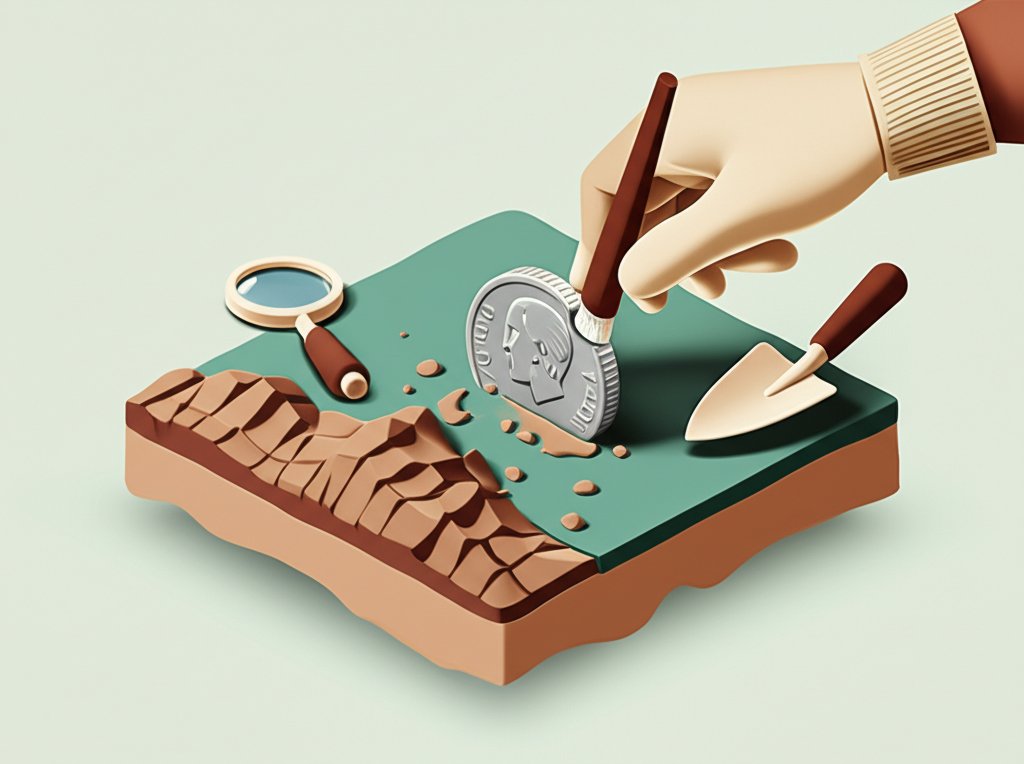
Uncovering the true silver half dollar value goes far beyond simply weighing its precious metal content. While the intrinsic value of silver provides a solid floor, the numismatic appeal—driven by factors like scarcity, condition, and historical significance—can elevate a common coin to a significant investment. For the collector and casual enthusiast alike, understanding these nuances is crucial to identifying hidden gems in your coin jar or recognizing the true worth of a potential acquisition.
At a Glance: Decoding Silver Half Dollar Value
- Three Main Series: Focus on Walking Liberty (1916-1947), Franklin (1948-1963), and Kennedy (1964-1970).
- Silver Content Varies: 90% silver for pre-1965 coins, 40% for 1965-1970 Kennedy halves.
- Condition is King: Professional grading (Sheldon Scale 1-70) dramatically impacts numismatic value, especially for rare dates.
- Key Dates & Varieties: Certain years, mint marks, and specific features (like Full Bell Lines on Franklins) command significant premiums.
- Historical Significance: Each series tells a story, adding to its collector appeal beyond just silver melt.
The Foundation: Silver Content and Intrinsic Value
At its core, the appeal of U.S. silver half dollars is tied to their precious metal composition. Unlike modern clad coinage, these historical pieces contain real silver, giving them an inherent "melt value" that fluctuates with the global silver market. This intrinsic value acts as a baseline, ensuring even the most common, worn silver half dollar holds more worth than its 50-cent face value.
The composition changes over time are critical to understanding this baseline:
- 90% Silver Half Dollars (Pre-1965): This category includes the Walking Liberty (1916-1947), Franklin (1948-1963), and the first year of the Kennedy half dollar (1964). These coins weigh 12.50 grams and are composed of 90% silver and 10% copper. Their substantial silver content makes them highly desirable for both collectors and precious metal investors.
- 40% Silver Half Dollars (1965-1970): Following the Coinage Act of 1965, the silver content in half dollars was reduced significantly. Kennedy half dollars minted from 1965 through 1970 contain only 40% silver and 60% copper. These coins weigh 11.50 grams and are often referred to as "silver-clad" due to their layered composition. While still containing silver, their intrinsic value is considerably less than their 90% counterparts.
To quickly gauge the raw value of your silver half dollars, especially common dates in circulated condition, you can typically calculate their melt value. Here's a quick reference:
| Series (Year Range) | Silver Content | Weight (grams) | Approx. Silver Weight (grams) | Estimated Melt Value* (per coin) |
| :---------------------- | :------------- | :------------- | :---------------------------- | :------------------------------- |
| Walking Liberty (1916-47) | 90% | 12.50 | 11.25 | ~$15 - $20 |
| Franklin (1948-63) | 90% | 12.50 | 11.25 | ~$15 - $20 |
| Kennedy (1964) | 90% | 12.50 | 11.25 | ~$15 - $20 |
| Kennedy (1965-70) | 40% | 11.50 | 4.60 | ~$5 - $10 |
*Note: Melt values are approximations and fluctuate daily with the spot price of silver. These ranges assume a moderate silver price.
While melt value offers a floor, it's just the beginning. The factors that dictate a coin's numismatic premium—its value to collectors—are far more complex. To truly understand why some coins are worth hundreds or even thousands of times their silver content, we need to delve into specific series, condition, and scarcity. For a broader understanding of how various factors influence a coin's overall worth, you might find our guide on Key Silver Dollar Value Factors particularly insightful, as many of these principles apply universally to collectible coinage.
Beyond Melt: Unlocking Numismatic Value in Half Dollars
The real thrill for collectors lies in identifying the silver half dollar value that vastly exceeds its metallic worth. This premium is almost entirely driven by numismatic factors, primarily the specific series, its historical context, and the coin's condition.
The Big Three: Understanding Each Series
Each silver half dollar series carries its own unique history, design elements, and points of interest for collectors.
- Walking Liberty Half Dollar (1916-1947):
- Design: Considered one of the most beautiful U.S. coin designs, depicting Lady Liberty striding towards the sunrise, draped in the American flag. The reverse features an eagle perched on a mountain crag.
- Collector Appeal: Highly sought after for its artistic merit and representation of America during two World Wars and the Great Depression.
- Key Value Drivers:
- Condition: Even common dates in high uncirculated grades (MS-65 and above) can fetch significant premiums.
- Scarce Dates/Mint Marks: Coins like the 1921-S (mintage 548,000) can reach over $180,000 in top conditions. Other notable rarities include the 1919-D (can exceed $90,000) and the original 1916 (values upwards of $80,000 for MS 67+).
- Mint Mark Placement: Some early dates (1916, 1917) have mint marks on the obverse, a feature collectors specifically look for.
- Franklin Half Dollar (1948-1963):
- Design: Features Benjamin Franklin on the obverse and the Liberty Bell with a small eagle on the reverse.
- Collector Appeal: The last 90% silver half dollar series before the Kennedy issue, notable for its short run and unique design.
- Key Value Drivers:
- "Full Bell Lines" (FBL): This designation refers to well-struck coins where the horizontal lines on the Liberty Bell are clearly visible and unbroken. Coins with FBL command substantial premiums. A 1955 Franklin with Full Bell Lines in MS 67+ FBL condition has sold for over $50,000.
- Condition: Like all series, higher grades mean higher value.
- Key Dates: While fewer extreme rarities than the Walking Liberty, some dates like the 1953-S and 1955 have lower mintages or are tougher to find in high grades.
- Kennedy Half Dollar (1964-1970):
- Design: Depicts President John F. Kennedy on the obverse and the Presidential Seal on the reverse.
- Collector Appeal: Immense popularity due to its commemorative nature following President Kennedy's assassination.
- Key Value Drivers:
- 1964 (90% Silver): This single year of 90% silver production is highly collected.
- 1965-1970 (40% Silver): These coins still contain silver and are collected, but their numismatic value is generally lower unless in exceptionally high grades or specific varieties.
- "Accented Hair" Proof (1964): A rare variety of the 1964 proof coin features more pronounced hair details above Kennedy's ear. A 1964 Kennedy "Accented Hair" Proof in PR70 condition can achieve values over $20,000+. This is a prime example of how a minor die variation can create significant value.
The Grader's Eye: How Condition Elevates Value
No single factor impacts the silver half dollar value more profoundly than its condition, or "grade." A pristine, perfectly preserved coin can be worth hundreds, even thousands, of times more than an identical coin that has seen heavy circulation or damage.
The Sheldon Scale (1-70):
Professional grading services like the Numismatic Guaranty Company (NGC) and Professional Coin Grading Service (PCGS) use the Sheldon Scale, which ranges from 1 (Poor) to 70 (Perfect Uncirculated).
- Circulated Grades (G-4 to AU-58): These coins show signs of wear, ranging from heavily worn (Good) to almost uncirculated (About Uncirculated). While still holding intrinsic silver value, their numismatic premium is lower unless they are extreme rarities.
- Uncirculated Grades (MS-60 to MS-70): These coins show no signs of wear from circulation. Even within this range, value increases exponentially with each point. An MS-63 might be worth double an MS-60, and an MS-67 might be worth ten times an MS-63. Features like "Full Bell Lines" (FBL) for Franklins or "Full Head" (FH) for Mercury Dimes (a similar concept) are often only considered for higher uncirculated grades.
- Proof Grades (PR-60 to PR-70): Proof coins are specially struck for collectors, often exhibiting mirror-like fields and frosted devices. They are graded similarly to uncirculated coins, with PR-70 being the highest possible grade.
Why Professional Grading Matters:
For any silver half dollar that appears to be in exceptional condition, or is a known key date/variety, professional grading is a critical step. An independent third party assesses the coin's condition, verifies its authenticity, and encapsulates it in a tamper-evident holder. This not only protects the coin but provides an objective, recognized grade that instellers confidence in buyers, unlocking its full numismatic potential.
Case Snippet: The Power of a Single Grade Point
Imagine you have a 1921-S Walking Liberty half dollar. If it grades as Fine-12 (F-12), it might be worth a few hundred dollars. However, if that same coin, perhaps pulled from an old collection, somehow managed to survive in Mint State-65 (MS-65) condition, its value skyrockets to well over $100,000. This dramatic difference highlights precisely why understanding and accurately assessing condition is paramount when determining silver half dollar value.
Practical Playbook: Identifying Valuable Half Dollars
Ready to uncover the potential in your silver half dollars? Here’s a structured approach:
Step 1: Identify the Series, Date, and Mint Mark
- Series: First, determine if it's a Walking Liberty, Franklin, or Kennedy. This narrows down the potential silver content (90% vs. 40%) and key features to look for.
- Date: Locate the year the coin was minted. This is essential for cross-referencing against mintage figures and rarity lists.
- Mint Mark: Look for a small letter (D for Denver, S for San Francisco, P for Philadelphia – though P mint marks weren't consistently used on halves until later, and for Walking Liberties, P is implied if no mark exists) typically on the reverse, or for some early Walking Liberties, on the obverse. The mint mark can dramatically affect rarity.
Step 2: Assess General Condition
- Initial Scan: Hold the coin under good light. Is there heavy wear? Are design elements distinct, or are they flat and merged?
- Specific Features:
- Walking Liberty: Can you clearly see Liberty's hand, folds in her gown, and the details on the eagle's feathers?
- Franklin: Are the lines on the Liberty Bell distinct? Is Franklin's hair well-defined?
- Kennedy: How much detail remains in Kennedy's hair and the eagle's breast feathers?
- Damage: Look for scratches, nicks, dents, cleaning marks (a dull, uniform look often indicates cleaning), or environmental damage (corrosion, heavy toning). Any of these will significantly reduce value.
- Rule of Thumb: If it looks almost perfect, like it was just minted, it might be an uncirculated candidate. If it's heavily worn, its value is likely closer to melt.
Step 3: Research Mintage Figures and Known Varieties
- Once you have the date and mint mark, consult a reputable coin price guide (online or print) or an NGC/PCGS population report.
- Low Mintage: Coins with low mintage figures (e.g., under a million) are inherently rarer and more valuable, especially in higher grades.
- Varieties: Look for known varieties specific to your coin (e.g., 1964 Kennedy "Accented Hair," Franklin "Full Bell Lines"). These often aren't obvious without specific knowledge.
Step 4: Check Recent Auction Data and Price Guides
- Online Resources: Websites like PCGS, NGC, and Heritage Auctions provide databases of past sales for graded coins. This is the most accurate way to understand current market values.
- Price Guides: Publications like the "Red Book" (A Guide Book of United States Coins) offer general price ranges for various grades, but remember these are averages and don't always reflect immediate market demand.
- Compare Apples to Apples: When researching, always try to compare your coin to one of the exact same series, date, mint mark, and grade.
Quick Answers About Silver Half Dollar Value
Q: Are all silver half dollars valuable beyond their melt value?
A: No. Many common date and heavily circulated silver half dollars, especially the 40% silver Kennedy halves, will primarily be worth their melt value. It's the rare dates, mint marks, and high-grade examples that command significant numismatic premiums.
Q: What's the fastest way to check if a half dollar contains silver?
A: The easiest way is to check the date. Any U.S. half dollar dated 1964 or earlier is 90% silver. Half dollars dated 1965-1970 are 40% silver. Coins dated 1971 and later contain no silver. A quick visual check can also help: silver coins typically have a distinctive luster and tone differently than copper-nickel clad coins.
Q: Should I clean my silver half dollar to increase its value?
A: Absolutely not. Cleaning a coin, no matter how gently, almost always damages its surface and significantly reduces its numismatic value. What might appear as dirt or toning to an untrained eye is often a natural patina that collectors prefer. Leave any cleaning to experienced professionals, or ideally, leave the coin as-is.
Q: When does it make sense to get a half dollar professionally graded?
A: You should consider professional grading for any silver half dollar that:
- Is a known key date or rare variety: These coins have high potential value even in lower-uncirculated grades.
- Appears to be in exceptional, uncirculated condition: If you suspect your coin is MS-60 or higher, grading can confirm its grade and maximize its value.
- Has special features: For instance, a Franklin half dollar with clear "Full Bell Lines."
- You intend to sell for a significant premium: Graded coins command higher prices and are easier to sell.
If your coin is a common date, heavily circulated, or damaged, the cost of grading will likely outweigh any potential increase in value.
Your Next Steps in Valuing Silver Half Dollars
The journey to understanding silver half dollar value is an ongoing process of learning, observation, and careful research. Begin by sorting your half dollars by series and date. Familiarize yourself with the key attributes and known rarities for each type. Don't be afraid to consult reputable online resources and print guides; they are your best friends in this endeavor.
Remember, every coin tells a story, and sometimes that story includes a significant monetary value. By applying a systematic approach—identifying the coin, assessing its condition, and researching its specifics—you'll be well-equipped to appreciate the history in your hand and potentially uncover a hidden treasure. Happy hunting!