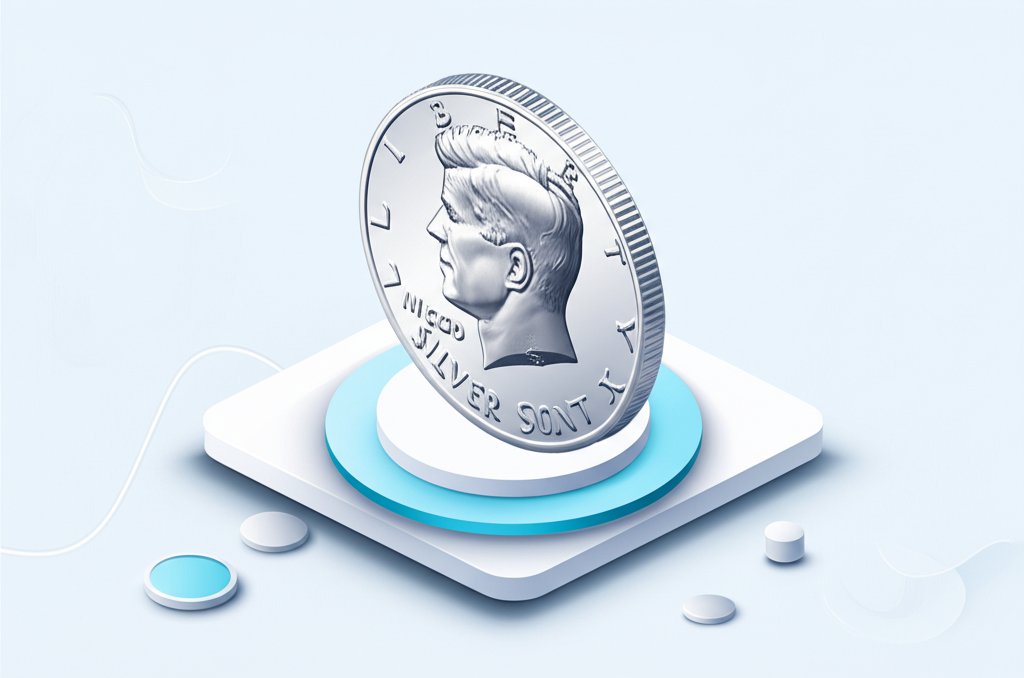
Stumbling upon an old half dollar can spark a flicker of curiosity: Is this silver? And if so, what is a silver fifty cent piece worth today? For many, the answer to this question isn't just about collecting; it's about uncovering a tangible piece of history that often carries significant intrinsic value far beyond its face value. Whether it’s a coin found in a grandparent's stash or a lucky find in circulation, knowing if you hold a silver half dollar and what its true value might be is key.
At a Glance: Your Silver Half Dollar Quick Guide
- Date is Key: Half dollars from 1964 and earlier are 90% silver. Those from 1965-1970 are 40% silver. 1971 and later are generally clad (no silver).
- Quick Checks: Look at the coin's date, examine its edge for a copper stripe, and compare its weight to known silver half dollar weights.
- Melt Value: Silver half dollars are always worth at least their "melt value," which is directly tied to the current spot price of silver.
- Beyond Melt: Rarity, condition (grade), mint mark, and specific varieties or errors can significantly increase a coin's value far beyond its silver content.
- Common Ranges: Circulated 90% silver halves typically fetch $10-$30+, while 40% silver halves usually range $3-$8+.
- Rare Finds: Certain key dates, mint marks, and errors can command hundreds, even thousands, of dollars.
The Silver Story: A Brief History of U.S. Half Dollars
For centuries, silver was the backbone of American coinage. The Coinage Act of 1792 established the U.S. dollar, and by extension, the half dollar, as a specific weight of pure silver. This tradition held strong for well over a century. Early half dollars, like the Barber, Walking Liberty, and Franklin series, were all struck with a robust 90% silver composition.
The shift began in the mid-20th century. By 1964, economic pressures and rising silver prices prompted a change. While the 1964 Kennedy Half Dollar retained the 90% silver standard, it was the last of its kind for circulation. The very next year, the silver content was drastically reduced. From 1965 through 1970, Kennedy half dollars were minted with a diluted 40% silver core, often referred to as "silver-clad" or "junk silver." Finally, by 1971, silver was removed entirely from circulating half dollars, which transitioned to a copper-nickel clad composition that remains today. This historical timeline is crucial for any aspiring coin identifier.
Identifying Your Silver Fifty Cent Piece: The Essential Checks
The first step in determining "what is a silver fifty cent piece worth" is simply confirming if it is silver. This process involves a few straightforward checks.
1. The Date: Your Primary Indicator
This is your go-to starting point. The year stamped on the coin tells you most of what you need to know about its silver content:
- 1964 and Earlier: These half dollars (Barber, Walking Liberty, Franklin, and 1964 Kennedy) are all 90% silver. They contain 0.362 troy ounces of pure silver.
- 1965 – 1970: These are 40% silver Kennedy Half Dollars. They contain a smaller but still significant 0.1479 troy ounces of pure silver.
- 1971 and Later: With very few, specific exceptions (mainly collector-edition proof or uncirculated sets for certain years, or extremely rare errors), these are generally copper-nickel clad and contain no silver.
Mini-Example: You find a 1962 Franklin Half Dollar. The date immediately tells you it's 90% silver. If you find a 1968 Kennedy, you know it's 40% silver. A 1978 Kennedy? Likely just clad.
2. The Edge Test: A Visual Confirmation
For half dollars from 1965 onwards, a quick glance at the coin's edge can provide visual confirmation of its composition.
- 90% Silver (1964 and earlier): The edge will appear uniform, with no visible copper stripe. It will be a consistent silver-gray color.
- 40% Silver (1965-1970): These coins are "silver-clad," meaning a silver outer layer bonded to a copper core. If you look closely at the edge, you'll see a faint, but discernible, copper line running through the middle. It's not as prominent as on modern clad quarters, but it's there.
- Copper-Nickel Clad (1971 and later): These have a very distinct, reddish-brown copper stripe visible on the edge, identical to modern quarters or dimes.
Tip: A worn 40% silver coin might have the copper showing more clearly, but even on a pristine one, the difference from a solid 90% silver edge is usually evident.
3. The Weight Test: Precision for Certainty
While not always necessary for casual identification, weighing a half dollar is a definitive way to confirm its silver content, especially if the date or edge is ambiguous. You'll need a precise digital scale (measuring to at least one-tenth of a gram).
- 90% Silver Half Dollars (1964 and earlier): These should weigh approximately 12.5 grams.
- 40% Silver Half Dollars (1965-1970): These should weigh approximately 11.5 grams.
- Copper-Nickel Clad Half Dollars (1971 and later): These should weigh approximately 11.34 grams.
Analogy: Think of it like baking. Even if the ingredients look similar, the specific weight of flour changes the final product. Similarly, the slight difference in weight confirms the metal composition.
4. The "Ring Test": An Auditory Clue
Experienced collectors sometimes use the "ring test," though it's less precise and can potentially damage a valuable coin if dropped incorrectly. Silver produces a distinct, higher-pitched, sustained "ring" when gently flicked or dropped onto a hard surface (like a wooden table or another coin). Clad coins tend to produce a duller "thud." This is best used as a corroborating indicator, not a primary identification method.
Decoding Silver Content: Calculating Melt Value
Once you've confirmed your half dollar is silver, its most basic value is its "melt value"—the inherent worth of the precious metal it contains. This value fluctuates daily with the spot price of silver.
Here's how to calculate it:
- Determine Silver Content:
- 90% Silver Half Dollars (1964 and earlier): Contain 0.362 troy ounces of pure silver.
- 40% Silver Half Dollars (1965-1970): Contain 0.1479 troy ounces of pure silver.
- Find the Current Silver Spot Price: Look up the current spot price of silver (e.g., on a financial news website, precious metals dealer site). This is usually quoted per troy ounce.
- Calculate Melt Value: Multiply the silver content by the current spot price.
Formula:
- For 90% Silver: 0.362 oz * (Current Silver Spot Price) = Melt Value
- For 40% Silver: 0.1479 oz * (Current Silver Spot Price) = Melt Value
Example:
If the spot price of silver is $25 per troy ounce: - A 1964 Kennedy (90% silver) would have a melt value of 0.362 * $25 = $9.05.
- A 1968 Kennedy (40% silver) would have a melt value of 0.1479 * $25 = $3.70.
It's clear why even a common circulated pre-1965 silver half dollar is worth significantly more than its 50-cent face value, often over 8600% more than a modern clad version.
Beyond Melt: Factors That Skyrocket Value
While melt value provides a floor, many silver half dollars are worth far more to collectors due to a combination of factors. Understanding these elements is crucial for discerning a common silver piece from a genuine numismatic treasure.
1. Condition (Grade): The Holy Grail of Coin Value
A coin's condition, or "grade," is paramount. Coins are graded on a 70-point scale (Sheldon scale), from Poor (P-1) to Perfect Mint State (MS-70). Even slight differences in wear can mean hundreds, if not thousands, of dollars.
- Circulated Grades: Coins that have seen everyday use (Good, Very Good, Fine, Very Fine, Extremely Fine) will show varying degrees of wear. Their value is often closer to melt value, but can still exceed it for scarcer dates.
- Uncirculated Grades (Mint State): Coins that have never been used in commerce (MS-60 to MS-70) retain their original luster and detail. These command significant premiums.
- Proof Coins: Special strikes made for collectors, often with a mirrored field and frosted devices, are typically more valuable if well-preserved.
Case Snippet: A common 1964 Kennedy Half Dollar in circulated condition might be worth $10-$25. But a 1964 Kennedy graded SP-68 (Special Strike) sold for an astounding $156,000, simply because of its exceptional, near-perfect condition. This illustrates the power of grade.
2. Rarity and Scarcity: Supply and Demand
Some half dollars are inherently rarer due to low mintage numbers, survival rates, or specific circumstances surrounding their production. The fewer available, the higher the demand and potential value, assuming collector interest.
3. Collector Demand: The Market's Influence
Even if a coin is rare, its value is ultimately driven by how many collectors want it. Popular series (like Walking Liberty Half Dollars) often have strong demand, even for common dates in good condition.
4. Historical Significance: A Story in Your Hand
Certain coins carry historical weight, making them more desirable. The 1964 Kennedy Half Dollar, for example, holds sentimental value as the first issue honoring the recently assassinated President.
Spotting the Hidden Gems: Key Dates, Varieties, and Errors
While most circulated silver half dollars will trade near their melt value, some stand out as significant collector items. Knowing what to look for can turn a casual find into a valuable discovery.
1. Valuable 90% Silver Half Dollars (1964 and Earlier)
The older series of 90% silver half dollars—Barber, Walking Liberty, and Franklin—all have key dates and varieties that can be quite valuable.
- Barber Half Dollars (1892-1915): Generally rarer and older, many dates are collectible. Look for low mintage years like 1892-O, 1892-S, 1897-O, 1897-S, 1904-S, 1905-O, 1907-O, 1913, 1914, 1915.
- Walking Liberty Half Dollars (1916-1947): A highly artistic and popular series. Key dates include:
- 1916-S, 1916-D: Low mintages.
- 1921, 1921-D, 1921-S: Very low mintages, particularly the 1921-S which can be quite valuable (e.g., $100-$300+ in circulated grades).
- 1938-D: Another low mintage.
- Franklin Half Dollars (1948-1963): Generally more common, but certain dates and varieties still hold premium value:
- 1948, 1949-S, 1950-D, 1951-S, 1952-S: Stronger premiums in higher grades.
- Full Bell Lines (FBL): A specific attribute collectors seek, referring to the distinct lines on the Liberty Bell on the reverse. Coins with clear FBL details are significantly more valuable, especially for dates like 1953, 1953-D, 1954-P.
2. Kennedy Half Dollars (1964-Present) – The Silver and Beyond
Even within the more common Kennedy series, there are notable exceptions.
- 1964 Kennedy (90% Silver): While common, exceptional uncirculated examples or proof coins can be valuable. The record sale for a 1964 SMS (Special Mint Set) SP-68 Kennedy at $156,000 demonstrates this potential.
- 1965-1970 Kennedy (40% Silver): Most are valued for their silver content. However:
- 1970-D Kennedy: This coin was only released in special Mint Sets, not for general circulation. If you find a 1970-D in circulated condition, it's highly unusual and can be worth $100-$300 or more, especially in higher grades (a 1970-D MS-67 sold for $13,000).
- Bicentennial Half Dollars (1776-1976): These coins feature the Independence Hall reverse. While most are clad, special 40% silver versions were minted for collector sets. These are identified by an 'S' mint mark (for San Francisco) and are typically worth $6-$50, depending on condition. Some errors, like doubled die varieties, can fetch up to $5,200.
- Post-1970 Rare Errors/Varieties (Clad): Though typically clad, some later-date half dollars have significant error or variety values:
- 1971-D Struck on a 40% Silver Planchet: An extremely rare error where a 1971-D coin was accidentally struck on a leftover 40% silver planchet from 1970. This can be worth over $10,000. It requires weighing the coin (should be 11.5g) to confirm.
- 1974-D Doubled Die Obverse: A noticeable doubling of design elements on the front of the coin, valued at several hundred dollars.
- 1998-S Matte Finish Kennedy: Part of a special collector set, with a limited mintage of around 60,000. These can be worth $100-$500.
3. Mint Marks: Where It Was Made
The mint mark on a coin tells you which U.S. Mint facility produced it, and it can significantly impact value.
- 1964 Kennedy: The mint mark (if present) is located on the reverse, below Kennedy's neck.
- 1968 and Onwards: The mint mark is typically found on the obverse (front) of the coin, above the date.
- "P" (Philadelphia): Philadelphia mints usually have no mint mark or a "P" (from 1980 onwards for half dollars).
- "D" (Denver): For Denver.
- "S" (San Francisco): For San Francisco (often used for proof or collector sets).
A Practical Playbook for Your Silver Half Dollar
Ready to identify and assess your half dollar? Here's a step-by-step guide:
- Initial Sort by Date: Separate your half dollars into three piles:
- 1964 and earlier (potential 90% silver)
- 1965-1970 (potential 40% silver)
- 1971 and later (likely clad, but check for Bicentennial 'S' or specific errors)
- Confirm Silver Content:
- For 1964 and earlier, you're almost certainly holding 90% silver.
- For 1965-1970, check the edge for the faint copper stripe to confirm 40% silver. If you have a scale, weigh them (12.5g for 90%, 11.5g for 40%).
- Check 1971+ for Exceptions:
- Look for Bicentennial half dollars (1776-1976 date) with an 'S' mint mark. These are 40% silver.
- Be aware of extremely rare errors like the 1971-D on a 40% silver planchet (requires weighing).
- Assess General Condition: How worn is the coin? Does it have scratches, dents, or signs of cleaning? Use a magnifying glass. If it looks pristine, untouched, and has its original luster, it could be an uncirculated or proof specimen.
- Look for Key Dates and Mint Marks: Refer to the list of valuable dates/varieties (e.g., 1921-S Walking Liberty, 1970-D Kennedy, specific Franklin FBLs). Don't forget the mint mark location.
- Estimate Value:
- For common dates in circulated condition, calculate the melt value. This is your baseline.
- For common dates in uncirculated condition, or for dates with stronger premiums, consult a reliable coin price guide (online or print) or a reputable coin dealer.
- If you suspect a rare variety or error, research extensively and consider having it professionally authenticated and graded.
Remember, the goal is to enjoy the process of discovery. Many silver half dollars are common but still hold nostalgic and intrinsic value.
While silver content is a crucial first step, understanding the full spectrum of half dollar values involves more nuances. For a comprehensive overview of all half dollar types and their potential worth, you can refer to our guide on How much is your half dollar worth?
Quick Answers to Common Questions
"Are Bicentennial half dollars silver?"
Most Bicentennial (1776-1976) half dollars found in circulation are copper-nickel clad and contain no silver. However, special collector versions minted at the San Francisco Mint (with an 'S' mint mark) were struck in 40% silver. Check for the 'S' mint mark and the coin's edge.
"How do I know if my Kennedy half dollar is silver?"
If your Kennedy half dollar is dated 1964, it is 90% silver. If it is dated 1965-1970, it is 40% silver (and will have a faint copper stripe on its edge). If it's dated 1971 or later, it's generally not silver, unless it's a special 'S' mint mark Bicentennial or a rare error.
"What's the easiest way to tell if a half dollar is silver?"
The easiest way is to check the date. If it's 1964 or earlier, it's 90% silver. If it's 1965-1970, it's 40% silver. For these 40% silver coins, a quick glance at the edge for a very subtle copper stripe can confirm it visually without needing a scale.
"Is a 40% silver half dollar worth collecting?"
Absolutely! While less pure than 90% silver, 40% silver half dollars still contain valuable precious metal and are collected for their silver content. Certain dates, like the 1970-D, also have numismatic value beyond their silver melt.
"Can I clean my silver half dollar to make it worth more?"
No! Do not clean your silver half dollars. Cleaning a coin, even an old one, is almost universally detrimental to its numismatic value. It removes the natural patina (toning) that collectors appreciate and can leave microscopic scratches, drastically reducing its worth. A dirty, uncleaned coin is almost always more valuable than a shiny, cleaned one.
Final Takeaways: Unlocking Your Half Dollar's Potential
Understanding what is a silver fifty cent piece worth boils down to a systematic approach. Start with the basics: identify the year, verify the silver content, and then delve deeper into its condition, rarity, and any unique attributes. Most of the silver half dollars you'll encounter will derive their value primarily from their precious metal content. However, the thrill of discovering a rare variety, a key date, or an exceptionally well-preserved specimen can transform a simple coin into a remarkable asset. Be patient, use the tools available (a magnifying glass, a scale, and reliable price guides), and always prioritize preservation over cleaning. Happy hunting!